
By Okoi Obono-Obla
The judiciary has added fresh impetus to Nigeria’s fight against corruption under the administration of President Bola Ahmed Tinubu. Unlike the loud and publicized approach of former President Muhammadu Buhari, Tinubu’s administration has adopted a more subtle and quiet strategy—yet one that is proving effective. This shift is evident in recent pronouncements on three major asset forfeiture cases, which underscore the growing strength of Nigeria’s anti-corruption framework.
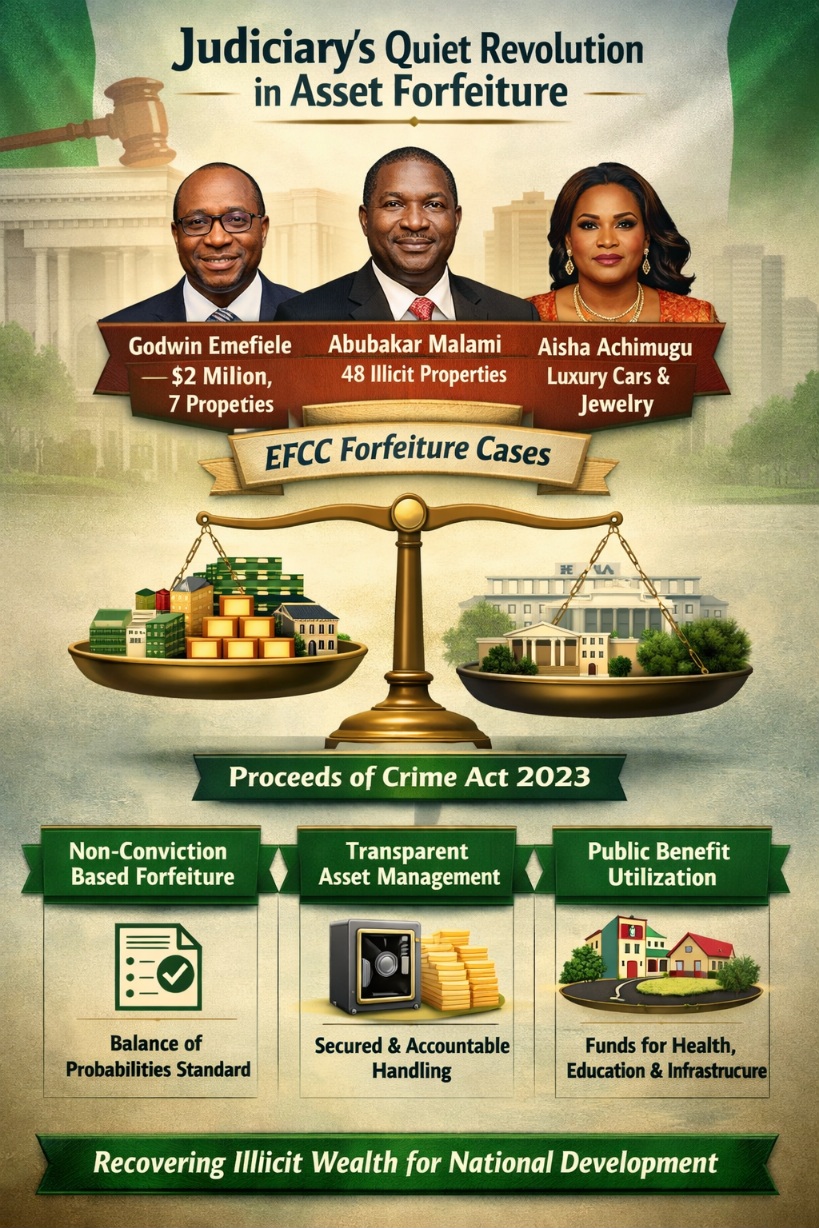
EFCC vs. Godwin Emefiele
In the case against Godwin Emefiele, former Governor of the Central Bank of Nigeria, the Supreme Court on July 17, 2026 upheld the EFCC’s appeal against the Court of Appeal’s earlier decision. The apex court affirmed the final forfeiture of seven landed properties, $2,045,000, and share certificates of Queensdorf Global Fund Limited to the Federal Government. The forfeited assets include luxury duplexes, prime lands in Ikoyi, Lagos, an industrial complex in Delta State, and high-value apartments.
EFCC vs. Abubakar Malami
The Federal High Court, Abuja, presided over by Justice Joyce AbdulMalik, ordered the final forfeiture of 48 properties worth over ₦212 billion belonging to Abubakar Malami SAN, former Attorney General of the Federation and Minister of Justice (2015–2023). The judgment confirmed that the properties were acquired illegitimately while in office.

EFCC vs. Aisha Achimugu
On July 16, 2026, Justice Jude Onwugbuzie of the Federal High Court, Lagos, granted a final forfeiture order against Lagos socialite Aisha Achimugu. The forfeited assets include jewelry worth ₦4.6 billion, 11 exotic cars valued at ₦4.23 billion, $50,000, and ₦30 million.
The Role of POCA 2023
The Proceeds of Crime (Management and Forfeiture) Act, 2023 (POCA), enacted at the twilight of Buhari’s administration, has significantly strengthened Nigeria’s asset recovery regime. POCA introduced innovations that empower anti-corruption and law enforcement agencies to pursue illicit wealth more effectively.
Key provisions include:
– Transparent Asset Management: POCA mandates the establishment of a central database and dedicated agencies for the management of forfeited assets, ensuring accountability and preventing re-looting.
– Non-Conviction Based Forfeiture: Unlike criminal trials that require proof beyond reasonable doubt, POCA allows asset forfeiture based on the civil standard of balance of probabilities. This liberalized procedure makes it easier to strip criminals of ill-gotten wealth.
– Utilization of Recovered Assets: The Act provides for recovered assets to be transparently deployed for public benefit, including funding social programs, infrastructure, and victim compensation.
Conclusion
The recent forfeiture judgments against Emefiele, Malami, and Achimugu demonstrate that Nigeria’s judiciary, backed by POCA, is quietly but decisively advancing the anti-corruption war. By stripping corrupt officials and criminal syndicates of their illicit wealth, the government is sending a clear message: crime will not pay. With POCA’s transparent management framework, fears of re-looting are being addressed, offering Nigerians renewed hope that recovered assets will serve the public good rather than enrich kleptocrats.