By Ibrahim Bunu
Email: ibrahimbunu2520@gmail.com
Introduction
When discussing global power, most people instinctively think of land size, population, military strength, or Gross Domestic Product (GDP). Rarely do they consider the ocean. Yet in the twenty-first century, maritime space has become one of the most valuable strategic assets a nation can possess.

A country’s Exclusive Economic Zone (EEZ) often contains enormous reserves of fisheries, oil, natural gas, rare earth minerals, renewable energy potential, and critical maritime trade routes. In many cases, the wealth beneath the sea exceeds that found on land.
However, possessing a large EEZ does not automatically translate into national power. Some relatively small countries have transformed their maritime zones into engines of prosperity and geopolitical influence. In contrast, others with even larger EEZs remain unable to protect or exploit their maritime zones.
Understanding why requires looking beyond geography.
What Is an Exclusive Economic Zone?
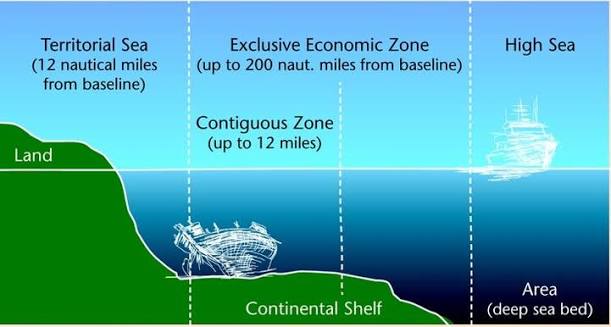
Under the United Nations Convention on the Law of the Sea (UNCLOS), every coastal state is entitled to an Exclusive Economic Zone extending up to 200 nautical miles (approximately 370 kilometers) from its coastline.
Within this zone, a country has exclusive rights to:
* Explore offshore oil and natural gas.
* Harvest fish and other marine resources.
* Develop offshore wind and renewable energy.
* Conduct marine scientific research.
* Exploit seabed minerals.
* Regulate artificial islands and offshore infrastructure.
It is important to distinguish an EEZ from territorial waters.
A country’s EEZ does not constitute sovereign territory. Foreign ships and aircraft retain freedom of navigation and overflight. What belongs exclusively to the coastal state are the economic rights over the natural resources found within that maritime zone.
The Greatest Misconception About EEZs
Many assume that a larger EEZ automatically makes a country richer or more powerful.
That assumption is incorrect.
A vast EEZ is comparable to owning thousands of hectares of farmland. If you lack tractors, irrigation, skilled farmers, storage facilities, roads, and security, the land produces very little value.
Similarly, an EEZ becomes meaningful only when a nation possesses the capacity to develop and defend it.
The true determinants of maritime power include:
* Naval capability.
* Coast Guard effectiveness.
* Marine technology.
* Offshore engineering expertise.
* Scientific research.
* Capital investment.
* Maritime law enforcement.
* Diplomatic influence.
* Industrial capacity.
* Political stability.
Without these capabilities, a large EEZ remains little more than lines drawn on a map.
Japan: A Small Country With a Maritime Empire
Japan is perhaps one of the best examples of how geography, technology, and governance can outweigh land size.
Land Area
Approximately 378,000 km²
EEZ
Approximately 4.5 million km²
Although Japan’s landmass is relatively modest, its thousands of islands generate one of the largest EEZs in the world.
Japan has converted this maritime advantage into national strength through decades of investment in:
* World-class shipbuilding.
* Advanced fisheries management.
* Offshore engineering.
* Marine scientific research.
* High-tech surveillance systems.
* Modern ports.
* One of the world’s most capable maritime self-defense forces.
Rather than merely claiming its waters, Japan actively manages them.
Its maritime domain supports food security, technological innovation, energy exploration, and strategic influence throughout the Indo-Pacific.
China: A Continental Giant With Maritime Ambitions
China presents a different model.
Land Area
Approximately 9.6 million km²
Official EEZ
Roughly 900,000 km²
China’s officially recognized EEZ is considerably smaller than Japan’s because much of its coastline faces neighboring countries whose maritime zones overlap.
Nevertheless, China seeks greater maritime influence through expansive claims in the South China Sea.
Its strategy includes:
* Artificial island construction.
* Naval modernisation.
* Coast Guard expansion.
* Maritime militia operations.
* Deep-water port development.
* Long-range surveillance.
* Overseas naval logistics facilities.
China demonstrates that maritime power depends not only on geography but also on national ambition, industrial capacity, and sustained investment.
France: The World’s Quiet Maritime Superpower
Few realize that France possesses one of the largest EEZs on Earth.
Land Area (European France)
Approximately 551,000 km²
EEZ
Over 10 million km²
How?
France retains overseas territories scattered across:
* The Caribbean.
* The Pacific Ocean.
* The Indian Ocean.
* The South Atlantic.
* Antarctica.
Each inhabited island generates its own EEZ.
As a result, France enjoys access to fisheries, energy resources, strategic naval positions, and scientific research opportunities across multiple oceans.
Its maritime reach greatly exceeds what its European landmass alone would suggest.
Australia: A Continental Nation Powered by the Ocean
Australia’s economy illustrates the enormous value of maritime resources.
Its EEZ exceeds 8 million km².
Within this zone, Australia exploits:
* Natural gas.
* Offshore petroleum.
* Commercial fisheries.
* Critical minerals.
* Offshore wind.
* Marine biodiversity.
Australia also maintains one of the world’s most sophisticated maritime surveillance systems to combat illegal fishing and secure its northern approaches.
New Zealand: Small Population, Huge Maritime Estate
New Zealand’s land area is only about 268,000 km², yet its EEZ exceeds 4 million km².
Despite having a population far smaller than many developing nations, New Zealand effectively manages its maritime resources through:
* Strict fisheries regulation.
* Scientific research.
* Maritime conservation.
* Modern Coast Guard operations.
* Advanced environmental management.
Its maritime governance has become an international model.
Norway: Turning the Sea Into National Wealth
Perhaps no country demonstrates the value of intelligent maritime management better than Norway.
Norway transformed North Sea oil and gas discoveries into one of the world’s largest sovereign wealth funds.
Instead of wasting petroleum revenues, Norway invested them for future generations.
Today, its offshore industries support:
* Energy exports.
* Advanced shipping.
* Offshore engineering.
* Marine technology.
* Renewable energy.
* High living standards.
The lesson is simple:
Natural resources create opportunity.
Good governance creates wealth.
Iceland: A Tiny Nation That Controls a Giant Fishery
Iceland has a population of fewer than half a million people.
Yet through effective management of its EEZ, it became one of the world’s leading seafood exporters.
Its famous “Cod Wars” with the United Kingdom demonstrated that even a small country can successfully defend its maritime interests when it possesses political determination and capable institutions.
Singapore: Maritime Power Without a Large EEZ
Singapore demonstrates that maritime influence is not determined solely by EEZ size.
Its EEZ is relatively modest.
Nevertheless, Singapore has become one of the world’s leading maritime powers because it invested heavily in:
* Port infrastructure.
* Shipping logistics.
* Maritime finance.
* Ship repair.
* Digital port management.
* Trade facilitation.
Its strategic location along the Strait of Malacca generates economic influence far beyond what its geography alone would suggest.
Indonesia: The Sleeping Maritime Giant
Indonesia consists of more than 17,000 islands.
Its EEZ exceeds 6 million km², making it one of the world’s largest.
Its maritime resources include:
* Fisheries.
* Oil.
* Natural gas.
* Nickel transportation routes.
* Critical shipping lanes.
Successive governments have invested in stronger naval capabilities and measures against illegal fishing.
Indonesia increasingly recognizes that its future prosperity depends as much on the sea as on the land.
The Philippines: Strategic Geography Matters
The Philippines possesses an EEZ exceeding 2 million km².
Its strategic location places it at the center of the South China Sea dispute.
The country’s experience illustrates another reality:
Possessing an EEZ is one thing.
Protecting it against stronger neighbors is another.
Consequently, the Philippines relies on diplomacy, international law, military modernization, and alliances to safeguard its maritime interests.
Nigeria: Africa’s Maritime Opportunity
Nigeria possesses an EEZ of roughly 200 nautical miles extending into the Gulf of Guinea.
Within this maritime zone lie:
* Offshore oil.
* Natural gas.
* Fisheries.
* Shipping routes.
* Blue economy opportunities.
Yet several challenges limit Nigeria’s ability to maximize these resources:
* Illegal fishing.
* Oil theft.
* Maritime piracy.
* Limited deep-sea surveillance.
* Weak marine scientific research.
* Inadequate shipbuilding capacity.
The country’s future maritime strategy should focus on strengthening the Nigerian Navy, improving maritime domain awareness, investing in satellite surveillance, modernizing ports, supporting local fishing industries, expanding offshore renewable energy, and developing a comprehensive blue economy framework.
Why Some Countries Fail to Benefit From Their EEZ
A large EEZ becomes a burden rather than an asset when countries lack:
* Strong naval forces.
* Coast Guard capabilities.
* Maritime aircraft.
* Satellite monitoring.
* Offshore drilling technology.
* Marine scientists.
* Shipbuilding industries.
* Investment capital.
* Effective governance.
* Anti-corruption mechanisms.
In such circumstances, foreign vessels illegally exploit fisheries, offshore resources remain undeveloped, and organized criminal networks flourish.
The New Competition: The Blue Economy
The twenty-first century is witnessing a transition from land-based competition to maritime competition.
The “Blue Economy” encompasses:
* Offshore energy.
* Aquaculture.
* Deep-sea mining.
* Marine biotechnology.
* Renewable energy.
* Coastal tourism.
* Ocean transport.
* Undersea digital cables.
Countries investing today will likely dominate tomorrow’s maritime economy.
Final Analysis
An Exclusive Economic Zone is not a measure of power in itself; it is a measure of potential.
The real source of maritime power lies in a nation’s ability to protect, govern, and develop its maritime resources.
Japan illustrates how technology and disciplined governance can transform a relatively small landmass into a maritime powerhouse.
France demonstrates how overseas territories create global reach.
Norway proves that sound management of offshore resources can secure prosperity for generations.
Singapore shows that strategic location and logistics can outweigh geographical size.
Indonesia reveals the opportunities and responsibilities that accompany an archipelagic state.
Nigeria, like many developing maritime nations, stands at a crossroads. The resources exist, but realizing their value will require sustained investment in maritime security, scientific research, industrial capacity, and institutional reform.
Ultimately, the future of global competition will not be determined solely by who controls the most land, but increasingly by who can best harness the wealth of the oceans. In an era where the sea underpins energy security, food production, global trade, and strategic influence, maritime capability has become one of the defining measures of national power.