

By Okoi Obono-Obla
From Tribe to Ethnic Nationality: The Yakurr Experience (1935–2026)
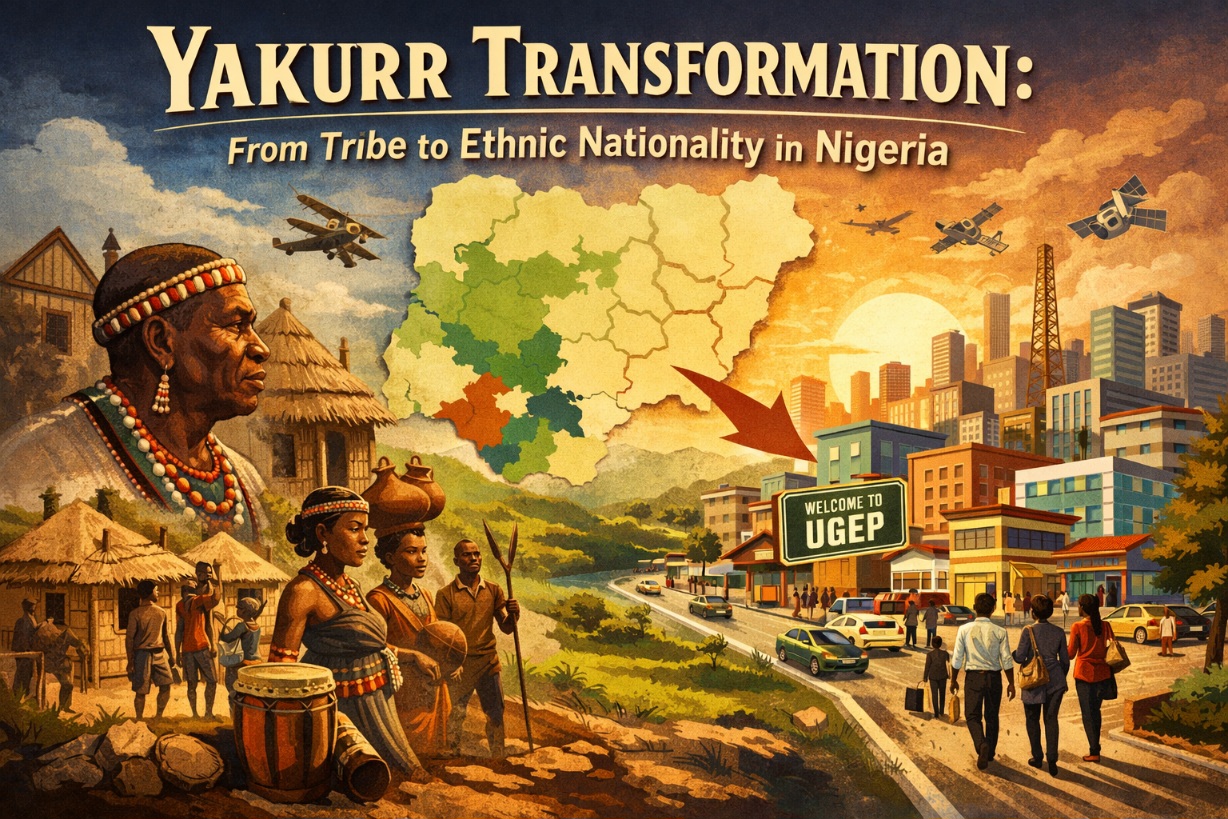
At the onset of colonialism in the early 1900s, many communities were mischaracterized by colonialists as “tribes.” While some were indeed tribes, numerous others were in fact ethnic nationalities. In 1935, Professor Cyril Daryll Forde of the School of Oriental and African Studies, University of London, was commissioned by the Colonial Office in London to visit Nigeria and carry out anthropological studies of the Yako (Yakurr) people of present‑day Cross River State.
In his book Yako Studies, he concentrated on the customs and traditions of the following Yakurr communities: Umor (Ugep), Ekori, Idomi, Mkpani, and Nko. His research, however, did not include Assiga, Nyima, Agoi Ekpo, Agoi Ibami, Itu Agoi, and Ekom Agoi, which are now part of Yakurr Local Government Area of Cross River State. The reason for this omission remains unclear.

Forde gave the population of the Yakurr villages he studied as follows:
– Umor – 10,000
– Ekori – 7,100
– Nkpani – 4,400
– Nko – 2,600
– Idomi – 1,900
Total: 26,000
Interestingly, in another breath, Professor Forde described Umor as a large compact community and put its population at 11,000 — slightly higher than his earlier estimate of 10,000. He also drew maps showing what he described as Yako tribal boundaries and neighboring tribes.
From 1935 to 2026 — a span of 91 years — the world has undergone profound changes. The Yakurr communities once described as “villages” have evolved into towns and cities. This period reflects humanity’s broader journey from industrial warfare and colonial empires into an era defined by digital technology, globalization, and planetary‑scale challenges.
African Milestones (1935–2026)
– Colonial rule (1935–1945): Most of Africa remained under European control during WWII, with colonies contributing soldiers and resources.
– Independence movements (1945–1970s): Nations such as Libya (1951), Ghana (1957), and Nigeria (1960) led the wave of independence.
– Apartheid in South Africa (1948–1994): Ended with Nelson Mandela’s election in 1994.
– Civil wars and conflicts (1960s–2000s): From Biafra in Nigeria (1967–1970) to Rwanda’s genocide (1994).
– African Union (2002–present): Established to promote unity, peace, and economic development.
– Economic growth (2000s–2026): Nigeria, Kenya, and South Africa emerged as regional powerhouses.
– Climate change impact (2010s–2026): Desertification, floods, and food insecurity became pressing challenges.
Demographic Transformation
Yakurr’s population has grown significantly since Forde’s 1935 survey. From about 26,000 people in 1935, the figure rose to over 100,000 by 1990, nearly 200,000 by 2006, and is projected to exceed 330,000 by 2026. This twelvefold increase reflects improved healthcare, education, food security, and urbanization.
Ugep, in particular, exemplifies this transformation. Once described by Forde as a “large compact community” of 10,000–11,000 people, Ugep has expanded into a major town. Recent estimates by the United Nations Population Commission and Worldometer put Ugep’s population at over 250,000, listing it among Nigeria’s most populous cities. Ekori, Nko, and Mkpani have also grown into thriving towns, while communities not covered in Forde’s study — Assiga, Nyima, Agoi Ibami, Agoi Ekpo, Ekom Agoi, and Itu Agoi — are now integral to Yakurr’s demographic and cultural landscape.
Conclusion
Statistically and demographically, a community that had a population of 26,000 in 1935 — and has since expanded into hundreds of thousands — can no longer be accurately described as a “tribe” or its settlements as “villages.” Places like Ugep, Ekori, Nko, and Mkpani have transformed into towns and cities, reflecting modern realities. Similarly, communities such as Assiga, Nyima, Ekpeti, Agoi Ibami, Agoi Ekpo, Ekom Agoi, and Itu Agoi, though not included in Forde’s 1935 survey, are integral to Yakurr today.
Thus, in light of demographic growth and socio‑cultural evolution, it is more appropriate to describe Yakurr as an ethnic nationality rather than a tribe.











I agree with you on this. I thought, given Ghana’s giant strides in political rejuvenation and economic power to becoming a reckoning, seen from the national discipline she now showcases in the regional activities, her impacts at fostering regional growth, development and sustainability are significant in no small measure to embracing an inclusion in Africa’s power force.