By Okoi Obono-Obla
Introduction
Early colonial anthropology classified many peoples of the Nigeria-Cameroon borderland as “Semi-Bantu” or “Semibantu.” The term, though once fashionable in academic literature, is no longer anthropologically tenable. It is wrong to describe any group as Semi-Bantu when modern linguistic, archaeological, and genetic evidence has proven that the very region where most of these so-called Semi-Bantu groups live – the Cross River area and the western grassfields, including groups such as the Yakurr, Ejagham, Yala, Mbembe and others – was in fact their original homeland and the point of dispersal of Bantu peoples to East, Central and Southern Africa.
This essay examines the origin of the concept, why it has been rejected, and why its continued use distorts our understanding of Cross River peoples.

The Origin of the Concept
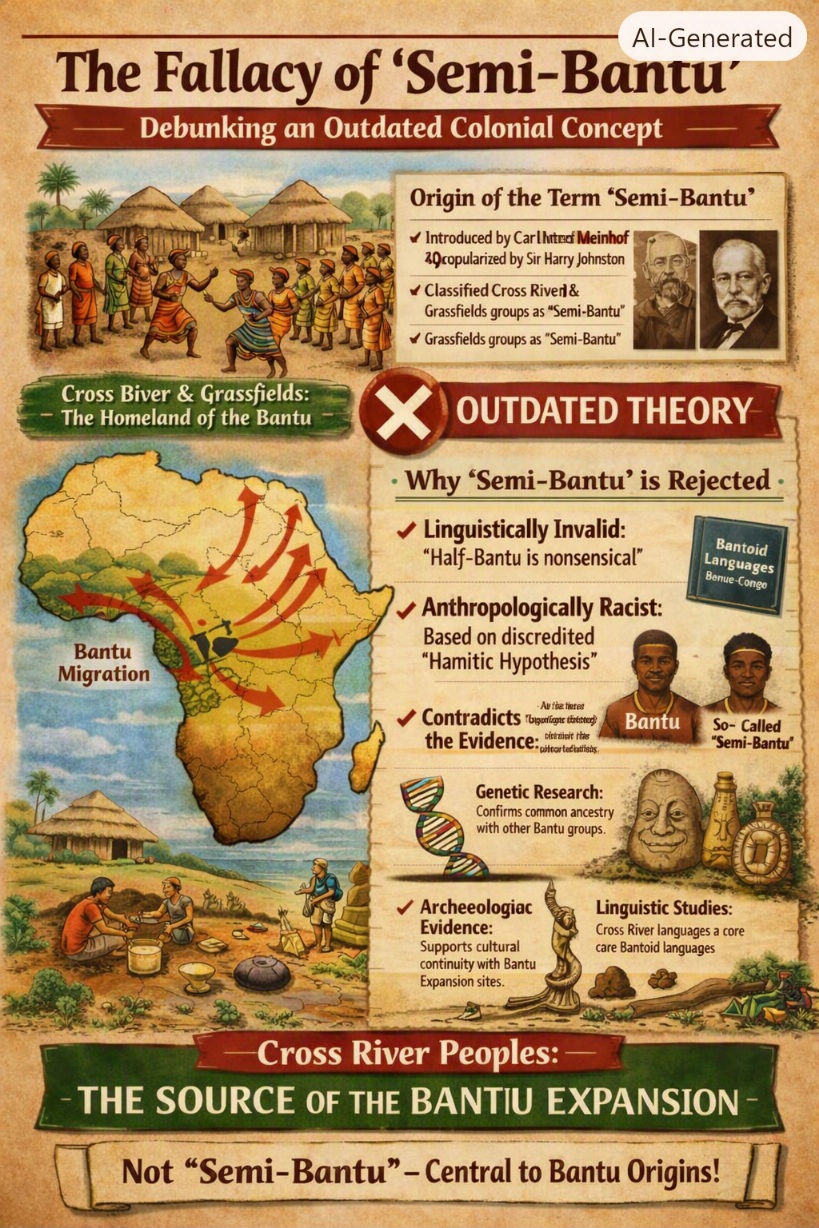
The term Semi-Bantu is a language classification within the Niger-Congo group proposed by linguist Carl Meinhof and popularized by Sir Harry Johnston (1919-1922) and P.A. Talbot. It was applied to specific inhabitants of the Western grassfields of Cameroon and Eastern Nigeria who speak languages that have certain characteristics of the Bantu language family, particularly the noun class system characteristic of Bantu languages, but were excluded from them.
The underlying assumption was typological rather than genealogical. As documented in the literature, this subset of languages was named ‘Semi-Bantu’ because they were seen as being ‘influenced’ by Bantu although there was no clear geographical model as to how this could have come about. Johnston applied it in a scattershot style to any language outside the Bantu area with traces of nominal classification.
British anthropologists like C. Daryll Forde perpetuated the label. His famous study of the Yako people of present-day Cross River State was titled “Kinship in Umor: Double Unilateral Organization in a Semi-Bantu Society.”
Why the Concept is No Longer Tenable
The term has been completely rejected by modern African linguistics and anthropology for three fundamental reasons:
1. It is Linguistically Vague and Unscientific. Johnston’s well-known category ‘Semi-Bantu’ was rejected as ‘vague and unscientific, since a language may be incompletely Bantu in more ways than one’. A language cannot be half-Bantu.
The term was systematically replaced. The term Bantoid reappears in Guthrie (1948) to describe what he called ‘transitional’ languages, replacing the rather more vague term ‘Semi-Bantu’. Later, Greenberg (1963) demonstrated that Bantu itself is not a separate race but merely a sub-branch of the larger Bantoid family, itself within Benue-Congo. The modern term Benue-Congo was introduced to replace Semi-Bantu. Today, what was called Semi-Bantu is properly classified as Southern Bantoid, comprising Grassfields, Ekoid, Cross River, Tivoid and other clusters.
2. It is Anthropologically Racist and Theoretically Flawed. The concept rested on the discredited Hamitic hypothesis and the equation of language with race. It assumed there was a pure Bantu race that migrated and mixed with “true Negroes” to produce semi-Bantus. Modern anthropology rejects any biological hierarchy of Bantu-ness. The social organizations of the Yako, Yakurr Leboku festival, Ejagham monoliths and Mgbe society, or Bamileke chieftaincy are not “semi” versions of anything; they are complete, distinct cultural systems.
3. It Contradicts the Established Bantu Homeland. This is the most decisive point. It is now a scholarly consensus that the boundary between Nigeria and Cameroon, specifically the Grassfields and Cross River region, is the original homeland of the Bantu expansion. Phylogeographic and archaeological studies locate the dispersal of Bantu-speaking peoples to East and Southern Africa from this very zone about 4,000-5,000 years ago.
Therefore, the logic is reversed. The Yakurr and other Cross River groups are not peripheral or “semi” Bantu peoples on the edge of the Bantu world. They are among the aboriginal, autochthonous populations of the Bantu homeland itself. They are the ancestral stock from which Bantu peoples dispersed. To call the people of the source area “semi” versions of their own descendants is historically and anthropologically absurd.
Conclusion
To continue describing any group as Semi-Bantu is to perpetuate a colonial typological error. The term has no linguistic validity, no anthropological utility, and no historical accuracy. It should be confined to historiography, used only in quotation marks when discussing early 20th-century literature.
We should refer to peoples by their proper ethnonyms – Yakurr, Ejagham, Efik, Tiv, Bamileke, Tikar – or, when a broader linguistic grouping is required, use the scientifically accepted terms: Benue-Congo, Southern Bantoid, or Cross River languages. The peoples of the Nigeria-Cameroon borderland are not Semi-Bantu; they are, in fact, central to understanding the very origin of the Bantu world.