By Okoi Obono-Obla
How a people from the ancestral homeland of the Bantu — in the Nigeria-Cameroon borderland from which Bantu-speaking peoples dispersed to Central, Eastern, and Southern Africa — were partitioned by colonialism into two sovereign states
By Okoi Obono-obla
African kingdoms and chiefdoms were traditionally and customarily not subject to the rules or principles of customary international law as developed in Europe from the 17th century onward. That system was largely shaped by Western philosophy and legal thought, particularly following works such as Hugo Grotius’ De Jure Belli ac Pacis (1625) and the Peace of Westphalia (1648), which entrenched the idea of sovereign, territorial states. It did not recognize African polities as equal sovereigns, and there was therefore no linkage between that European system and Africa before colonialism.

This does not mean that Africa had no system of inter-polity relations. Kingdoms and empires such as Mali, Songhai, Benin, Oyo, Asante, Kongo, and Ethiopia had well-developed practices of diplomacy, treaty-making, trade regulation, envoy immunity, extradition, and rules of war. They simply operated within African normative systems, not European ones.
Sustained European contact began in the 15th century, when the Portuguese reached the West African coast in the 1440s and the Kingdom of Kongo by 1482. From then onward, Europeans ventured out in search of new lands and markets where they could trade and sell their products, and to explore resources to sustain European markets that had become saturated and in need of expansion.
When Europeans arrived in Africa in the 17th and 18th centuries, they encountered numerous kingdoms, chiefdoms, and thousands of other polities. These polities did not have the clearly demarcated, linear boundaries recognised by European customary international law. Instead, their boundaries were often fluid frontier zones defined by natural features, allegiance, and control over people and trade routes. This allowed relatively free movement of goods and people, without modern immigration controls such as passports, although travellers were still generally subject to local authority, tribute, and rules of hospitality.
In The Fortunes of Africa: A 5000-Year History of Wealth, Greed, and Endeavour, Martin Meredith captures the scale of what followed. He observed that by the end of the Scramble for Africa, European powers had merged some 10,000 African polities into just forty colonies.[1] This amalgamation made Africa easier — and cheaper — to govern, by compressing a vast diversity of political systems into a small number of colonial units designed for administrative manageability.
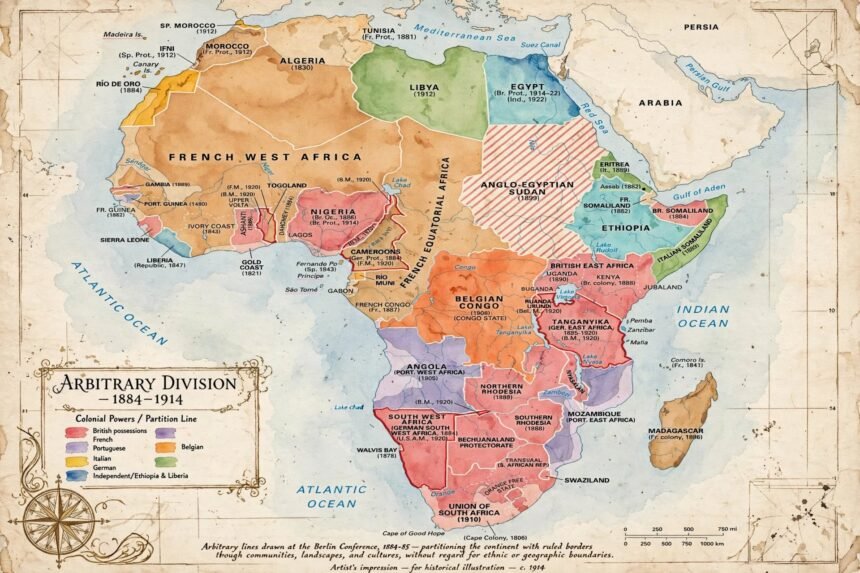
This is how new countries and protectorates were arbitrarily carved out after the Berlin Conference, convened by European powers in Berlin in 1884-1885 at the instance of Chancellor Otto von Bismarck. Its aim was not to end the Scramble for Africa, but to regulate it and prevent competition for African territory from degenerating into war among European powers, without the slightest regard for ethnic composition or anthropological ties.[2]
The significance of this partition is deepened by the history of the very region where it cut deepest. The original homeland and dispersal point of the Bantu peoples of Africa lies in the borderland of Nigeria and Cameroon, in the Benue Valley / Grassfields / Cross River area that includes Ejagham territory. From there, Bantu-speaking peoples dispersed to Central, Eastern, and Southern Africa. The Ejagham are thus not only a divided people; they are a people who remained in or near the ancestral homeland from which a large part of Africa was peopled.
In the Cameroon area, where the Ejagham people originated before spreading southwest into present-day Nigeria, the Ejagham were partitioned into two and allocated to both Nigeria and Cameroon. Cameroon was allotted to Germany and Nigeria to the United Kingdom. Unfortunately for the Ejagham, the two parts were thus placed under different colonial powers, with different languages, legal systems, and cultural values imposed on them — a division later deepened when German Cameroon was partitioned between Britain and France after the First World War.[3]
Because the Ejagham were colonised by two different powers, their history diverged. Cameroon was first colonised by Germany. After the First World War, the League of Nations placed Germany’s former colonies under mandate and divided Cameroon between France, which received about 80% of the territory, and Britain, which received the remainder bordering Nigeria.
Britain administered the Southern Cameroons as part of Nigeria’s Eastern Region. When a leadership crisis broke out in the East in 1953 over Professor Eyo Ita’s position as Leader of Government Business, it deepened the rift between the Calabar-Ogoja-Rivers leaders and the Igbo leadership of the National Council of Nigeria and the Cameroons (NCNC).[4]
The Cameroonians became agitated and demanded their own Region, arguing that if they could be treated shabbily within the Eastern Region, they could not trust that they would be treated well as Cameroonians. The British conceded, and in 1954 the Southern Cameroons was separated from the Eastern Region as a quasi-Region in its own right.[5]
The Ejagham, however, did not mobilise as a distinct people to advocate either that their Cameroonian kinsmen should remain, or that they should go with them.
The decisive moment came with the United Nations plebiscite of 11 February 1961. The people of the British Cameroons were asked to choose between joining Nigeria or joining the Republic of Cameroon. The Northern Cameroons voted by about 60% to join Nigeria, becoming Sardauna Province on 1 June 1961. The Southern Cameroons voted by about 70.5% to join Cameroon, becoming West Cameroon in the Federal Republic of Cameroon on 1 October 1961.[6]
For the Ejagham, the plebiscite sealed the division. Those in the Southern Cameroons became citizens of Cameroon; those across the border in Cross River remained citizens of Nigeria. What had begun as an arbitrary colonial line in the 1880s thus became a permanent international boundary, dividing one people between two sovereign states.
The Ejagham were not alone in this experience. Colonial partition divided many African peoples and left them straddling two or more modern states. The Yoruba were divided between Nigeria and Benin Republic; the Hausa between Nigeria, Niger, and Cameroon; the Kanuri between Chad, Nigeria, and Niger; the Ewe between Togo and Ghana; and the Akan between Ghana and Côte d’Ivoire, among others.
The Ejagham case is therefore not an exception but an illustration of a continental pattern: peoples who once moved freely within fluid, people-centred political spaces were compressed into colonial units, then frozen into post-colonial states, without regard to the ethnic and anthropological ties that had long bound them together.
Notes / References
[1] Martin Meredith, The Fortunes of Africa: A 5000-Year History of Wealth, Greed, and Endeavour (London: Simon & Schuster, 2014).
[2] General Act of the Berlin Conference, 1884-1885.
[3] Treaty of Versailles (1919), Art. 119; League of Nations Mandates for Cameroon, confirmed 1922.
[4] Richard L. Sklar, Nigerian Political Parties (Princeton, 1963), pp. 115-140.
[5] Nigeria (Constitution) Order in Council, 1954 (Lyttelton Constitution), in force 1 October 1954.
[6] United Nations Plebiscite in the British Cameroons, 11 February 1961; UN General Assembly Resolution 1352 (XIV).[7] On the Bantu homeland: J. Vansina, and recent phylogeographic and linguistic studies locating the Bantu homeland in the Benue Valley / Grassfields / Cross River borderland between south-eastern Nigeria and western Cameroon, with dispersal beginning c. 4000-5000 years ago.