
By Okoi Obono-obla
Echoes of Ancestry: Tracing Cross River’s Roots to North-East Africa and the Near East
When I write about history, cultural anthropology, and ethnographic events, my aim is to promote interest, spark debate, and encourage the cross-fertilization of ideas. I believe intellectual scholarship should help us trace the origins of our various peoples and demonstrate that, despite differences in culture and language, we are ultimately one. Yet, some readers become upset, agitated, or even accuse me of bias — suggesting that I am promoting my own community rather than contributing to collective knowledge.
One exception is Mr. Amissine Ogban from Agwagwuna in Biase Local Government Area of Cross River State. A reservoir of traditional history, his interventions have greatly enriched my essays. In response to my piece, Tradition and Adaptation: The Dressing Heritage of the Obol Lopon of Ugep, Mr. Ogban offered a deep and intriguing perspective on the origins of the people of present-day Cross River State. He wrote:

“My brother Obol Lopon is properly dressed by tradition in that visit to the State Governor. I used to feel for the traditional rulers who deliberately keep to our values, not to mention the cold this year. I want to throw a little light on ‘BE-INAH.’ Inah in English is SIR, ELDER, ELDERLY, or OLD MAN. BE-INAH in Agwagwuna is something deeper. It is a circle of very few who are close to our CREATOR. They are like gods among us, the link between the living and our ancestors. INAH here now is Creator, INAH is God. The towel recalls the turban used by our people in the Ancient Religion before migration from North East Africa and Palestine. The hat that capped Obol’s head is what the Israeli Rabbi wears during worship. We are for Renaissance.”
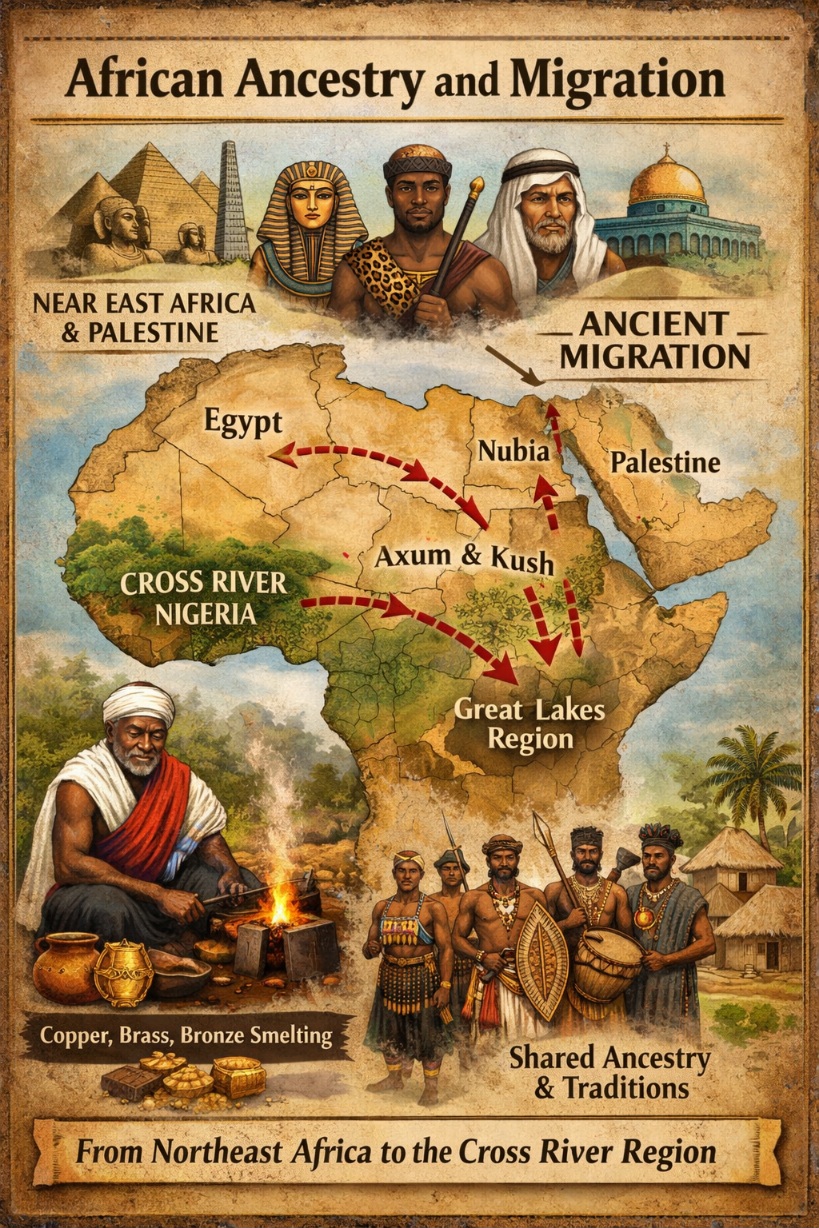
Ogban’s reflections suggest that our ancestors may have migrated from North-East Africa — Egypt, Ethiopia, Sudan, Uganda, Somalia, Kenya — and Palestine. This aligns with a conversation I had in 2023 with my Ugandan friend, Roshbell Ididi, who noted striking cultural parallels. He mentioned that his people in Uganda bear the name Edet, which is also common among communities in the Lower and Upper Cross River Basin of Nigeria. When I asked if this implied shared ancestry, he replied:
“Okay. Now that the origin is from Congo, which is near Ethiopia and Sudan, we can conclude that when we look at the kingdom of Ethiopia, also known as Axum (Abyssinia), it covered all of Eastern Africa and parts of Central Africa before colonial balkanization. Nubians originally come from Northern Sudan, and since we Iteso come from Sudan and Ethiopia, we are one people with the Yako (Yakurr). But due to migration and other factors, we moved and settled across the continent…”
I later discussed this with my great friend, Comrade Tar Ukoh, former Artistic Director and General Manager of the National Troupe of Nigeria. He emphasized:
“The art and craft of copper, brass, and bronze smelting dates back thousands of years to the Ancient Kush/Nubian civilization of the Empire of Meroe, in present-day Egypt down to Southern Sudan. Most West African ethno-genealogies derive from this central region of Africa. The Ekoi/Ejagham, Kongo, and Luba-Lunda kingdoms of the Great Lakes region of East Africa all share a common ancestry. We, the inheritors of this formidable heritage, must return to the root source of our ancestry. Leboku of the ancient Yakurr of Nigeria is one such source of our voyage to rediscovery.”
We can also learn history from the materials and artefacts our people use, such as the Yokong — a sort of spear used by the Onun Ekor (Military Commander) and Okpebri as part of their dressing code during processions. It has always given me the impression that we originated from an area where the culture was pastoral or desert-like, which contrasts sharply with our eventual migration into the tropical rainforest.
Conclusion
These perspectives — whether from Ogban, Ididi, or Ukoh — point to a profound truth: our histories are interconnected, our migrations intertwined, and our traditions rooted in a shared African and Near Eastern ancestry. By revisiting these narratives, we not only enrich scholarship but also inspire younger generations to see beyond divisions and embrace the unity of our heritage.