

By Okoi Obono-Obla
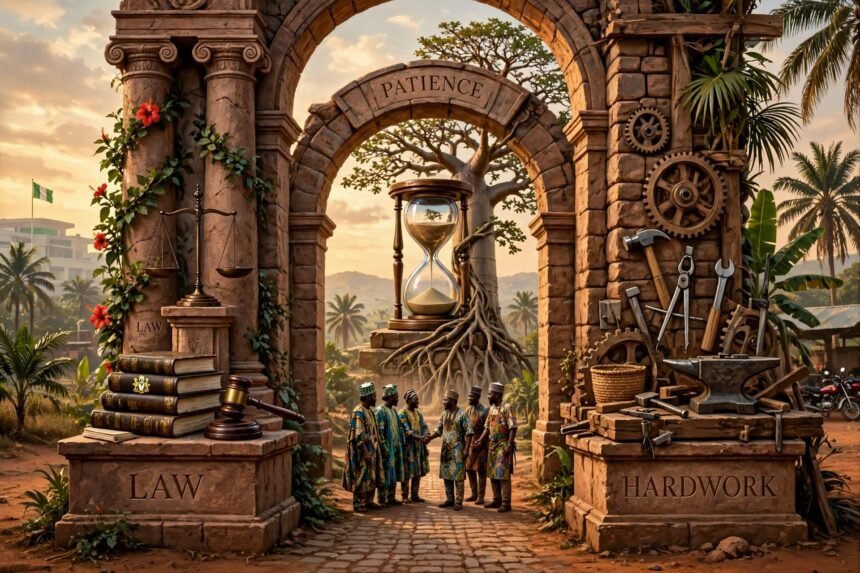
History teaches those who are willing to learn. The 2013 merger that produced the APC succeeded because it was built on law, patience and discipline — not noise, blame and impatience.
THE 2013 MERGER: HOW THE APC WAS BUILT ON LAW, NOT NOISE
When the progressive political parties decided to merge in 2013, for the first time in the history of contemporary Nigeria, the leadership of those parties was meticulous, deliberate and serious. Being experienced and abreast of the history of the country, they were conscious of the fact that reactionary forces, whether from the government in power at the time or from elsewhere, might want to scuttle what they intended to do: to set up a broad-based national progressive party that would be a competitor.

The political parties began by setting up merger committees made up of experienced people drawn from all facets of national life, including academia and social criticism. For example, the defunct Congress for Progressive Change (CPC) had Professor Tamuno David-West in its merger committee. The defunct Action Congress of Nigeria (ACN) had an experienced politician and doyen of journalism, Chief Segun Osoba.
The ANPP Merger Committee was chaired by the former Governor of Kano State, Mallam Ibrahim Shekarau. The CPC Merger Committee was chaired by an experienced public servant, former Deputy Governor of Bauchi State and Senator of the Federal Republic of Nigeria, Senator Garba Gadi. The ACN had as Chairman of its Merger Committee Chief Tom Ikimi, an architect and former Minister of Foreign Affairs of Nigeria. The APGA Merger Committee was headed by Senator Annie Okonkwo, a very successful businessman and politician.
The first thing the leadership did was to collapse the merger committees of the political parties involved in the merger talks into one, to facilitate and ease negotiations. That was how the Joint Inter-Party Merger Committee was formed, made up of all the members of the merger committees of the ACN, ANPP, CPC and the faction of APGA that was part of the merger talks. All the chairmen of the various merger committees were appointed co-chairmen, while the Chairman was Chief Tom Ikimi. Equally, the secretaries of the respective political parties were all appointed Co-Secretaries of the Joint Inter-Party Merger Committee.
The venue for the merger talks was the house of Chief Tom Ikimi on Thames Street, Maitama. It was at this venue that the merger talks held from February 2013 until June 2013, when the talks were concluded.
To enable the Joint Inter-Party Merger Committee to do its work very well, it was broken into several sub-committees. I was appointed into the Legal and INEC Compliance Committee. This was a very vital committee on which the entire merger was hinged. The Chairman was an experienced politician, two-term Governor of Benue State and then Senator of the Federal Republic of Nigeria, Senator George Akume. The Secretary of the Committee was an experienced lawyer, Barrister James Ocholi, SAN. The task of the Committee was to study carefully the Constitution of the Federal Republic of Nigeria, 1999, the Electoral Act 2010 and other extant legislation, to ensure that all the intricacies concerning the merger of political parties and the registration of political parties were scrupulously complied with, giving no room for INEC or anybody to exploit any legal or constitutional gap or hiatus to outmanoeuvre or scuttle the merger.
It was the sub-committee that advised that, since APGA and DPP were in factions, none of them should sign the merger documents, but should remain in the shadow or background, to avoid the other factions going to court to scuttle the merger. Therefore, the documents that required the National Chairmen and National Secretaries of the respective merging parties to sign and execute were only signed by the defunct National Chairmen and National Secretaries of the ACN, ANPP and CPC. The National Chairman of the ACN was Chief Bisi Akande; the National Secretary was Senator Lawal Shuaibu. The National Chairman of the ANPP was Dr Ogbonnaya Onu; the National Secretary was Alhaji Tijjani Tumsah. For the CPC, the National Chairman was Prince Tony Momoh and the National Secretary was Engineer Buba Galadima.
We packaged all the prerequisite documents required by the Constitution and the Electoral Act for the registration of the political association known as the All Progressives Congress (APC). All the merging parties held their respective national conventions to approve, by respective resolutions, their merger and the formal dissolution and collapse of their structures into the APC.
After the merger talks and the submission of all necessary documents to INEC, we had a major challenge when an obscure political association, apparently set up by the PDP and known as the African Peoples Congress, which deliberately adopted the same acronym as the All Progressives Congress (APC), filed an action in the Federal High Court, Abuja, seeking an order of mandamus to restrain INEC from registering the All Progressives Congress, on the ground that its acronym conflicted with that of the African Peoples Congress. The case was assigned to Honourable Justice Gabriel Kolawole of the Federal High Court to hear and determine. Barrister James Ocholi, SAN and I were instructed to defend the APC in court, and gladly we won the case and the African Peoples Congress lost.
The CPC also faced a similar challenge, as a renegade faction of the party challenged the decision of the party to merge with other political associations in the High Court of the Federal Capital Territory, Abuja (Gudu Judicial Division), presided over by Honourable Justice Adebukola Banjoko (now of the Court of Appeal), and I defended the CPC as counsel and won.
The merging parties did not complain or resort to accusing all and sundry, as we are seeing today by politicians who say they are a coalition and are moving en masse to hijack and supplant the structure in place in the African Democratic Congress (ADC), triggering a debilitating legal conundrum which they now blame on everybody, including the Federal Government and the APC, instead of their leadership owning up to its mistakes. History is always there for people to study and avoid the pitfalls that leadership mistakes caused, mistakes that resulted in disastrous consequences, rather than basking in self-pity and drawing public sympathy.
Conclusion: The lesson of 2013 is clear. Mergers succeed when leaders respect the law, do the hard work quietly, and take responsibility for their own mistakes. They fail when leaders rush, cut corners, and blame everyone else for the consequences of their own errors.