

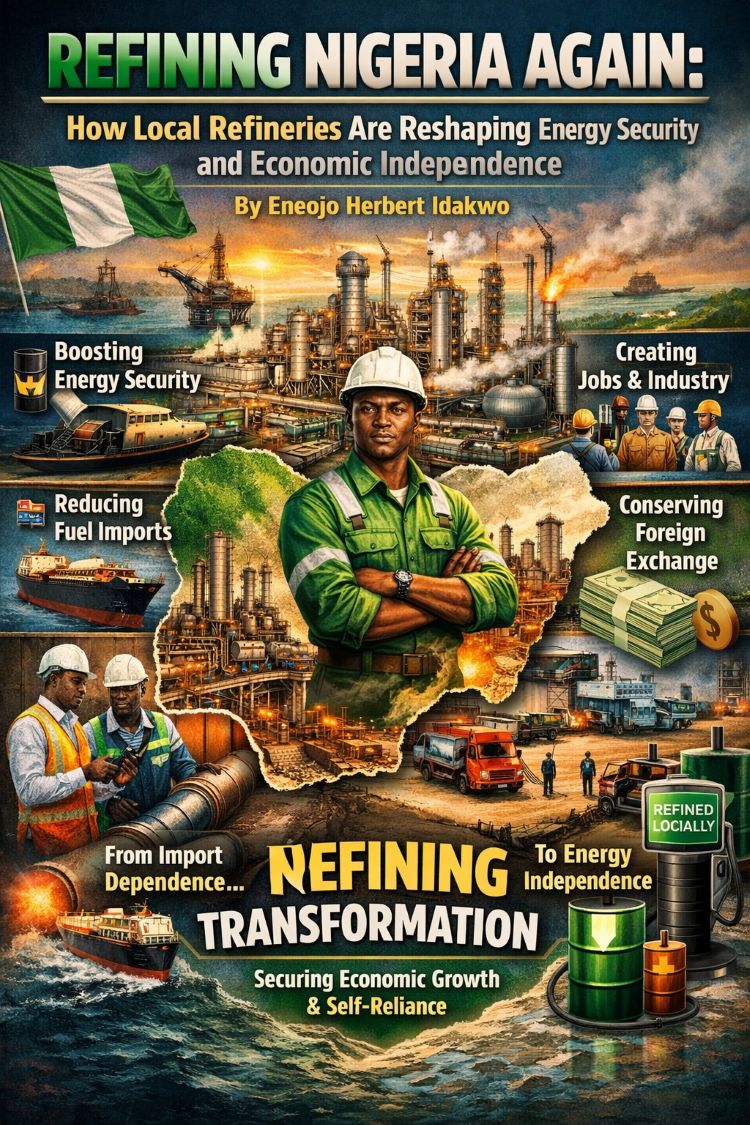
By Eneojo Herbert Idakwo
Few realities have symbolized Nigeria’s economic contradictions more starkly than this: Africa’s largest crude oil producer spent decades importing much of the refined petroleum products consumed by its own citizens.
For years, crude oil left Nigerian shores in massive quantities, only for refined products to return at enormous cost. The arrangement drained foreign exchange reserves, exposed the country to international supply disruptions, encouraged subsidy dependence, and left the economy vulnerable to global market fluctuations.
The situation became one of the most frequently cited examples of structural inefficiency in Nigeria’s post-independence economic history.

Today, however, a significant shift appears to be underway.
The administration of President Bola Ahmed Tinubu has placed considerable emphasis on expanding domestic refining capacity as part of its broader energy and economic reform agenda. Combined with private-sector investment and policy reforms, Nigeria is gradually moving from a nation heavily dependent on imported refined products toward one seeking greater energy self-sufficiency.
Supporters believe this transition could become one of the most consequential developments in Nigeria’s economic future.
The Long Road to Refining Self-Sufficiency
Nigeria’s refining challenge did not emerge suddenly.
For decades, state-owned refineries struggled with:
- Aging infrastructure
- Poor maintenance
- Operational inefficiencies
- Corruption allegations
- Low production capacity
- Frequent shutdowns
As domestic refining capacity declined, dependence on imported petroleum products increased.
This dependence created a cycle with far-reaching consequences.
Foreign exchange demand rose as importers sourced refined products abroad. Government subsidy obligations expanded. Supply disruptions became recurring concerns. Price volatility exposed the economy to external shocks.
Meanwhile, citizens often questioned why a country blessed with substantial crude oil resources remained dependent on imports for products it should have been producing domestically.
The answer lay in years of underinvestment and structural neglect.
Why Refining Matters Beyond Fuel
The conversation about refineries is often reduced to petrol prices, but refining capacity affects much more than fuel availability.
A functioning domestic refining sector influences:
- Foreign exchange stability
- Industrial growth
- Energy security
- Employment creation
- Government revenue
- Supply chain reliability
- Investor confidence
When a nation imports large volumes of refined products, it exports economic opportunities alongside its crude oil.
By refining locally, more value remains within the domestic economy.
Engineers, technicians, transport operators, contractors, suppliers, and manufacturers all benefit from expanded downstream activity.
This is why many economists view refining not simply as an energy issue but as an industrial development issue.
The Tinubu Administration’s Energy Vision
The Tinubu administration inherited a period of major transition within Nigeria’s oil and gas sector.
Global energy markets were evolving. Domestic subsidy reform had become unavoidable. Investor confidence required rebuilding. Local refining projects were beginning to emerge as viable alternatives to long-standing import dependence.
The government’s strategy has focused on creating conditions that encourage:
- Increased downstream investment
- Regulatory certainty
- Local refining expansion
- Greater private-sector participation
- Improved energy security
Officials argue that domestic refining is essential for reducing Nigeria’s exposure to international supply shocks and strengthening long-term economic resilience.
The administration also views refining expansion as part of a larger effort to reposition the energy sector for growth and competitiveness.
The Rise of Domestic Refining Capacity
Perhaps the most visible development in recent years has been the emergence of large-scale domestic refining operations alongside expanding modular refinery initiatives.
For decades, discussions about local refining often remained confined to policy documents and political promises. Today, operational refining capacity is becoming a tangible reality.
Supporters argue that this development could fundamentally alter Nigeria’s energy landscape.
Expanded local refining capacity offers several potential benefits:
- Reduced dependence on imported fuel
- Improved supply stability
- Lower foreign exchange pressure
- Increased domestic industrial activity
- Greater energy sovereignty
While challenges remain, the direction of travel appears increasingly clear.
Nigeria is attempting to move up the value chain rather than remaining primarily an exporter of raw crude.
Conserving Foreign Exchange
One of the strongest economic arguments for local refining lies in foreign exchange conservation.
For years, fuel imports consumed significant amounts of foreign currency, placing pressure on reserves and contributing to broader exchange-rate challenges.
Every litre of imported fuel represented foreign exchange leaving the economy.
Domestic refining changes that equation.
By processing crude oil locally, Nigeria can reduce import dependence and retain more economic value within its borders.
In an economy undergoing foreign exchange reform and seeking greater currency stability, this advantage carries strategic importance.
Government officials increasingly point to local refining as part of the broader effort to strengthen Nigeria’s balance of payments and improve economic resilience.
Energy Security in an Uncertain World
The global energy market has become increasingly unpredictable.
Geopolitical tensions, supply disruptions, shipping challenges, and international conflicts have repeatedly demonstrated how vulnerable import-dependent nations can be.
Countries that rely heavily on imported energy products often face heightened exposure to external shocks.
Nigeria’s refining push therefore has implications beyond economics.
It is also about national security.
A nation with stronger domestic refining capacity possesses greater control over critical energy supplies.
This control enhances stability during periods of international market turbulence and reduces dependence on external actors.
The Tinubu administration appears to recognize that energy security is increasingly becoming a strategic national priority.
Jobs, Industry, and Economic Multipliers
Refineries do not operate in isolation.
Around every major refining operation exists a broader ecosystem of economic activity.
This includes:
- Engineering services
- Logistics companies
- Maintenance contractors
- Manufacturing suppliers
- Transportation networks
- Technical training institutions
- Small and medium enterprises
As refining capacity expands, these supporting sectors often grow alongside it.
The result is an economic multiplier effect capable of generating employment and stimulating industrial development.
For a country with a rapidly growing youth population, such opportunities carry significant long-term importance.
The administration’s supporters argue that refining expansion should therefore be viewed not merely as an energy achievement but as an industrialization strategy.
Challenges on the Path Forward
Despite growing optimism, significant challenges remain.
Domestic refining alone cannot instantly solve all energy-sector problems.
Issues requiring continued attention include:
- Pipeline security
- Crude oil theft
- Regulatory consistency
- Infrastructure maintenance
- Market competitiveness
- Distribution efficiency
- Pricing stability
There is also the challenge of ensuring that increased refining capacity translates into measurable benefits for ordinary Nigerians.
Citizens naturally expect improvements in fuel availability, supply reliability, and broader economic stability.
Meeting those expectations will be critical to sustaining public confidence.
Beyond Import Dependence
The broader significance of Nigeria’s refining transition lies in what it represents.
For decades, the country operated within a model that exported raw resources while importing higher-value finished products.
That model generated wealth but often failed to maximize domestic economic value.
The expansion of refining capacity signals an attempt to reverse that pattern.
Rather than remaining primarily a supplier of crude oil, Nigeria is seeking greater participation in value-added production.
This shift aligns with wider discussions about industrialization, economic diversification, and national competitiveness.
A New Chapter in Energy Independence
Three years into the Tinubu administration, the refining sector is emerging as one of the most closely watched components of Nigeria’s economic transformation agenda.
The journey is far from complete.
Major structural challenges remain. Global market uncertainties persist. Domestic expectations continue to rise.
Yet there is growing evidence that the country is beginning to move away from one of its most enduring economic contradictions.
The success of this transition will ultimately depend on sustained investment, policy consistency, operational efficiency, and continued sector reform.
But for the first time in many years, Nigeria appears to be taking meaningful steps toward refining more of its own resources, securing more of its own energy future, and retaining more of the wealth generated from its natural endowments.
If sustained, that shift could become one of the defining economic stories of the Tinubu era.
Not merely because it changes how Nigeria fuels its economy, but because it changes how Nigeria thinks about economic independence itself.