By Boma West
A child opens his eyes before dawn, not because he has a school bus to catch or a breakfast waiting on the table, but because another day has begun inside a cramped tent that has become his home. His mother joins a queue for water with hundreds of others. His father wonders whether he will ever see his farmland again. This is not the aftermath of a natural disaster that struck yesterday. This has become a way of life for many Nigerians.
The tragedy of internal displacement has quietly become one of the country’s deepest humanitarian failures. Terrorism, banditry, communal violence, farmer-herder conflicts and devastating floods have uprooted millions from their homes over the past decade. Every fresh attack creates another wave of families carrying little more than the clothes on their backs. Every flooded community produces another generation of displaced people forced to depend on charity for survival.
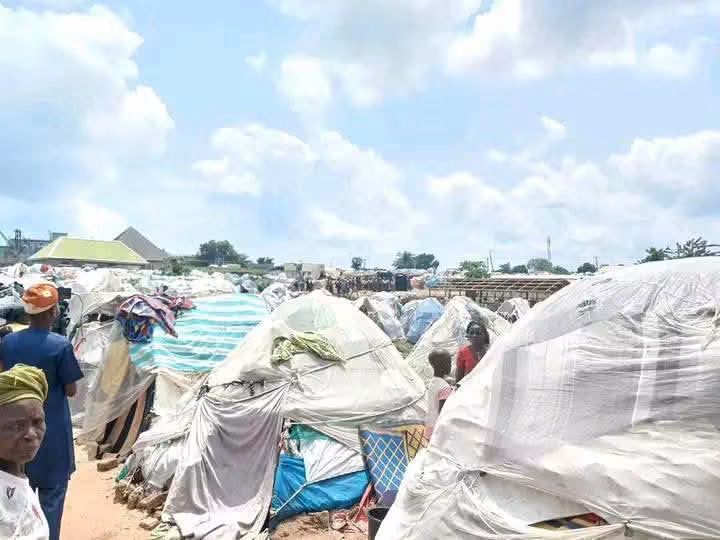
Nigeria has hundreds of camps and informal settlements spread across several states. Many were established as temporary shelters. Many have now existed for years. Temporary has gradually become permanent, leaving thousands trapped in a cycle of uncertainty from which there appears to be no clear escape.

Walking through many of these camps presents a painful contradiction. Human beings are alive, yet many are not truly living. Families occupy overcrowded shelters built from tarpaulin, zinc sheets, sticks and worn fabric. Privacy hardly exists. Children are born inside camps and grow into adolescence without ever experiencing the comfort of a real home. Rain turns pathways into muddy pools. Dry seasons bring unbearable heat beneath thin roofs never designed for long-term habitation.
Clean water remains a daily struggle in many camps. Long queues begin before sunrise. Limited sanitation facilities create conditions where disease spreads easily. Toilets are often too few for the population they serve. Poor drainage and inadequate waste disposal compound already difficult living conditions. Humanitarian workers continue to provide vital support, yet the needs consistently exceed available resources.
Healthcare tells another troubling story. Pregnant women frequently struggle to access quality maternal services. Children remain vulnerable to malaria, diarrhoea, respiratory infections and malnutrition. Mental health is perhaps the least discussed crisis despite the invisible wounds carried by survivors of violence. Many have watched loved ones murdered, homes destroyed and communities erased. Trauma does not disappear because food has been distributed.
Education offers little comfort either. Thousands of displaced children have spent years outside conventional classrooms. Temporary learning centres have prevented complete educational collapse in some camps. Shortages of qualified teachers, textbooks and permanent structures continue to deny many children the quality education they deserve. Every year spent outside proper schooling represents another blow to Nigeria’s future workforce.
Poverty follows displacement with frightening consistency. Farmers have lost their land. Traders have lost their businesses. Artisans have lost their customers. Families that once supported themselves now depend largely on humanitarian assistance. Whenever food supplies arrive late or donor funding declines, hunger quickly becomes another emergency. Small businesses inside camps provide limited relief, though they cannot replace functioning local economies.
Women and girls often carry an even heavier burden. Overcrowding, weak security arrangements and extreme poverty expose many to sexual exploitation, abuse and gender-based violence. Desperation has pushed some families towards harmful coping strategies, including child marriage. Such realities expose the vulnerability that thrives wherever hope becomes scarce.
Measured against internationally accepted humanitarian standards, many displacement camps still fall below what any human being should accept as decent living conditions. The United Nations Guiding Principles on Internal Displacement recognise adequate shelter, clean water, sanitation, healthcare, education, security and protection as basic rights, not privileges. The Sphere Humanitarian Standards establish clear benchmarks for emergency response around the world. Nigeria has made progress in some camps through partnerships involving government agencies, United Nations organisations and humanitarian groups. Persistent overcrowding, inadequate funding, insecurity and rising numbers of displaced persons continue to undermine these efforts. Survival should never be mistaken for dignity.
Government has repeatedly maintained that camps are temporary solutions rather than permanent settlements. Efforts have been made, particularly in parts of Borno State, to facilitate voluntary returns through the reconstruction of houses, schools, health centres and roads. Agricultural support schemes, vocational training programmes and livelihood initiatives have also been introduced to help returning families rebuild their lives.
Such efforts deserve recognition. They also demand honest scrutiny.
Many communities remain unsafe despite official declarations of improved security. Some displaced families have returned only to face renewed attacks. Others have discovered that their homes have vanished, their farms have become overgrown and their local economies have collapsed. Returning people to broken communities without sustainable opportunities merely relocates suffering from camps back to abandoned villages.
The conversation should therefore move beyond simply closing camps. Success cannot be measured by the number of camps shut down. Success should be measured by the number of displaced Nigerians who regain stable homes, secure livelihoods, functioning schools, accessible healthcare, reliable electricity, productive farmland and confidence that they will not be forced to flee again.
Durable solutions require far more than humanitarian relief. They demand serious investment in reconstruction, rural development, security, job creation and social services. Displaced families should become active participants in rebuilding their own communities through agriculture, skills acquisition, small businesses and local enterprise. Dependence must gradually give way to economic independence.
Nigeria possesses both the human capacity and institutional structures to achieve this transformation. Political will remains the missing ingredient. Every prolonged stay inside a displacement camp represents a reminder that somewhere government has been unable to provide either security or opportunity. Every child growing up inside a tent reflects a national promise yet to be fulfilled.
No Nigerian chooses displacement. No parent dreams of raising children inside a camp. No elderly citizen wishes to spend the final years of life surviving on food rations and humanitarian aid. Internally displaced persons are not statistics in official reports. They are citizens whose rights remain equal to those living behind the gates of comfortable estates.
History will not judge Nigeria by the number of camps it established during times of crisis. History will judge the nation by how quickly it helped its displaced citizens return to lives of dignity, security and self-reliance. That is the standard a compassionate society should never stop pursuing.