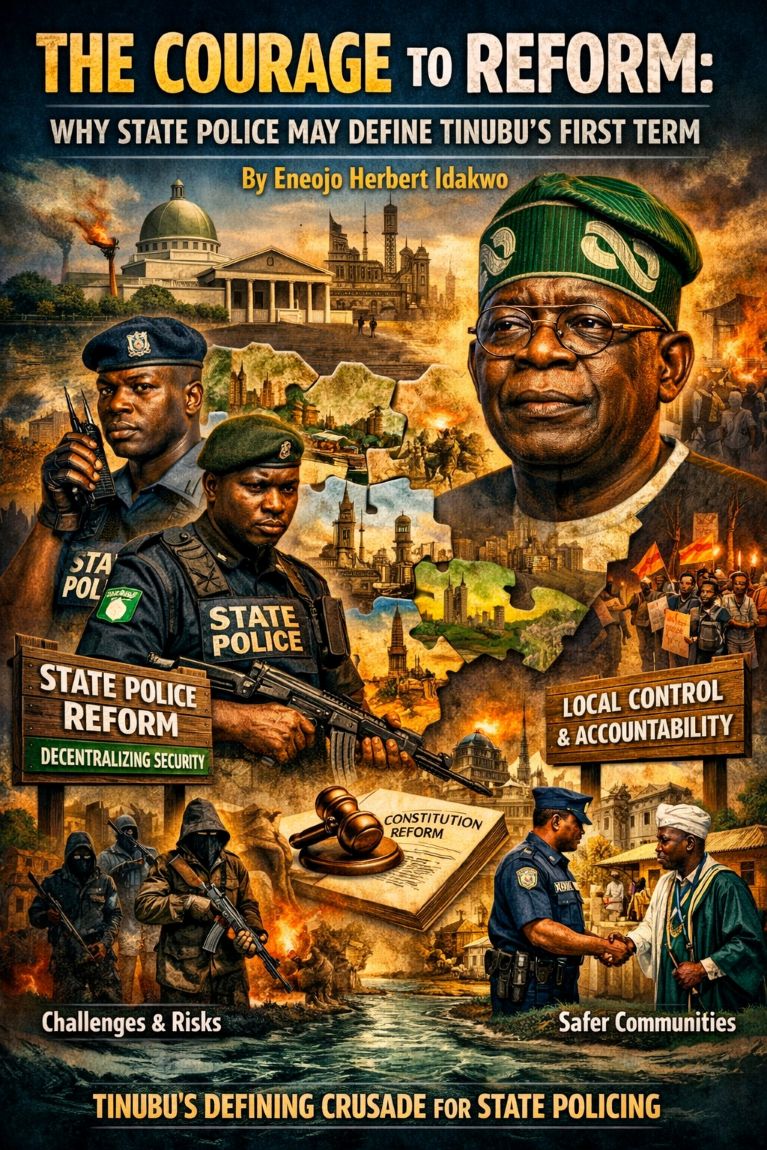
THE COURAGE TO REFORM: WHY STATE POLICE MAY DEFINE TINUBU’S FIRST TERM
By Eneojo Herbert Idakwo
For decades, Nigeria has wrestled with a difficult question. Can a single, centrally controlled police force adequately secure a vast and diverse federation?
From the forests of the North West to farming communities in the Middle Belt and the crowded streets of southern cities, insecurity has repeatedly exposed the limits of the present structure. Governors complain they are called “chief security officers” in their states yet they lack command over the police formations within their own territory. Communities call for faster response and local knowledge that a distant command structure often struggles to provide.

The debate over state police has therefore lingered for years. It has been discussed in constitutional conferences, political campaigns, and academic circles. Yet successive administrations avoided taking the decisive step. The issue remained politically sensitive. Many leaders feared that decentralizing the police might create new tensions or empower state governments in ways that could be abused.
What has been lacking is not the argument. What has been lacking is the political will.
That is why the recent position taken by President Bola Ahmed Tinubu marks an important moment in Nigeria’s democratic evolution.
During the last Iftar gathering at the Presidential Villa in Abuja with members of the National Assembly , the president spoke plainly about the need to revisit the constitutional framework of policing. He urged lawmakers to begin the necessary constitutional work that would make the establishment of state police possible.
The setting was informal. The message was not.
By placing the issue directly before the legislature, the president signaled that the debate must now move from endless discussion to practical reform.
Other signals from the administration also pointed in the same direction. Shortly after assuming office, the inspector general of the Nigeria Police Force Olatunji Disu initiated a move in the same direction by setting up an eight member committee to examine the operational framework that would guide the transition when the constitution is amended.
This approach reflects a method that combines political decision with institutional preparation. One arm of government begins the legal work. The policing establishment begins the technical work.
Taken together, the signals are unmistakable.
For a country as complex as Nigeria, security solutions must reflect the realities on the ground. Local policing structures can bring several advantages.
First, intelligence gathering becomes more effective. Officers drawn from or deeply familiar with their communities can identify threats before they grow into crises.
Second, response time improves. Local command structures can deploy personnel without waiting for distant approvals.
Third, accountability becomes clearer. When citizens know which authority controls their police structure, they also know where responsibility lies.
Of course, concerns remain. Critics warn that state governors could misuse local police forces against political opponents. That concern deserves serious safeguards. Any constitutional reform must include strong oversight mechanisms, professional standards, and federal checks that prevent abuse.
But refusing to reform because abuse is possible is not a solution. Every institution carries risk. The task of leadership is to design systems that manage those risks.
In that sense, the debate over state police has always been a test of courage in governance.
Few leaders are willing to touch it.
Nigeria’s security crisis requires bold thinking, and bold thinking requires political capital. A president must be willing to stake authority on a reform whose benefits may unfold gradually.
The willingness of the Tinubu administration to open this constitutional conversation therefore represents more than a policy proposal. It reflects a governing philosophy that accepts that Nigeria must evolve if it is to remain stable and secure.
Reforms of this scale rarely mature within a single political term. Constitutional amendments require debate, negotiation, and consensus across many interests. Institutional adjustments take time to implement. Public trust develops gradually.
That is why continuity in leadership often becomes important when foundational reforms are underway.
If the process of establishing state police moves from proposal to constitutional amendment, and from amendment to operational framework, it could reshape the security architecture of Nigeria for generations.
Such a transformation would stand as one of the most consequential governance reforms since the return to democratic rule.
For many supporters of the administration, this is precisely why the coming political cycle will matter. They argue that a reform agenda already set in motion requires time to mature. Interrupting it midway may return the country to the familiar pattern of abandoned initiatives.
The question before voters therefore extends beyond personalities or party rivalries. It touches on whether Nigeria should continue along a path of structural reform.
State police may yet become one of the defining markers of this administration’s legacy. If it succeeds, it will demonstrate that long avoided national questions can finally be addressed when leadership chooses courage over hesitation.
Nigeria is still a nation under construction. Institutions are evolving. Systems are being tested and redesigned.
The journey is not complete. But the direction is becoming clearer.