By Okoi Obono-obla
The Yakurr people of present-day Cross River State, Nigeria, trace their ancestral homeland to a place known as Lekanakpakpa or Akpa.
According to the foremost historian of the Yakurr, Dr. Otu Abam Ubi, in his seminal work The Yakurr People of the Middle Cross River Region (2019) International Edition — based on his PhD thesis The Yakurr: A Reconstruction of Pre-Colonial History at the University of Lagos in 1978 — Akpa is the shortened form of Lẹkanakpakpa. The work traces Yakurr history from their ancestral homeland in south-western Cameroon before the collapse of the Wukari Empire (Kwararafa).
Oral traditions are consistent on this origin. The Yakurr trace their origins to “Akpa”, which oral traditions describe as their ancestral homeland. The traditions of their neighbours — the Okuni, Nsofan, and Ojo peoples — corroborate this claim. They confirm that they lived together with the Yakurr at Lẹkanakpakpa, which the Okuni and Nsofan refer to as “Onugi” and the Ojo as “Lẹkpamkpa”.

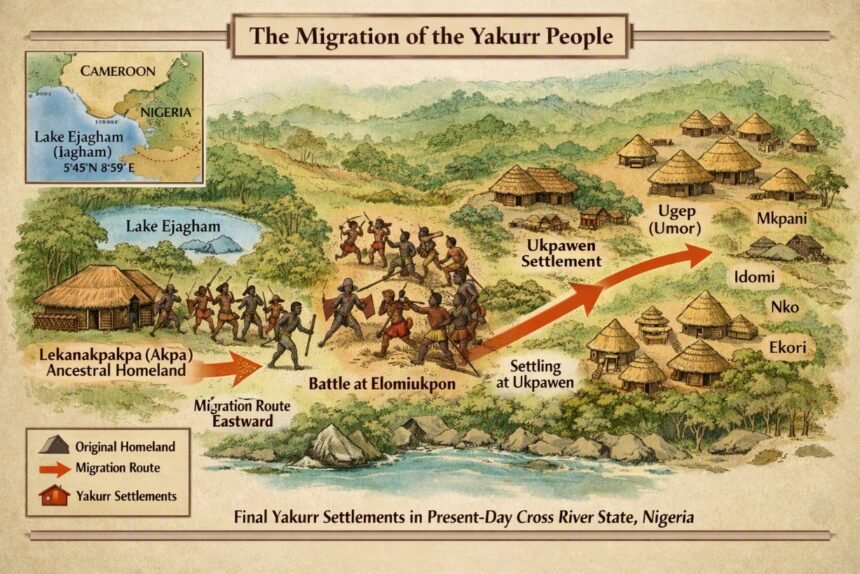
Dr. Ubi and other sources place Lẹkanakpakpa in what is today the Cameroon-Obudu range and, more precisely, close to Lake Ejagham — rendered in older literature as Lake Ijagham.
Precise Location of Lake Ejagham
Lake Ejagham is not a mythical lake. It is a small, oval-shaped solution-basin lake located:
Coordinates: 5°45′N 8°59′E / 5.750°N 8.983°E
Location: Near Eyumojock town and commune, in Manyu Division, Southwest Region of the Republic of Cameroon — the area formerly known as South Western Province
Geography: In a sparsely populated region of evergreen rain forest, with a surface area of about 0.49 km², draining into the Munaya River, part of the Cross River system. It lies in the heart of the Ejagham homeland.
This location places it directly within the Ejagham ethnic territory, from which the wider Cross River peoples, including the Yakurr, are believed to have dispersed.
The Migration and Settlement at Ukpawen
According to Yakurr oral tradition, the migration was triggered by a dispute over burial customs around AD 1617. The Yakurr began leaving Akpa around AD 1617 after a dispute with neighbouring groups over a burial custom led to war and forced them from their homeland.
Ubi describes the migration as occurring over several generations between the seventeenth and eighteenth centuries.
A distinct and important tradition concerns the movement of three of the core Yakurr groups — Ugep, Mkpani and Idomi.[Umor]
Oral history records that Ugep, Mkpani and Idomi moved together as a single group. On their journey, they arrived at Ukpawen, where a battle ensued with an indigenous group at Elomiukpon. In the heat of the fierce fighting, a woman who was in labour and unable to climb the hill was forced to drop off. The rest of the party pressed on, climbed the hill, and established a settlement known as Ukpawen. The woman who was left behind and her offspring subsequently established Idomi.
Later, while still at Ukpawen, a disagreement ensued between Umor and Mkpani. As a result, the Mkpani group moved further away to establish the present settlement of Mkpani. Ugep remained at Ukpawen and expanded to become Umor.
Around AD 1660, these first migrants had already established the nucleus of Ugep and Idomi in what is now Cross River State. Subsequent migrations between 1677 and 1707 led to the founding of Nko.
Ekori, the Last Settlement, was founded last. After the initial settlements had stabilized, the final wave of Yakurr migration resulted in the establishment of Ekori, completing the five core Yakurr towns known today as Ugep, Mkpani, Idomi, Nko, and Ekori.[Umor]
Thus, Dr. Ubi’s scholarship and Yakurr oral tradition provide a historical-geographical bridge: the Yakurr ancestral town of Lekanakpakpa / Akpa / Umorwen was situated close to Lake Ejagham (Ijagham) at 5°45′N 8°59′E near Eyumojock in the Southwest Region of Cameroon, from where the Yakurr ancestors began their eastward migration, fought at Elomiukpon, settled briefly at Ukpawen, and finally dispersed to found present-day Yakurrland — with Ekori as the last settlement to be founded.