
By George Bamidele Ogunjimi LLB, LLM, BL, PhD, Dip. Journalism.
There is a profound injustice at the heart of the history of the transatlantic slave trade: the enslavers were compensated, the enslaved were abandoned, and the wealth generated through human suffering was allowed to pass from one generation to another.
For more than four centuries, millions of African men, women and children were captured, transported and sold into slavery. Their labour built fortunes, enriched European empires, financed commercial institutions and contributed to the economic development of the Americas and Europe. Their humanity was sacrificed for profit, while their descendants inherited the consequences of dispossession.
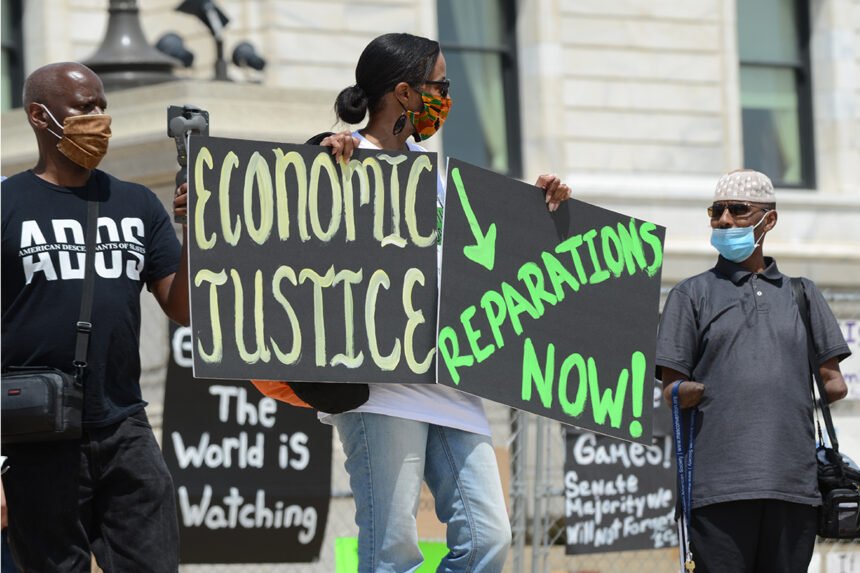
The question of reparations is therefore not a demand for charity. It is a demand for historical accountability, economic justice and recognition of an unresolved debt.

The hypocrisy of emancipation.
Britain’s Slavery Abolition Act 1833 provides one of the clearest examples of historical injustice.
When slavery was abolished across most of the British Empire, the government allocated £20 million to compensate slave owners for the loss of their enslaved workforce. This represented approximately 40 per cent of the government’s annual expenditure.
The enslaved received nothing.
Indeed, many were forced to continue working for their former enslavers under the apprenticeship system.
The compensation loan was not finally repaid by British taxpayers until 2015.
The contradiction is extraordinary: Britain recognised the financial interests of those who had enslaved human beings but ignored the rights and suffering of the people who had actually endured enslavement.
If compensation was considered appropriate for the enslavers, why was justice considered unnecessary for the enslaved?
The economic debt of slavery.
Slavery was not simply a system of human cruelty; it was an organised economic enterprise.
The wealth generated through African labour flowed into shipping, banking, insurance, manufacturing, agriculture and international commerce.
Meanwhile, Africa experienced the forced removal of millions of its people, the destruction of communities, demographic disruption and the weakening of established economic and political structures.
Some of the wealth accumulated through slavery became inherited property, institutional capital and enduring commercial advantage. The descendants of enslaved Africans, however, were largely denied the opportunity to inherit equivalent wealth.
It is therefore misleading to suggest that slavery has no relevance to contemporary economic inequality.
The argument is not that every modern inequality originates in slavery, or that every contemporary European citizen bears personal guilt. It is that the historical relationship between exploitation, wealth accumulation and inherited disadvantage deserves recognition and investigation.
The legal foundations for reparations
Reparations are not merely a moral aspiration. They have foundations in established principles of international law.
1. International Law Commission Articles on State Responsibility (2001).
Articles 30–37 recognise principles of cessation, restitution, compensation and satisfaction where internationally wrongful acts have been established.
Article 31 provides for full reparation for injury caused by an internationally wrongful act.
2. International Convention on the Elimination of All Forms of Racial Discrimination (1965)
Articles 2, 5 and 6 establish obligations concerning racial equality, the elimination of discrimination and effective remedies for violations.
These provisions are particularly relevant to continuing racial discrimination and its contemporary consequences.
3. Durban Declaration and Programme of Action (2001)
Paragraphs 99–102 recognise the historical suffering caused by slavery, the transatlantic slave trade and colonialism, and address the responsibility to remedy their lasting consequences.
4. United Nations General Assembly Resolution A/RES/80/250 (2026).
Adopted on 25 March 2026, this resolution recognised the trafficking of enslaved Africans and racialised chattel enslavement as the gravest crime against humanity. It also called for meaningful dialogue on reparatory justice, including compensation, restitution, apologies and guarantees of non-repetition.
Although a General Assembly resolution does not automatically create an enforceable financial liability against individual states, it represents an important development in international recognition of reparatory justice.
There remains a legitimate legal debate about retrospective responsibility, applicable historical law and the identification of beneficiaries. However, those difficulties should encourage serious legal examination, not provide a blanket excuse for refusing discussion.
What should reparations involve?
Reparations should extend beyond financial payments. They should constitute a comprehensive programme of restorative justice, including:
– Financial compensation through an internationally negotiated reparations fund.
– Investment in African and Caribbean education, healthcare and infrastructure.
– Scholarships, research and technological development.
– Restitution of African cultural artefacts and historical property.
– Debt relief and economic development partnerships.
– Formal apologies and institutional acknowledgement.
– Measures addressing continuing racial discrimination and economic exclusion.
The CARICOM Reparations Commission’s Ten Point Plan provides an important framework for these proposals.
Such a programme must be transparent, independently monitored and designed with the participation of affected communities. Reparations must benefit ordinary people rather than become another source of political patronage.
Conclusion: Emancipation was not reparation
The abolition of slavery ended the legal ownership of human beings. It did not restore stolen labour, reunite destroyed families, return lost opportunities or compensate generations of suffering.
Nor did it automatically dismantle the economic advantages accumulated through enslavement.
The descendants of enslaved Africans should not be expected to accept historical injustice as an unfortunate event whose consequences must simply be forgotten.
Equally, contemporary governments and institutions should not be assigned automatic personal guilt for the actions of previous generations. The question is one of institutional continuity, historical responsibility and the consequences of documented wrongdoing.
The demand for reparations is not about reversing history. It is about confronting it honestly and addressing the injustices that remain unresolved.
Britain and other former slave-trading powers cannot celebrate the abolition of slavery while refusing to examine the compensation paid to enslavers and denied to the enslaved.
Freedom was not a gift from the enslaver. It was a human right that had been violently denied.
A debt does not become morally extinguished simply because generations have passed. Nor does the passage of time transform the proceeds of exploitation into legitimate historical innocence.
The case for reparations is ultimately a case for completing the unfinished work of emancipation: ensuring that those whose ancestors paid the highest price for the wealth of others are not permanently excluded from the justice they were denied.
Abolition ended slavery. It did not settle the debt.
George Ogunjimi Esq
jurisrepubliclegal@gmail.com
06/11/2026.