
By Otunba (Dr.) Abdulfalil Abayomi Odunowo
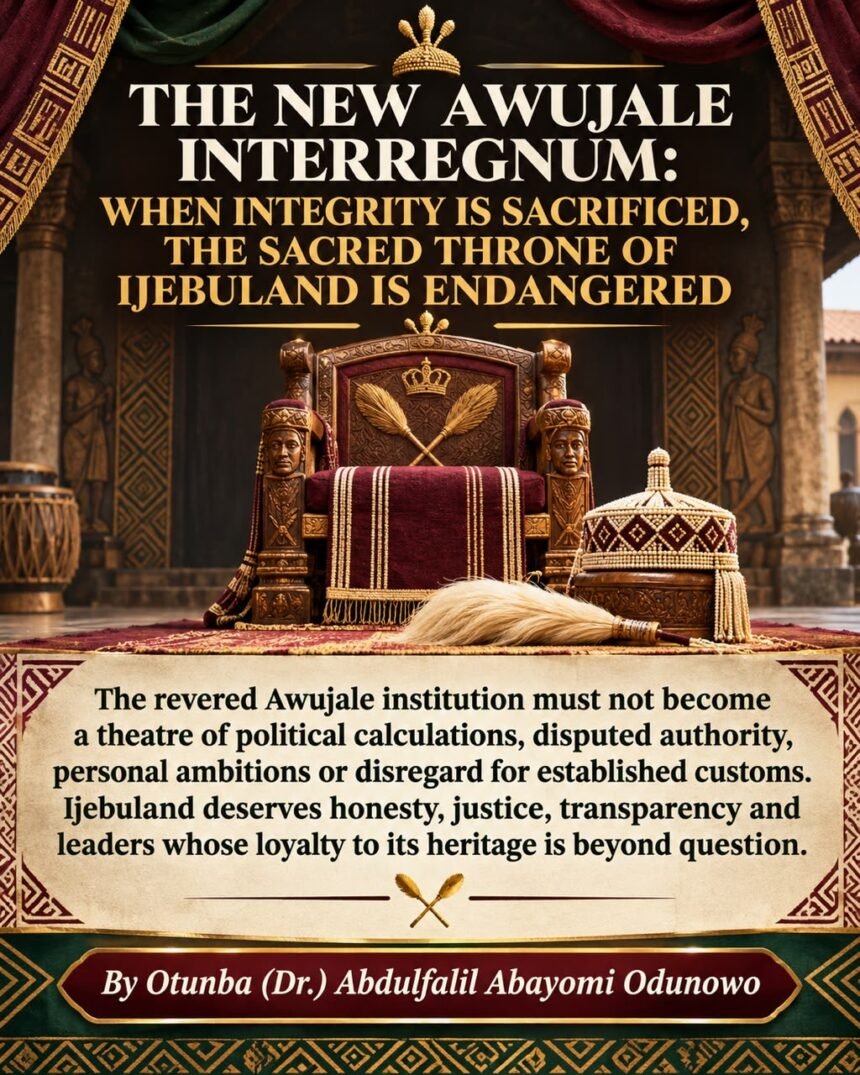
The revered institution of the Awujale must never be reduced to a platform for political maneuvering, contested authority, personal ambition, or disregard for established custom. Ijebuland deserves honesty, fairness, transparency, and leadership whose commitment to its heritage is unquestionable.
We write in shock, profound disappointment, and growing concern over recent developments in the administration of the revered Awujale throne of Ijebuland. What should have remained a solemn period devoted to cultural preservation, institutional continuity, and respect for the legacy of our forebears is steadily turning into an unnecessary source of controversy, mistrust, and division. When honesty is discarded, integrity is treated as optional, and personal interests begin to eclipse sacred duties, the damage can be far-reaching.
The Awujale throne is not a tool of political expediency. It is not a heritage to be managed according to individual preference. It stands as the enduring emblem of the history, dignity, sovereignty, and cultural identity of the Ijebu people. No person, regardless of influence, should be allowed to weaken that institution.
**A Throne Built Across Centuries and Strained by Politics**
Oba Sikiru Kayode Adetona, Ogbagba II, of the Anikinaiya Ruling House, ascended the throne on 2 April 1960 and reigned for sixty-five years until his transition on 13 July 2025. His reign was among the longest and most consequential in contemporary Nigerian traditional history.
Choosing his successor is not a matter for administrative improvisation. The process is governed by the registered Declaration made under Section 4(2) of the Chiefs Law of 1957 of the former Western Region, a declaration approved in 1959 and still the foundational customary-law instrument for the Awujale chieftaincy. That Declaration recognizes four ruling houses in a fixed rotational order: Anikinaiya, Fusengbuwa, Fidipote, and Gbelegbuwa. It is now the turn of the Fusengbuwa Ruling House.
History itself cautions against handling this institution carelessly. In November 1981, the then Governor of Ogun State, Chief Olabisi Onabanjo, suspended Oba Adetona and set up a commission of inquiry that recommended his deposition. The institution survived that political crisis only because the 1983 military intervention, followed by a later court judgment, restored the monarch. The lesson remains unmistakable: whenever governments or powerful interests try to subject the Awujale stool to short-term political considerations, the legitimacy of the entire traditional order is endangered. We must not permit history to return in another form.
The Unsettled Issue of the Olisa’s Suspension
One of the most disturbing features of the current controversy is the reported suspension of the Olisa of Ijebu-Ode, Chief Rasheed Adeoye Adesanya, by the late Awujale, Oba Dr. Sikiru Kayode Adetona, GCON. The basic question is clear: Was the Olisa still under a valid suspension at the time of the late Awujale’s passing, and if so, under what customary or legal authority was that suspension lifted?
This is far from a minor procedural matter. It strikes at the very legitimacy and credibility of the present interregnum arrangement. In the traditional view advanced by many Ijebu stakeholders, the disciplinary authority of a reigning Awujale over palace chiefs carries deep significance. The Olisa holds a central position among the Ilamuren kingmakers. If the suspension imposed by the late Awujale was still operative, then the Ijebu people deserve a transparent account of how the affected chief later came to exercise responsibilities of such importance without a properly established reinstatement process.
Those who argue that only a substantive Awujale can reverse such a suspension have raised a serious customary issue that deserves authoritative examination. At the same time, the alternative traditional procedure reportedly involving the Balogun and the next eligible family for the Olisa chieftaincy must be carefully assessed against the relevant registered chieftaincy declaration and established customary practice.
The relevant historical instruments, including the declarations associated with the Chiefs Law of 1957, must be examined together with the Obas and Chiefs Law of Ogun State 2021 and any binding judicial decisions. Tradition cannot be selectively invoked when convenient and ignored when it becomes inconvenient.
Until the issues surrounding the suspension and reinstatement are satisfactorily settled, the appointment of the Olisa to head the newly reconstituted interregnum council will understandably continue to generate concern. Recent statements by groups such as the Ijebu Progressive Elders Forum have already brought this matter into the public domain. Neither silence nor administrative fiat can resolve it.
**How Did We End Up With Two Rival Interregnum Arrangements?**
The recent transition announced by senior Ijebu chiefs from the former Awujale Interregnum Administrative Council, constituted by the Ogun State Government in August 2025 under the leadership of Ogbeni Oja, Chief Sonny Kuku, to an Adele Oba Awujale-in-Council, was followed almost immediately by the State Government’s reconstitution of another interregnum council under the Olisa as Chairman and the Bobasuwa, Chief Chris Okunowo, as Secretary. This sequence raises serious concerns about institutional coordination and traditional authority.
How did a structure supposedly created to preserve unity become the source of competing claims? Why were the underlying disagreements not resolved through genuine consultation with recognized traditional authorities before another administrative body was announced? And why should an institution as revered as the Awujale throne be exposed to repeated administrative changes without a clear and publicly understood customary and legal basis?
It is becoming increasingly difficult to understand why an interregnum, which ought to be only a temporary mechanism for maintaining continuity, has now become the centre of such deep disagreement.
An interregnum is not a substitute Awujale. Its role is to preserve, not dominate; to maintain continuity, not reinvent institutions; and to serve, not accumulate power. Any administrative arrangement must remain within these essential limits.
**The Role of Ogbeni Oja Chief Sonny Kuku**
The events involving the former council led by Ogbeni Oja, Chief Sonny Kuku, also require close examination. The Ijebu people are entitled to know why that earlier arrangement became unsustainable, what disagreements led to its transition into another body, and whether the decisions taken reflected broad traditional consensus.
There are concerns among stakeholders that efforts to accommodate competing interests may have contributed to the present institutional confusion. Those concerns should be addressed openly rather than allowed to harden into accusations and counter-accusations.
Leadership within a traditional institution demands a level of responsibility higher than what is ordinarily expected in political organizations. Personal ties, influence, and expectations must never replace established custom. Where leadership is entrusted with protecting the sacred heritage of a people, it must be transparent, accountable, and above reasonable suspicion.
**The Ijebu State Question: Loyalty to Ijebu Heritage Matters**
There is another deeply troubling aspect to the present situation. For more than five decades, generations of Ijebu sons and daughters have championed the actualization of Ijebu State, with Ijebu-Ode as its capital. This agitation is more than an administrative preference. It is a longstanding demand rooted in historical identity, equity, justice, and recognition of the old Ijebu Province. The late Awujale himself was among the most consistent and outspoken advocates of this cause, repeatedly describing the demand as historically justifiable, constitutionally grounded, and long overdue.
The emergence of the alternative Ijebu-Remo State proposal has therefore caused understandable concern among those committed to the original Ijebu State aspiration. Chief Chris Funmilola Okunowo, the Bobasuwa of Ijebu, and Chief Sonny Kuku must appreciate the importance of responding to public concern about their respective positions on this sensitive issue. They are entitled to their own views on state creation. Even so, anyone entrusted with representing the broader interests of Ijebuland should be able to show fairness, openness, and respect for its historical aspirations.
The leadership of Ijebuland must never become a vehicle for quietly replacing the collective aspiration of generations with a different political agenda. Those entrusted with our traditional institutions must not allow disagreement over Ijebu State or Ijebu-Remo State to compromise their duty to protect the Awujale throne.
The agitation for Ijebu State must remain a legitimate subject of public debate, while the administration of the throne must remain impartial and inclusive. Our concern is not merely about the individuals involved. It is about whether the custodians of Ijebu institutions can be trusted to defend those institutions above private interests.
The Governor Must Reconsider This Approach
We respectfully call on His Excellency, Prince Dapo Abiodun, CON, Executive Governor of Ogun State, to appreciate the seriousness of the situation. The Governor has a constitutional duty to preserve peace, uphold the law, and respect the legitimate cultural institutions of the people. Yet the legal authority of government must be exercised with deep sensitivity to the history, customs, and collective dignity of Ijebuland.
An administrative appointment may satisfy a formal governmental process and still fail to command the cultural confidence required for an institution of this importance. That is exactly why broader consultation has become necessary.
We respectfully urge the Governor to consider involving credible, independent, and widely respected Ijebu personalities, including persons of the standing of Senator Adegbenga Sefiu Kaka and Professor Bilesanmi, subject to their willingness, suitability, and acceptance by relevant stakeholders. Their possible involvement, together with recognized customary authorities, could help to facilitate an independent review, reconciliation, and a more broadly acceptable administrative framework.
What Ijebuland needs at this delicate moment is not another struggle for institutional control. It needs individuals who command confidence, understand the sanctity of the Awujale throne, and are ready to place the collective interest of the Ijebu people above every other consideration.
**The Question of Legitimacy Cannot Be Brushed Aside**
It must be clearly understood that an appointment does not automatically settle every question of traditional legitimacy. If a suspension imposed by the late Awujale was still subsisting, the proper course is to establish the facts, examine the applicable customary law, and determine whether a valid reinstatement occurred. Any unresolved issue concerning the Olisa’s authority could expose decisions relating to the Awujale succession to further dispute.
The existence of a court judgment, including the consent judgment in Suit No. HCJ/180/2025, or a governmental appointment must likewise be carefully examined to determine exactly what it authorizes and whether it addresses the underlying traditional disciplinary issue.
Legal authority and customary legitimacy must be reconciled, not set against one another unnecessarily. The Ijebu people deserve a succession process whose outcome will endure the test of time, law, and tradition.
**Our Demands**
We therefore call for the following immediate steps:
1. Full disclosure of the records concerning the Olisa’s suspension and reinstatement, including all relevant documents, dates, decisions, and authorities involved.
2. An independent review of the applicable customary declarations, including the historical provisions governing the Olisa chieftaincy and the Awujale succession process under the 1957 Declaration.
3. Clarification of the legal authority for the reconstituted interregnum council, including the relevant provisions of the Ogun State Obas and Chiefs Law 2021 and the effect of any binding court judgments.
4. A transparent review of the council’s composition, ensuring that public confidence, integrity, and customary competence remain central considerations.
5. A formal consultation involving recognized Ijebu traditional institutions, respected elders, and appropriate legal experts, with the aim of achieving a peaceful and culturally acceptable resolution.
6. A clear restriction of the council’s activities to its lawful and properly established functions, without allowing interim administrative responsibilities to encroach on powers reserved for a substantive Awujale or duly authorized kingmakers.
7. A commitment to prevent political disagreements over Ijebu State or Ijebu-Remo State from influencing the management of the Awujale institution.
**Ijebuland Must Not Be Taken for Granted**
The Ijebu people are historically conscious, culturally sophisticated, and deeply protective of their institutions. They understand the distinction between temporary administrative convenience and the preservation of sacred tradition. They also understand that the dignity of a throne built and sustained across generations must never be diminished by the controversies of a single political administration.
We do not seek confrontation. We seek justice.
We do not seek disorder. We seek legitimate authority.
We do not seek to diminish the Governor or any traditional chief. We seek to defend an institution greater than every individual now involved.
Those entrusted with responsibility during this interregnum must remember that history will judge not only their appointments, but also their conduct. The issue is not who temporarily holds an administrative office. The real issue is whether their actions will preserve or diminish the institution they claim to serve.
The Awujale throne existed long before the present political leadership, and it will remain long after every current officeholder has left the stage. That reality should inspire humility, restraint, and respect.
**A Word Is Enough for the Wise**
We respectfully urge the Ogun State Government to act with wisdom, transparency, and urgency before these disagreements further erode public confidence or create avoidable tension in Ijebuland.
Let the relevant documents be produced.
Let the traditional authorities be heard.
Let the customary and legal questions be resolved.
Let the integrity of the succession process be protected.
Above all, no personal ambition, political consideration, or disputed authority must be allowed to overshadow the sacred dignity of the Awujale institution.
**IJEBULAND IS NOT FOR PERSONAL EXPERIMENTATION. THE AWUJALE THRONE IS NOT A POLITICAL APPOINTMENT.
TRADITION MUST BE RESPECTED. LAW MUST BE UPHELD. INTEGRITY MUST PREVAIL**
A word is enough for the wise.
Otunba (Dr.) Abdulfalil Abayomi Odunowo
**Convener, Ijebu Lokan fun Itesiwaju Ijebu**
Concerned Ijebu Stakeholder and Advocate for Ijebu State Actualisation