By Okoi Obono-Obla
The reaction of the National Publicity Secretary of the African Democratic Congress (ADC), Mallam Bolaji Abdullahi, to the judgment of Hon. Justice Peter Lifu delivered on 5th November, 2026 in Suit No. FHC/ABJ/CS/1819/2025 – Nafiu Bala Gombe v. ADC & 4 Ors., has unfortunately introduced a wrong narrative into the public domain.
In a press statement titled “Lifu Judgment: APC Wants To Set Nigeria On Fire”, the party anchored its objection on what it called “the subsisting judgment of Hon. Justice Musa Liman of the same Federal High Court delivered on 2nd July, 2026 in Suit No. FHC/ABJ/CS/1637/2025.” With due respect, that argument is legally misconceived and seeks to confuse the issues.
As a lawyer and observer of our political developments, it is necessary to put the facts in proper perspective.

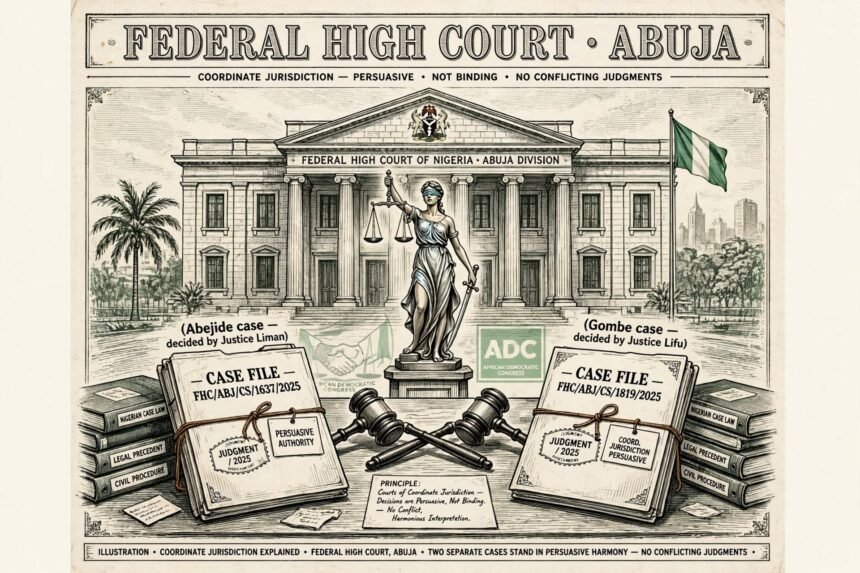
Two different cases went before two judges of coordinate jurisdiction. They are not the same.
First, the Abejide Case:
In Suit No. FHC/ABJ/CS/1637/2025, Hon. Leke Joseph Abejide, a serving member of the House of Representatives, filed an action challenging the emergence of Senator David Mark and Ogbeni Rauf Aregbesola as National Chairman and National Secretary of the ADC. The Federal High Court, per Hon. Justice Musa Liman, on 2nd July, 2026, dismissed the suit for lacking merit and held that it was an internal affair of the party. That was the end of Abejide’s personal challenge.
Second, the Gombe Case:
In Suit No. FHC/ABJ/CS/1819/2025, the plaintiff is Chief Nafiu Bala Gombe, who was the elected National Deputy Chairman (North-East) of the ADC. His case is fundamentally different. His contention is that upon the resignation of Chief Ralph Nwosu as National Chairman, the Constitution of the ADC provided a clear succession mechanism, which made him the Acting National Chairman. He therefore challenges the entire process that brought in a Caretaker Committee led by Senator Mark as illegal, unconstitutional, null and void. He joined INEC as a party, because INEC is the custodian of legitimate party leadership.
Hon. Justice Peter Lifu, after hearing the parties, found merit in Gombe’s case and declared the Mark-led Caretaker Committee illegal and nullified all actions taken under it.
Why there is no conflicting judgment:
For the principle of res judicata or conflicting judgments to apply, the law is settled: the parties must be the same, the issues must be the same, and the reliefs must be the same. None of these exist here.
Abejide is not Gombe. The cause of action of a member disagreeing with his party’s choice of leaders is not the same as the cause of action of a Deputy National Chairman asserting a constitutional right of succession. The reliefs sought are different. The evidence before the two courts is different.
More importantly, it is elementary law that decisions of courts of coordinate jurisdiction – such as one judge of the Federal High Court and another judge of the same Federal High Court – are of persuasive authority, not binding. Justice Lifu was not bound to follow Justice Liman. He was only bound to consider whether Justice Liman’s decision was distinguishable on the facts. It clearly was.
To therefore claim that the judgment of 5th November 2026 “conflicts” with the judgment of 2nd July 2026 is to misunderstand the doctrine of precedent. If the ADC is aggrieved by Justice Lifu’s decision, the legitimate and honourable path in a constitutional democracy is to appeal to the Court of Appeal, which has the jurisdiction to set a binding precedent, not to resort to political statements alleging desperation of the ruling party and attempting to intimidate the judiciary.
The Federal High Court has not contradicted itself. It has simply decided two different cases on their peculiar facts. The narrative of conflicting judgments should be discarded.
@Okoi Obono-Obla is a legal practitioner and former Special Assistant to the President. He writes from Abuja.