

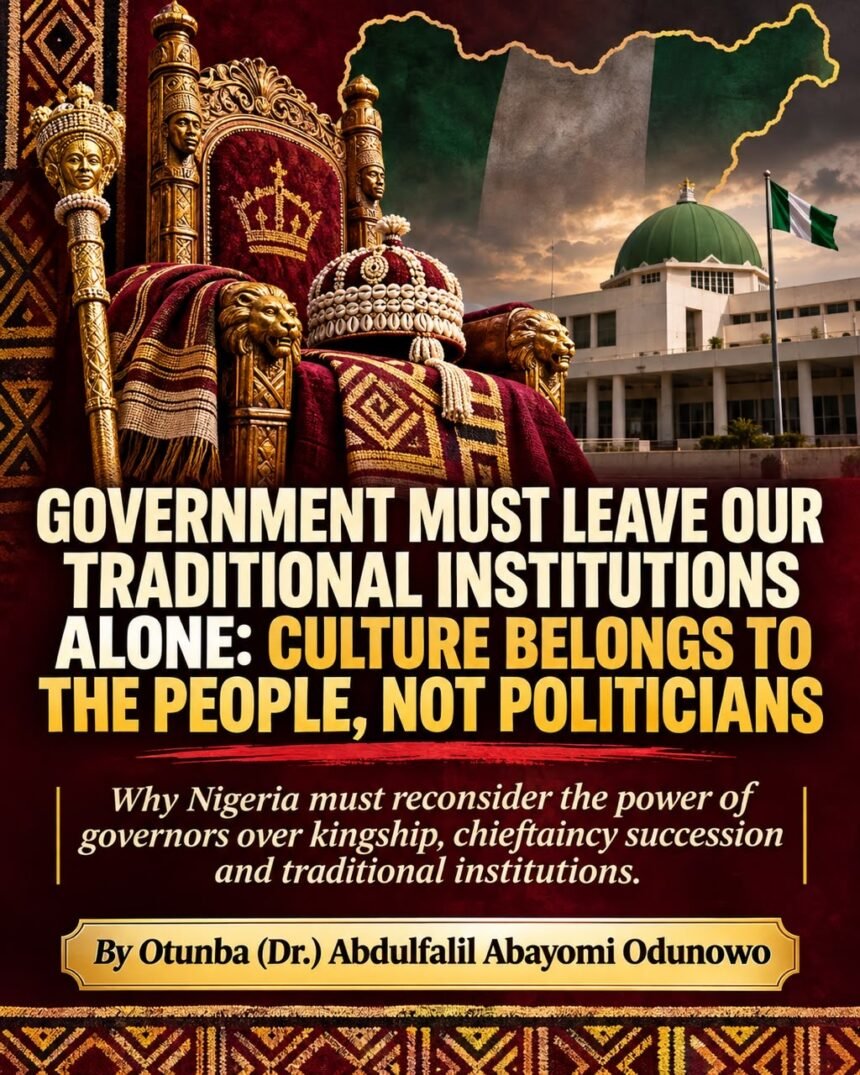
By Otunba (Dr.) Abdulfalil Abayomi Odunowo
Why Nigeria must rethink the power governors wield over kingship, chieftaincy succession and traditional institutions.
Nigeria’s approach to traditional institutions contains a deep contradiction. Under state law, a governor elected for four years, or at most eight, can influence the selection, recognition and, in some cases, removal of traditional rulers whose institutions are centuries old and whose authority may last a lifetime.
That arrangement calls for serious national re-examination.
How can someone whose political mandate is temporary exercise decisive authority over an institution whose legitimacy rests on generations of history, ancestry, custom and the shared identity of a people? This is more than an administrative inconsistency. It raises basic questions about cultural autonomy, institutional legitimacy and the proper limits of political power.
Government should not be the source of a king’s traditional legitimacy. That legitimacy ought to come from the people, their established customs and their recognised traditional institutions.
Two institutions with different responsibilities
The role of government is to provide security, infrastructure, education, healthcare, economic development, justice and public administration. Its authority derives from the Constitution and the democratic mandate of the electorate. Traditional institutions exist for a different reason. They preserve cultural identity, sustain historical continuity, safeguard communal heritage, encourage social cohesion and provide leadership rooted in the customs and traditions of their communities. A governor embodies a political administration. A traditional ruler embodies a people and an institution that ought to outlast political administrations.
A governor may come from the APC, PDP, ADC or any other political party. A king, by contrast, must be able to serve everyone in his community, regardless of political affiliation.
When government exerts excessive control over traditional institutions, it creates the risk that political loyalty, personal ties and partisan calculations will shape decisions that should be governed by established custom. It also places traditional rulers in the troubling position of needing political goodwill to preserve the independence and security of their thrones. That should never be the basis of traditional authority.
A four-year mandate should not shape a lifetime institution
The most disturbing aspect of the current system is the imbalance between the limited tenure of political officeholders and the lasting nature of traditional institutions. A governor may leave office after four or eight years, yet decisions taken within that short period can affect the leadership, stability and cultural direction of a community for decades. A disputed appointment can leave divisions behind long after the governor who made it has left public office.
When succession is politically influenced, it can erode the credibility of an institution whose strength depends on public acceptance and historical legitimacy. The mere fact that government has statutory power to intervene does not mean such intervention is culturally fitting or institutionally wise. What is lawful today can be changed tomorrow if experience shows that the law allows unnecessary political interference. The real issue is not only whether a governor legally may approve a traditional ruler. It is whether that power ought to remain in its current form.
Historical roots of the problem
Pre-colonial Yoruba political systems reflected a different balance. In the Old Oyo Empire, the Alaafin was not an absolute monarch. The Oyomesi, a council of seven hereditary kingmakers led by the Bashorun, chose the Alaafin from eligible royal candidates according to custom. They also had power to depose him by presenting the empty calabash (or a calabash containing parrot’s eggs), a signal requiring the king to take his own life. These checks and balances were internal to the institution and grounded in the community’s own structures, not imposed by an external political ruler with only temporary tenure. Comparable principles of limited monarchy, kingmaker selection and customary accountability existed across many Yoruba polities and other African kingdoms.
Colonial rule disrupted that order. Through indirect rule, British administrators subordinated traditional authorities to colonial governors and used them mainly as instruments of tax collection and local administration. Traditional rulers lost much of their independent authority and became accountable upward to the colonial state rather than primarily to their people and customs. After independence, Nigeria inherited and expanded this model. The 1999 Constitution left traditional institutions without meaningful constitutional protection and treated chieftaincy largely as a residual state matter. As a result, state laws gave governors substantial powers of recognition, approval and, in many instances, deposition.
The effects have been plain. Governors have suspended or deposed traditional rulers over political disagreements or perceived disloyalty. Notable cases include the deposition of the Emir of Gwandu in 2005 and the Emir of Kano, Muhammadu Sanusi II, in March 2020. Similar interventions have occurred in Anambra, Osun, Nasarawa and other places, often leading to prolonged litigation, division within communities and a weakening of the institution’s moral authority. In Kogi and other states, governors have also limited the ability of traditional rulers to create titles or chiefdoms without prior approval, citing security concerns that often conceal deeper efforts at control.
The Awujale succession and the wider national question
The ongoing controversies over the Awujale succession in Ijebuland show why this debate cannot wait. Ogun State’s 2021 Obas and Chiefs Law creates a statutory framework for the selection, appointment and recognition of traditional rulers. The Ogun State Government has defended its interventions by pointing to those legal responsibilities, including the power to nullify processes considered contrary to peace, order and good government. Disputes involving procedure, ruling-house entitlements and administrative councils have already gone to court.
The existence of that legal framework must be recognised. But its existence should not stop citizens from asking whether it truly protects the independence of traditional institutions. The Awujale throne does not belong to any governor, political party or administration. It belongs to the historical institution of Ijebuland, governed by its applicable customs and laws.
The same principle should govern the Alaafin of Oyo, the Ooni of Ife, the Oba of Benin, the Emir of Kano and traditional institutions throughout Nigeria. Our royal institutions must not be turned into extensions of Government Houses. Their cultural legitimacy should not rest on the political preferences of whatever administration happens to be in power.
Evidence from places that have protected traditional institutions
Where traditional institutions enjoy greater independence from short-term political control, both communities and the wider polity often gain.
In Botswana, the pre-colonial kgotla system of village assemblies has been intentionally preserved and incorporated into modern governance. These public forums allow citizens to discuss community matters, hold leaders accountable and settle disputes. Customary courts connected to the kgotla handle most civil cases and many criminal cases—estimates often place the figure at around 80–90 per cent in rural areas. Scholars and observers associate this participatory tradition with Botswana’s relative democratic stability, lower polarisation, high electoral turnout and effective management of mineral wealth.
British colonial rule there was relatively light and left core Tswana institutions largely intact. Independence leaders then integrated those institutions productively into modern governance rather than subordinating them to partisan executives.
In Ghana, Article 270 of the 1992 Constitution expressly guarantees the institution of chieftaincy, together with its traditional councils as established by customary law. The Chieftaincy Act creates a structured system of National and Regional Houses of Chiefs and Traditional Councils. Chiefs administer a substantial share of land, commonly estimated at around 80 per cent under customary tenure, and they play recognised roles in dispute resolution, community development, cultural preservation and local peacebuilding. Although tensions remain and reform is still needed, the constitutional protection and institutional architecture make it harder for any single governor or administration to treat stools as political prizes.
Successive governments have publicly affirmed traditional authorities as indispensable partners in development, security and social cohesion. These examples do not mean traditional institutions are flawless or should stand above the law. They show that when selection, succession and internal affairs remain primarily in the hands of recognised customary authorities, subject to constitutional rights and independent judicial oversight, those institutions retain greater legitimacy, act as more credible mediators and contribute more effectively to social stability and development. Freedom from partisan political control does not create confrontation; it creates more dependable partners.
What Nigeria must change
Nigeria should pursue comprehensive reform of its chieftaincy laws, guided by five core principles.
1. End discretionary political control over traditional succession. The selection and installation of kings should be decided by recognised customary authorities, subject to the Constitution and independent judicial oversight.
2. Establish independent traditional institutions. Traditional councils should have meaningful authority over succession procedures and internal cultural affairs without being controlled by serving politicians.
3. Separate cultural legitimacy from government recognition. Administrative recognition should be a transparent process for verifying lawful succession, not an avenue for governors to impose preferred candidates.
4. Protect traditional rulers against political victimisation. No king should face arbitrary suspension, deposition or intimidation because of political disagreements with a governor. Any disciplinary process must observe due process and provide an independent right of appeal.
5. Make traditional institutions accountable to their communities. Independence from government must not result in unchecked authority for ruling houses, kingmakers or traditional councils. Transparent procedures, community participation and lawful dispute-resolution mechanisms are necessary.
These proposals would require legislative reform, not merely a change in administrative practice. Current Nigerian chieftaincy arrangements assign statutory responsibilities to state authorities, and the courts have recognised the legal significance of those procedures. Reform, therefore, is a matter of deliberate policy choice.
Independence does not mean confrontation
Removing political interference from traditional institutions should not be mistaken for an attempt to encourage conflict between governors and kings. Government and traditional institutions still need to work together on community development, peacebuilding, cultural preservation and security. But cooperation is not subordination, and respect is not political obedience.
A governor should respect the authority of the traditional institution. A king should respect the constitutional authority of government. Neither should try to take over the legitimate responsibilities of the other. Traditional institutions that are genuinely independent would probably become more effective partners in governance because their advice would be less limited by partisan pressures. A king who can speak for his people without fear of political retaliation is able to offer government more credible counsel.
Conclusion: Let government govern and let tradition endure
Nigeria must start recognising that traditional institutions are not political appointments for governors to distribute. They are custodians of history, identity, continuity and the collective heritage of communities. Today’s political administration will eventually become just another chapter in history. Our traditional institutions should still be standing long after that administration has gone.
We cannot keep subjecting institutions built over centuries to the shifting preferences of politicians whose mandates last only a few years. The time has come to rethink the relationship between government and traditional authority, reform the laws that permit excessive political interference and return responsibility for traditional succession to the communities and customary institutions to which it rightly belongs.
Let governors govern. Let communities preserve their traditions. Let kingmakers choose according to established customs. Let the courts uphold the law. And let our kings serve their people without political intimidation or interference. A throne must never become the property of a political administration.
It belongs to history, to tradition and, above all, to the people.
Otunba (Dr.) Abdulfalil Abayomi Odunowo
National Chairman AATSG.
18TH NOVEMBER 2026.