
by Otunba (Dr.) AbdulFalil Abayomi Odunowo
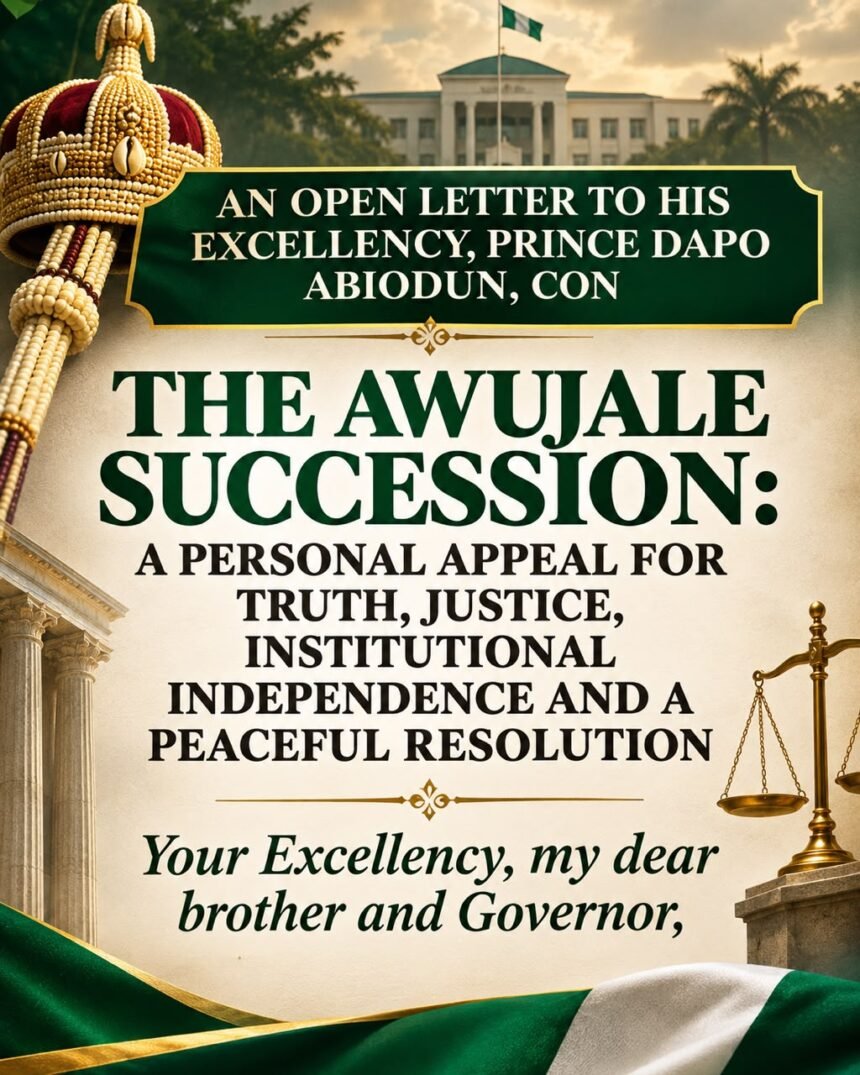
Your Excellency, my dear brother and Governor,
I am writing not only as a son of Ijebuland who cares deeply about the future of our foremost traditional institution, but also as your friend of more than forty years. Our bond has always gone beyond politics or public office. You remain both my leader and my brother, and it is in that spirit of respect and shared duty that I address you publicly on the unresolved dispute over the selection of the next Awujale of Ijebuland.
When I visited your residence in Iperu recently, you spoke candidly about your frustration that advice you had trusted on this issue had led you astray. You also restated your resolve that the final outcome must be lawful, fair, and acceptable to the people of Ijebuland. I have thought carefully about that discussion, and I believe the moment has come to move past competing narratives and institutional tension toward a resolution that is open, credible, and transparent.

The Awujale stool is far too important to be turned into a battleground for personal ambition, bureaucratic rivalry, or avoidable court disputes. What I set out below is not an effort to impose a result, advance any candidate, or take over the traditional responsibilities of those charged with the selection. It is a practical framework that I respectfully place before you for serious consideration.
1. Establish the true status of the suspended succession process
The first responsibility is to determine exactly why the earlier process was suspended and whether the concerns that led to that decision were ever substantiated. Allegations, no matter how serious or how often repeated by influential persons, do not become facts by repetition alone. Where claims of irregularity have been made, they should be investigated fairly, and everyone affected should be given a proper opportunity to respond. If breaches of the law or established procedure are proved, then corrective action should follow. If the allegations remain unproven, they should not be allowed to block lawful nomination and selection rights indefinitely.
I recommend an independent review of the relevant administrative records, nomination documents, complaints, and court orders. If that review finds that the earlier process cannot legally continue, then a fresh process should begin strictly in line with the registered Awujale Chieftaincy Declaration, applicable legislation, and binding judicial decisions. If, however, the earlier process is still legally valid, then the proper course may be to continue from the last lawful stage instead of restarting without necessity. The aim is not simply to restart proceedings, but to ensure that whatever path is followed can survive legal scrutiny and earn public confidence.
2. Introduce an independent royal lineage verification framework
One of the central issues is the authenticity of claims to royal lineage. The Awujale institution is rooted in a shared royal heritage from which the recognised ruling houses emerged. Where ancestry is in dispute, a structured verification process is both desirable and feasible.
I propose an independent Royal Genealogy and Lineage Verification Panel made up of respected Ijebu historians, representatives of the recognised ruling houses, qualified genealogical researchers, appropriately qualified genetic specialists, and independent legal advisers. Its first responsibility should be to develop an agreed documentary and customary framework for identifying the relevant royal lineages.
Where it is scientifically appropriate and voluntarily accepted, DNA testing may be used as supplementary evidence. Living princes such as Prince Ade Adetona and Barrister Adesumbo Adesanya, or other independently verified members of the relevant lineages, could be approached if their participation would supply useful reference information, always subject to prior genealogical and scientific assessment.
I understand that as many as 95 individuals have been connected to the contest, though that number itself needs independent confirmation. Where lineage is genuinely disputed, voluntary testing conducted under a properly designed protocol may be helpful. Even so, biological relationship is not the same as legal entitlement under the Chieftaincy Declaration.
A person may share ancestry yet have no nomination rights; on the other hand, the limits of available reference samples may mean that DNA cannot conclusively prove or disprove a lineage. No aspirant should therefore be automatically disqualified solely because a result is inconclusive, because the person declines a non-mandatory test, or because of an interpretation not supported by qualified experts.
Ultimate eligibility must still be determined by the registered Declaration, established custom, and applicable law. Even so, a properly constituted verification exercise can separate substantiated claims from unsupported assertions and reduce avoidable disputes.
3. Reconstitute the Interregnum Administrative Council on a broadly representative basis
Administering the palace during a vacancy is fundamentally different from selecting the next Awujale. Those two functions must not be confused. Subject to the legal status of the existing Council and any subsisting court orders, I recommend that its present composition be reviewed and, where lawful, reconstituted on a broader, more inclusive, and clearly defined basis.
The Council should include representation from key traditional institutions of Ijebuland, including the Council of Otunbas, the Council of Chiefs, the Regberegbe institutions, and the Council of Obas, whose nominee, I propose, should serve as Chairman, subject to the applicable legal and customary framework. Appointments should be guided by integrity, institutional knowledge, and broad confidence across Ijebuland, and should follow appropriate consultation and conflict-of-interest screening. The intention is not to create a rival traditional authority, but to ensure orderly custodianship until a substantive Awujale is lawfully installed.
4. Completely separate the Administrative Council from the Afobajes
This is the most important institutional safeguard. Under established custom, the registered Declaration, and applicable law, the Afobajes hold a distinct and prescribed role in the selection of the Awujale. The Administrative Council, by contrast, exists only to meet temporary administrative needs during the interregnum. The two may cooperate where necessary, but their membership and decision-making functions must remain separate.
I therefore recommend that no serving prescribed Afobaje should at the same time serve as Chairman, Secretary, or member of the Interregnum Administrative Council. This is not to say that every previous overlapping appointment was necessarily unlawful. It is a preventive measure designed to avoid conflicts of responsibility, protect the independence of the kingmakers, and remove unnecessary grounds for challenging the integrity of the eventual selection. A kingmaker should not be put in a position where administrative involvement in a disputed matter may later call his impartiality into question. This principle should apply equally to all prescribed kingmaking offices. The Afobajes must remain independent, united in their institutional duties, and free from unnecessary entanglement in administrative controversy.
5. Limit the Administrative Council to clearly defined functions
A reconstituted Council should operate under published terms of reference confined to palace administration, the maintenance of buildings and facilities, the preservation of records and assets, the coordination of authorised administrative activities, and communication with relevant authorities. It should not decide who qualifies as a royal candidate, choose nominees, influence the votes of the Afobajes, or assume powers reserved for the ruling house and the prescribed kingmakers. Nor should it claim to exercise the substantive traditional authority of a reigning Awujale. An interregnum is a period of custodianship, not an opening to establish a competing centre of traditional power.
6. Respect the distinct roles of the ruling house and the Afobajes
This succession cannot be settled through administrative convenience. The registered Chieftaincy Declaration remains the foundation for identifying the recognised ruling house, the nomination procedure, and the responsibilities of the prescribed kingmakers. The nomination rights of the Fusengbuwa Ruling House, insofar as they apply to the present vacancy, must be respected. The Afobajes must be allowed to carry out their lawful selection responsibilities independently. Government, for its part, must exercise its own statutory responsibilities within the limits of the law. None of these institutions should take over the role of another. A clear administrative framework distinguishing nomination, eligibility verification, selection, governmental approval, and recognition would prevent any one body from using another as a vehicle of influence.
7. Resolve the administrative controversy without prejudicing the courts
The reported litigation over the reconstitution of the Interregnum Administrative Council, including Suit No. HCJ/201/2026, shows how serious the institutional disagreements have become. I do not seek to prejudge that case, nor do I suggest that any subsisting court order should be ignored. Even so, the dispute over interim palace administration must be carefully distinguished from the separate legal questions relating to the nomination and selection of a substantive Awujale.
Government should obtain a comprehensive legal review of all relevant proceedings, including Suit No. HCJ/180/2025, the reported HCJ/201/2026 proceedings, and any other binding decisions affecting the succession. Where lawful settlement or clarification is available, it should be pursued. Where judicial determination is necessary, the courts must be left to discharge their constitutional role. The purpose is to prevent avoidable administrative disputes from unnecessarily extending the vacancy while fully preserving the rights of all parties.
8. Establish a transparent and time-bound roadmap
Ijebuland deserves clarity. Prolonged uncertainty has deepened anxiety, encouraged speculation, and heightened institutional tension. After the necessary legal review, your administration should publish a practical roadmap identifying the competent authorities for each stage, the relevant legal requirements, the status of previous nominations, the procedure for resolving outstanding eligibility disputes, and a realistic timetable for completing the lawful selection process. Where court orders or other legal constraints affect particular stages, those limitations should be expressly stated. An independent legal and traditional advisory team could monitor compliance without interfering with the powers of the ruling house or the Afobajes. Transparency may not end every disagreement, but it will greatly reduce suspicion and misinformation.
9. Protect the dignity of the Awujale institution above personal interests
The Awujale throne existed long before our present political institutions and will endure beyond the present generation. It belongs neither to the Government of the day nor to any individual chief, administrative council, or aspiring prince. It is a sacred inheritance held in trust for the people of Ijebuland. The late Oba Sikiru Kayode Adetona sat on that throne for decades and left behind an institution whose dignity must be safeguarded. We owe it to his memory, to our ancestors, and to generations yet unborn to ensure that the next Awujale emerges through a process grounded in legality, established custom, fairness, and public confidence.
A succession concluded in haste while unresolved questions remain may create disputes that outlive those who managed it. Yet an unnecessarily prolonged vacancy risks weakening confidence in the very institutions entrusted with preserving our traditional heritage. The proper path is neither reckless haste nor endless delay, but a lawful, transparent, and disciplined resolution.
10. My personal appeal
My dear brother and Leader our friendship of more than forty years gives me the confidence to offer this counsel plainly and without pretence. I do not wish to see you misled, embarrassed, or drawn into controversies that a careful review of the facts and sincere consultation can resolve. A Governor must make decisions on the basis of law, evidence, and the obligations of public office. The frustration you expressed in Iperu persuaded me that you understand how important it is to get this right.
I therefore respectfully urge you to:
* establish the legal and factual basis for the suspension of the earlier process and determine whether it should lawfully resume or begin afresh;
* commission an independent genealogical review, with voluntary and scientifically appropriate DNA testing considered only where it can genuinely assist;
* review and, where legally permissible, reconstitute the Interregnum Administrative Council to reflect broader traditional representation;
* ensure complete separation between membership of the Administrative Council and the prescribed Afobajes;
* publish strict terms of reference limiting the Council to lawful administrative responsibilities;
* protect the independent nomination rights of the appropriate ruling house and the selection responsibilities of the Afobajes; and
* establish a transparent and legally compliant timetable for concluding the succession.
These recommendations are made in good faith and without prejudice to any candidate, ruling house, traditional chief, or party to pending litigation. A process founded on transparency, lawful authority, and institutional independence will give the people of Ijebuland greater confidence in the eventual outcome.
Conclusion: Let history record that we protected the throne
History will remember more than the name of the next Awujale. It will also remember the circumstances of his emergence and whether the institutions of Ijebuland were strengthened or weakened during this critical moment. The duty before us is larger than the installation of one traditional ruler. It is the preservation of the credibility, continuity, and dignity of an institution that embodies centuries of Ijebu identity.
Let the Administrative Council manage the palace within its lawful mandate.
Let the appropriate ruling house exercise its legitimate nomination rights.
Let the Afobajes independently carry out their prescribed selection responsibilities.
Let the courts decide the legal disputes properly brought before them.
And let the Ogun State Government discharge its statutory responsibilities with fairness, restraint, and respect for our traditions.
Above all, no personal ambition, administrative rivalry, or unsubstantiated allegation should be allowed to obstruct a lawful and credible resolution.
I offer these reflections with respect for your office, affection born of our longstanding friendship, and an abiding commitment to the future of Ijebuland. May the Awujale throne emerge from this interregnum not diminished by controversy, but strengthened through justice, integrity, and respect for the institutions that have preserved it across generations.
May wisdom guide every decision, and may peace, unity, and justice prevail throughout Ijebuland.
Otunba (Dr.) AbdulFalil Abayomi Odunowo
14 November 2026