
By Okoi Obono-Obla
For more than a decade, the Bakassi Deep Seaport was a promise on paper. It was conceived in 2014, with an Environmental and Social Impact Assessment developed in March 2015, and then left to gather dust.
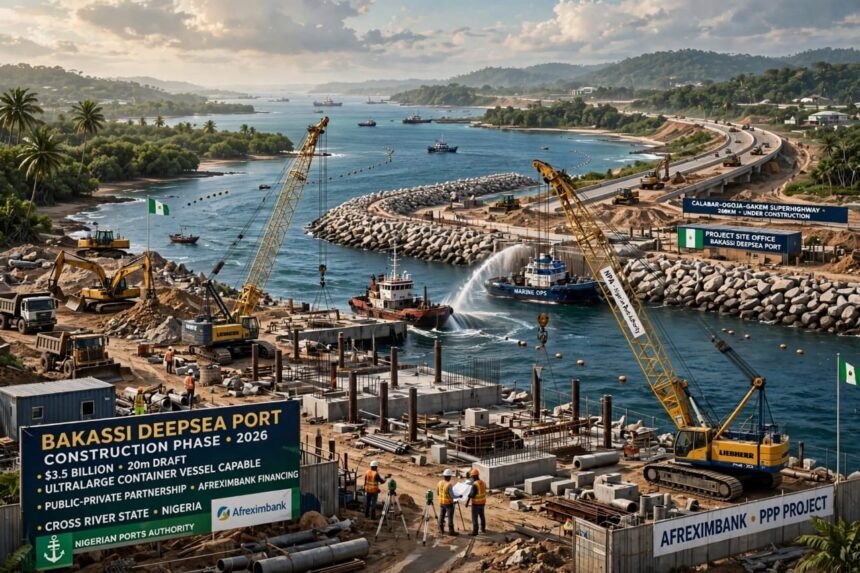
On Friday, 13 November 2026, that long delay ended. President Bola Ahmed Tinubu, represented by Vice-President Kashim Shettima, performed the groundbreaking ceremony in Bakassi. What was once a drawing-board project has now entered the realm of construction.
This did not happen by accident. It happened because Governor Bassey Edet Otu sustained the vision and pushed it towards actualisation. President Tinubu himself commended the Governor and the people of Cross River for doing so. Under Otu, the State completed the preparatory work: an Environmental Impact Assessment, hydrographic, geotechnical and geophysical surveys, and secured the necessary federal approvals. The project is now being delivered through a Public-Private Partnership arrangement, with an initial funding approval of $2.27 billion.

That is what leadership looks like: not noise, not slogans, but the quiet, painstaking work of making a project bankable, approvable and buildable.
What It Means for Cross River State
1. An end to economic isolation
Cross River has lived too long on the margins of Nigeria’s maritime economy. The Bakassi Deep Seaport ends that isolation. It places the State directly on the Gulf of Guinea trade route and gives it a gateway of its own.
2. Jobs, direct and indirect
The President has said the port will create employment for engineers, crane operators, truck drivers, welders, customs officers, hoteliers, market women and others. For Cross River youths, this is not abstract economics. It is work at the quayside, work in logistics, work in construction, work in hospitality, work in trade.
3. A market for what Cross River produces
Shettima specifically mentioned cocoa from Ikom, rice from Ogoja, timber and other minerals. Today, our farmers and producers struggle with distance, cost and middlemen. Tomorrow, with a deep seaport at their doorstep, they will have a shorter route to regional and international markets. Agricultural produce, solid minerals and manufactured goods from Cross River will no longer have to travel hundreds of kilometres to find a ship.
4. Industrialisation and the blue economy
A port is not just a place where ships berth. It is an industrial magnet. Logistics, fishing, shipping, tourism, shipbuilding, warehousing, processing and packaging will cluster around it. The Federal Government has put the potential of Nigeria’s blue economy at $44 billion annually. Cross River, if it plans well, can claim a fair share of that future.
5. Revenue and renewal
A functioning port widens the tax base, grows internally generated revenue, attracts private investment, revives towns around Bakassi, Calabar and the corridor, and gives the State the fiscal room to fund roads, schools, hospitals and security. This is how a State that inherited over ₦204 billion in domestic debt in May 2023 begins to build a different economic story.
What It Means for Nigeria
1. A second maritime gateway
Nigeria has for too long depended overwhelmingly on Lagos ports. The Bakassi project is designed to complement existing ports, improve cargo movement and ease the congestion crippling Nigeria’s ports.
2. Capacity for the biggest ships
The port is designed with a 20-metre draft to accommodate large vessels that currently bypass Nigerian ports. That matters. When big ships bypass you, you pay more for freight, you lose transhipment business, and you remain a feeder market to other countries’ ports. A 20-metre draft changes that equation.
3. An eastern economic corridor
Shettima described the seaport as a strategic national investment that would establish an eastern maritime economic corridor, connecting the South-South, South-East, Middle Belt and North-East to regional and international markets. Linked to a 260-kilometre superhighway, Bakassi will not serve Cross River alone. It will serve a vast hinterland that has waited too long for direct access to the sea.
4. Diversification beyond oil
The President has described the project as a defining milestone in Nigeria’s economic diversification. A country that wants to move beyond oil must build the infrastructure for trade, manufacturing, agriculture and services. A deep seaport is that kind of infrastructure.
5. Stronger standing in the Gulf of Guinea
The project is intended to help Nigeria retain regional cargo, expand international market access and strengthen its maritime competitiveness. In a region where neighbouring countries are racing to build modern ports, Nigeria cannot afford to stand still. Bakassi is Nigeria’s answer.
The Lesson
The opposition will reduce this to politics. Let them.
The people of Cross River know the difference between a project that was talked about and a project that was prepared, approved, funded and flagged off. Governor Otu did not invent the Bakassi dream. He did what previous administrations could not do: he carried it from vision to groundbreaking.
A port does not transform a State overnight. It must be built, managed honestly, connected by road and rail, protected from sabotage and corruption, and integrated into a wider industrial plan. But every great transformation begins with a foundation stone.
On 13 November 2026, that stone was laid in Bakassi.