


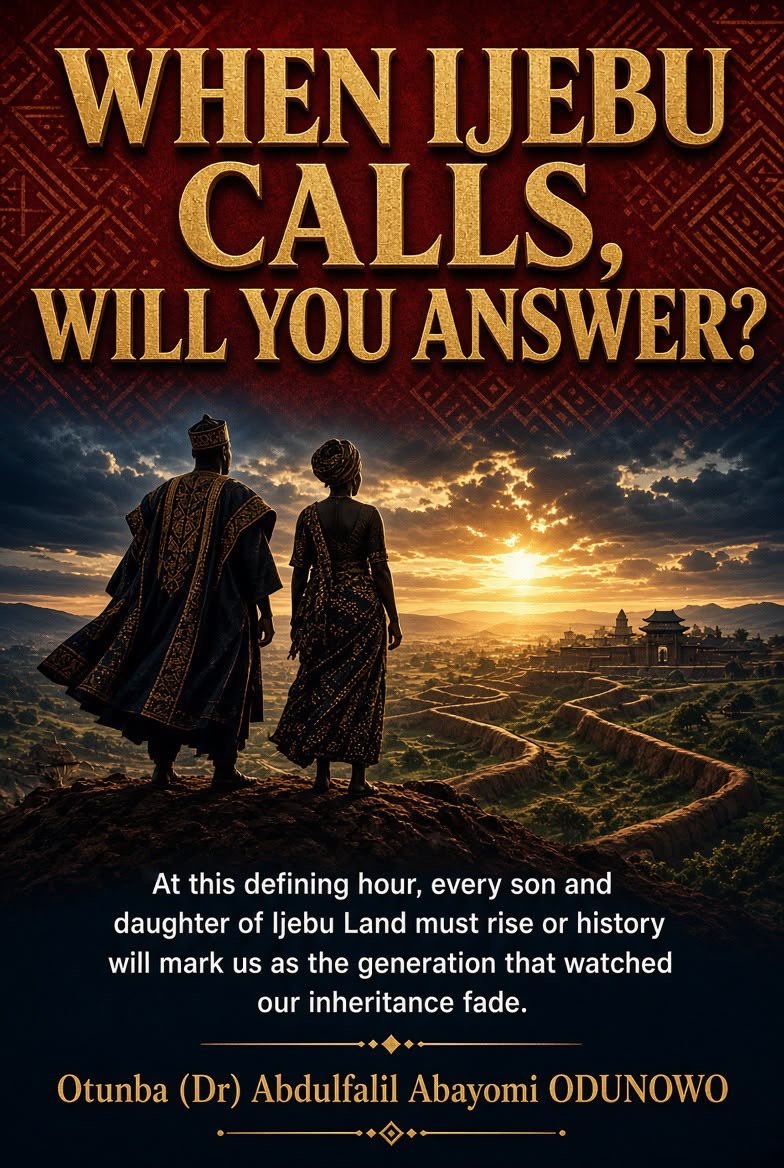
By Otunba (Dr) Abdulfalil Abayomi ODUNOWO
At this defining hour, every son and daughter of Ijebu Land must rise, or history will remember us as the generation that stood by and watched our inheritance slip away.
There comes, in the life of every people, a point when silence stops being neutral. It becomes betrayal. For the children of Ijebu Land, that point is here.
For more than six decades, from the closing days of colonial rule to the birth of modern Nigeria, generations of our fathers and mothers carried one firm, unbroken aspiration: greater political recognition, fairness, and a voice worthy of a people whose history is etched in soil, trade, and resilience. Some invested their influence in it. Others gave up careers, fortunes, and peace. Many who carried that dream have now gone to their ancestors. They placed the baton in our hands.

And now history asks, in a voice that won’t be silenced: When Ijebu called, did you answer?
This is not just another election. It isn’t the ambition of one man, one party, or one faction. It’s about whether a people who built one of West Africa’s earliest organised kingdoms, who for centuries controlled the vital trade routes between the Lagos Lagoon and the Yoruba interior, who raised Sungbo’s Eredo, those vast earthen fortifications counted among the largest man-made structures on the African continent, are ready to organise, peacefully and democratically, to claim their rightful place.
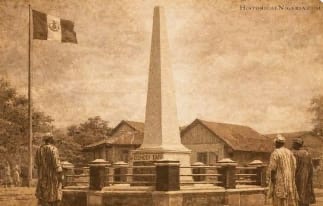
The British conquest of 1892 ended our commercial monopoly, but it didn’t erase who we are. Ijebu Province stood among the colonial provinces of the 1920s. Of those roughly twenty to twenty-four old provinces, Ijebu remains the only one still denied statehood. That’s not opinion. That’s the historical record. Equity demands that this chapter be brought to a close.
THIS MUST BE BIGGER THAN PARTY
We will belong to different parties. We will support different candidates. We will debate policy. That’s democracy. Still, there are seasons when the soil that formed us must matter more than the labels that separate us. Ijebu must become the common ground, the non-negotiable centre.
We seek no injustice against any other community. We do not ask that another people be reduced so we may rise. Our claim is simpler, and frankly stronger: equity must matter.
Fairness must matter. History must matter. And Ijebu, whose sons and daughters have given Nigeria governors, senators, industrialists, educators, and the longest-reigning first-class monarch of the modern era, must matter.
YOUR TEN PEOPLE CAN CHANGE HISTORY
Political power isn’t manufactured in air-conditioned conference rooms. It’s built in living rooms, on verandas, in markets, in WhatsApp groups, and at polling units. So the call is plain and urgent:
Activate your circle.
Identify at least ten people, family, schoolmates, colleagues, neighbours, church or mosque members, people in your ward and polling unit. Speak with them. Tell them the story of a kingdom that once regulated trade across the region, that produced early secondary institutions such as Ijebu Ode Grammar School in 1913, that has contributed disproportionately to commerce, education, and public service. Tell them that of all the old provinces, only ours is still waiting. Encourage peaceful participation.
Then ask each of those ten to reach another ten.
One becomes ten.
Ten become one hundred.
One hundred become one thousand.
Thousands become tens of thousands.
And just like that, a private conversation becomes the unmistakable voice of a people.
This is how democratic power is built, not with hatred, not with violence, not with intimidation, but through organisation, persuasion, and the ballot.
BEING IJEBU MUST MEAN SOMETHING
Our heritage cannot stay boxed up in names, festivals, aso-oke, and Ojude Oba. Sometimes heritage demands responsibility. This is one of those moments.
To our elders: lend this cause the weight of your wisdom.
To our traditional and community leaders: call for unity and peaceful civic engagement.
To our professionals and business people: put your networks and organisational strength in service of equity.
To our women: stir the communities that have always drawn courage from your resolve.
To our youth: turn your energy and digital reach toward constructive participation.
To our sons and daughters in the diaspora: distance does not erase duty. Activate your families and friends at home.
And to every ordinary Ijebu man and woman: never think you’re too small to matter. Your circle matters. Your voice matters. Your vote matters. Your polling unit matters.
HISTORY WILL RECORD WHAT WE DO
A generation from now, our children will ask what happened when Ijebu stood at this crossroads.
They will ask: Where were you? Did you speak? Did you organise? Did you participate? Or did you simply watch?
May our answer be clear and proud:
“When Ijebu called, I answered.
When my generation was asked to stand,
I stood.
I activated my circle.
I mobilised my ten.
I defended equity without bitterness.
I participated.
I was counted.”
Our fathers began the journey. Our mothers kept the dream alive through decades of struggle. Others carried the torch through colonial rule, independence, and the long seasons of military and civilian government. We must not be the generation that lets that flame go out.
From our towns to our villages, from our streets to our wards, from our communities to every polling unit, let a new consciousness rise, not against any other people, but for Ijebu; not with hatred, but with conviction; not through violence, but through democratic participation; not as scattered individuals, but as one people with one voice and a shared determination to secure a fair place in our collective political future.
IJEBU, THE TIME IS NOW.
ACTIVATE YOUR CIRCLE.
MOBILISE YOUR TEN.
STAND UP AND BE COUNTED.
ONE PEOPLE. ONE VOICE. SHARED PROGRESS.
Otunba (Dr.) Abdulfalil Abayomi Odunowo
Convener
Ijebu Lokan fun Itesiwaju Ijebu Movement












The point about silence no longer being neutral gives the appeal its real weight. A call to protect an inheritance becomes more actionable when people can see the specific forms of participation available to them: learning the issues, joining local conversations, preserving community history, or supporting accountable civic efforts. Framing responsibility this way may help turn concern into sustained action rather than a momentary response.
When drafting in a language other than one’s own, counting alone is rarely enough. A useful editor should also make sentence length, repetition, and keyword concentration visible before those details turn into a harder revision later. Contador de Palabras presents an interesting writing-oriented approach because it combines basic limits with signals that can support clearer Spanish copy. The key is to treat readability and keyword density as prompts for review, not as rigid targets: a shorter sentence is not automatically clearer, and repeated terms may be necessary when precision matters. That distinction keeps automated text checks useful without letting them flatten a writer’s voice.
A missing song title can make even a familiar tune surprisingly hard to track down, especially when there are no usable lyrics. find a song by humming gives people a practical starting point: capture the clearest short musical phrase available, then compare the returned candidates against the rhythm and melody they remember. Treating recognition as a narrowing tool is useful because similar melodies, background noise, and incomplete clips can all affect the match.
The piece frames silence as a choice with consequences, then turns that idea into a direct appeal to Ijebu sons and daughters. Its strongest question is practical: what forms of participation can protect an inheritance without reducing the conversation to slogans? Accountability matters here, because a defining hour calls for citizens to examine both public leadership and their own responsibilities to the community.
Small punctuation choices can quietly improve how readers scan a page. A middle dot works well as a compact separator between short labels, dates, or categories, while a larger circular mark can establish list hierarchy. Keeping a reference for visually similar characters is useful because fonts and platforms do not always render them identically. Clear naming also helps writers choose symbols intentionally instead of relying on whatever a keyboard happens to offer.
Japanese text limits are not always interchangeable. A character limit answers one question, while UTF-8 and Shift_JIS byte totals can matter for exports or older systems; paragraph and line counts help assess the page’s visual density. A 文字数カウンター that updates these values together makes it easier to spot which constraint needs editing before shortening text blindly. Keeping the draft in the browser also avoids uploading its contents for a routine check.
A clear tattoo brief can reduce avoidable back-and-forth without turning the consultation into a rigid specification. It helps to note the intended body area, approximate dimensions, preferred mood, essential symbols, and elements to avoid. Reference images are more useful when each one is labeled for what it contributes, such as texture, framing, or line quality. That gives the artist a readable set of priorities and makes revisions easier to discuss.
Copying a character is quick, but the surrounding format often determines whether it remains correct. A page focused on copy approximately symbol can be more useful when it also clarifies the difference between a displayed glyph and the underlying character encoding. Readers working across plain text, HTML, stylesheets, and code editors benefit from knowing which representation belongs in each setting. That guidance turns a simple lookup into a dependable writing and publishing check.
A useful study routine is to start with short words, check the character groups that cause confusion, then replay the same sequence at a comfortable speed. The ability to move between written characters and signals makes corrections much easier to understand. A morse code translator that also offers audio, copying, and saved files can support both quick checks and more deliberate practice without turning a simple exercise into a complicated setup.