


Compiled by Bolaji Aluko Ph.d
September 2026
AI Mediated
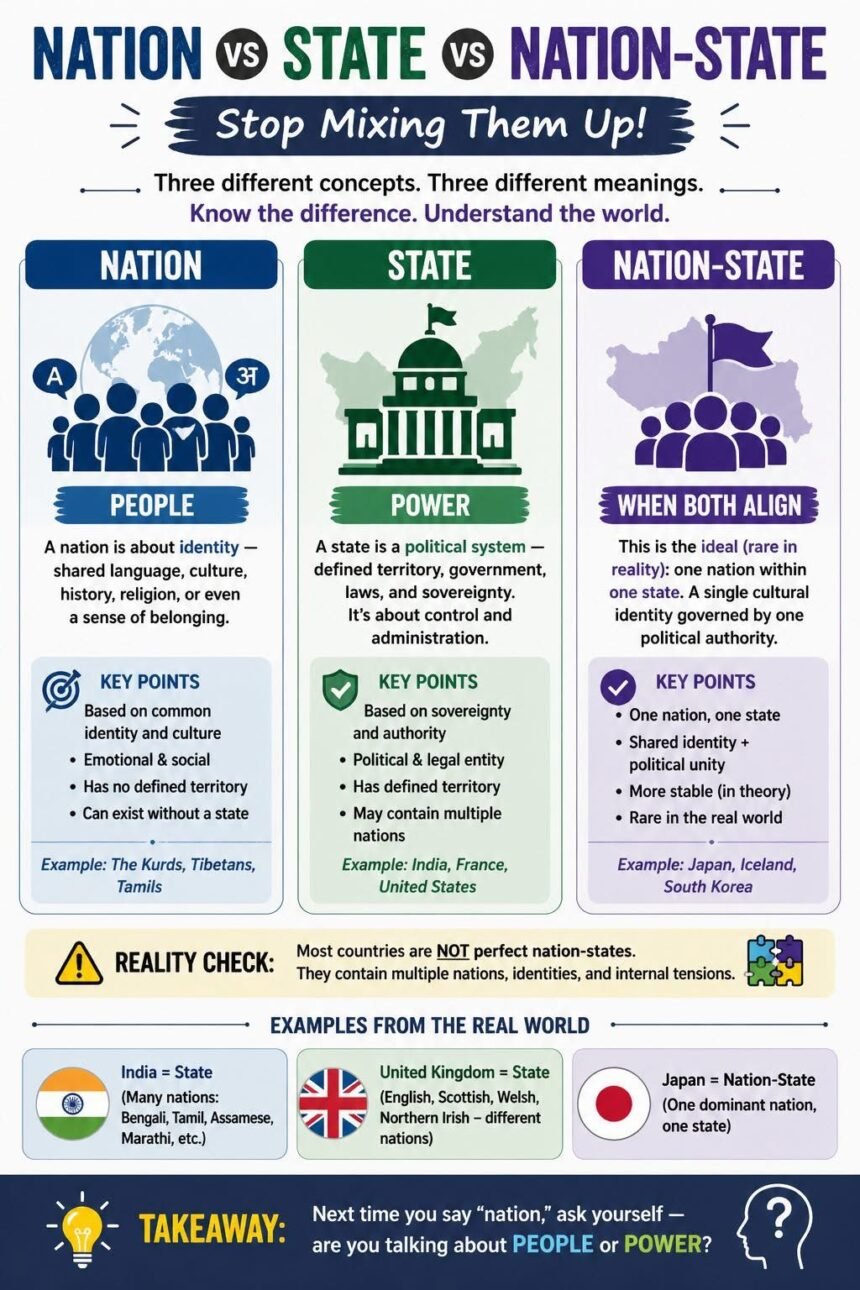
A country is a distinct geographic territory, a state is a political and legal entity with a government and sovereignty over that territory, and a nation is a socio-cultural group of people connected by shared history, language, or culture. [1, 2, 3]

Country
Definition: A distinct physical and geographic region of land.
Focus: The land and its borders.
Example: Canada or Nigeria. [3]
State
Definition: A centralized political organization with a permanent population, defined territory, a governing apparatus, and sovereignty (supreme power and independence).
Focus: Government, laws, and power.
Example: The United States functions as a sovereign state. [2, 4, 5, 6, 7]
Nation
Definition: A large group of people bound together by common identity, language, history, or ethnicity, regardless of whether they have their own government or borders.
Focus: People and shared culture.
Example: The Kurds are a nation without a sovereign state of their own. [1, 6, 8, 9]
When a cultural nation aligns cleanly with a sovereign state, it is called a nation-state (such as Japan). [5, 9]
[1] https://www.youtube.com
[2] https://www.facebook.com
[3] https://www.quora.com
[4] https://www.reddit.com
[5] https://www.thoughtco.com
[6] https://www.youtube.com
[7] https://artsci.usu.edu
[8] https://brainly.in
[9] https://unacademy.com
England, Wales, and Scotland are called countries due to history and tradition, but they are not states because they lack sovereignty. [1, 2]
In international law and politics, there is only one sovereign state here: The United Kingdom of Great Britain and Northern Ireland (UK). [3, 4]
The setup works this way for several key reasons:
1. They lack Sovereignty
To be a sovereign state on the world stage, an entity must have the ultimate, independent authority to govern itself, issue passports, manage its own military, and conduct its own foreign policy. [2]
England, Scotland, and Wales do not have individual seats at the United Nations.
They cannot sign international treaties or open independent foreign embassies.
All of that supreme legal power belongs exclusively to the UK central government in London. [2, 3, 5]
2. They were Independent Nations First
Historically, England and Scotland were entirely independent kingdoms with their own monarchs and laws. Wales was a distinct principality. They were joined together through political unions over centuries (such as the Acts of Union 1707 between England and Scotland). Because they spent centuries as distinct nations, they retained their cultural identities and geographic names as “countries” within the new single state. [1, 6, 7, 8, 9, 10]
3. The UK is a “Unitary” State, Not a Federation
Unlike the United States or Nigeria, where power is divided between a federal government and individual states by a constitution, the UK is a unitary state. [1, 11]
In a federation, the states have constitutional rights to exist and govern that the federal government cannot easily take away.
In the UK, the central Parliament in London holds all original power.
Through a process called devolution, London granted Scotland and Wales their own regional parliaments to manage local issues (like education and healthcare). However, because this power is handed down from the center, London technically retains the supreme legal authority. [3, 11, 12, 13, 14]
Summary of the UK Structure
Entity Political Status Has Sovereignty?
United Kingdom Sovereign State Yes — Represented globally.
England Constituent Country No — Governed directly by the UK Parliament.
Scotland Constituent Country No — Has a devolved parliament but answers to the UK.
Wales Constituent Country No — Has a devolved parliament but answers to the UK.
(Note: Northern Ireland is the fourth part of the UK, and is variously described as a country, province, or region). [3, 11]
The relationship within the UK has seen major developments recently, including a joint push for self-determination by leaders in Scotland, Wales, and Northern Ireland.
[1] https://www.reddit.com
[2] https://medium.com
[3] https://www.quora.com
[4] https://www.facebook.com
[5] https://www.facebook.com
[6] https://en.wikipedia.org
[7] https://www.quora.com
[8] https://www.britannica.com
[9] https://study.com
[10] https://evanevanstours.com
[11] https://en.wikipedia.org
[12] https://www.reddit.com
[13] https://abcnews.com
[14] https://abcnews.com
Whither Scotland, Wales, (Northern) Ireland, England?
The tension between the UK central government and its constituent nations has escalated into a major historical milestone. For the first time since devolution began, Scotland, Wales, and Northern Ireland are all led by First Ministers who want to break away from the UK. [1, 2]
The three leaders signed a landmark document known as the Cardiff Agreement (or the Cardiff Declaration), declaring that “Westminster’s time is coming to an end” and demanding the right to democratic self-determination. [1, 3, 4]
The specific drivers, details, and legal mechanisms behind the devolution and independence movements across the nations break down as follows:
1.Scotland: The Push for a Second Referendum
The Background:
Scotland held an official independence referendum in 2014, voting 55% to 45% to remain in the UK. However, the Scottish National Party (SNP) argues that the UK’s subsequent exit from the European Union (Brexit)—which Scotland overwhelmingly voted against—fundamentally changed the political landscape. [5]
Current Status:
First Minister John Swinney is pushing to hold a second independence referendum by 2031. Current opinion polling shows Scottish support for independence hovering very close to a tight split, with some recent polls indicating a tiny majority (around 47% to 50%) in favor. [5, 6, 7, 8, 9]
The Legal Block:
The UK Supreme Court ruled that the Scottish Parliament cannot legally hold an independence vote without authorization from the central UK government in London. UK Prime Minister Andy Burnham has continually maintained that a second referendum is “off limits”. [5, 10]
2.Wales: Rising Autonomy and “Fairness”
The Background:
Historically, Wales has had a quieter independence movement than Scotland, traditionally focusing more on securing greater localized powers (devolution) over things like health and education. [11, 12]
Current Status:
Under First Minister Rhun ap Iorwerth (leader of the nationalist party Plaid Cymru), Welsh independence sentiment has steadily risen, with polling now showing 32% support. [2, 6, 13]
The Strategy:
Unlike Scotland, Wales is not demanding an immediate independence vote. Instead, they are demanding a fundamental redesign of the UK’s framework. Wales wants a massive injection of devolved powers from London—such as matching the specific legislative and financial flexibilities that Scotland already possesses—to fix what they view as an unfair funding model. [1, 4, 7, 14]
3. Northern Ireland: The Irish Unification Debate
The Background:
Unlike Scotland and Wales, Northern Ireland’s path to leaving the UK is explicitly outlined in international law via the 1998 Good Friday Agreement. It dictates that if a clear majority of the population appears to want a united Ireland, the UK government is legally required to hold a “border poll” (a referendum on reunification).
Current Status: Led by First Minister Michelle O’Neill of the Irish nationalist party Sinn Féin, the momentum toward leaving the UK to merge with the Republic of Ireland has intensified. Sinn Féin leadership expects a reunification poll to take place by 2030. Polling currently tracks support for a united Ireland at around 36%. The movement also received an unexpected spotlight following public comments from US President Donald Trump expressing his support for a united Ireland. [2, 3, 6, 13, 15]
What is “Self-Devolution” vs. Independence?
It helps to view the goals of these nations as a spectrum of autonomy:
Devolution (More Local Control):
Keeping the UK together, but stripping Westminster of its domestic powers. The constituent nations want total authority over their own taxes, courts, policing, and internal economies, leaving London in charge of only macro-issues like national defense and foreign embassies.
Independence (Full Sovereignty): Completely dissolving the political union. Scotland, Wales, or a unified Ireland would become entirely independent, sovereign states with their own seats at the United Nations, their own militaries, and the power to rejoin the European Union independently. [12, 15, 16]
[1] https://www.bbc.com
[2] https://www.aa.com.tr
[3] https://www.aa.com.tr
[4] https://punchng.com
[5] https://www.bbc.com
[6] https://www.aljazeera.com
[7] https://www.bbc.co.uk
[8] https://www.bbc.co.uk
[9] https://www.bbc.com
[10] https://www.bbc.com
[11] https://en.wikipedia.org
[12] https://www.iiea.com
[13] https://www.theguardian.com
[14] https://www.bbc.co.uk
[15] https://www.aljazeera.com
[16] https://newseu.cgtn.com












The distinction is especially helpful because these terms are often used as if they were interchangeable. A country describes territory, while a state concerns the political and legal structure that governs it; a nation instead points to a community shaped by shared culture, language, or history. Keeping sovereignty separate from cultural identity also makes discussions of multinational states and stateless nations clearer.