


By Otunba (Dr.) Abdulfalil Abayomi Odunowo
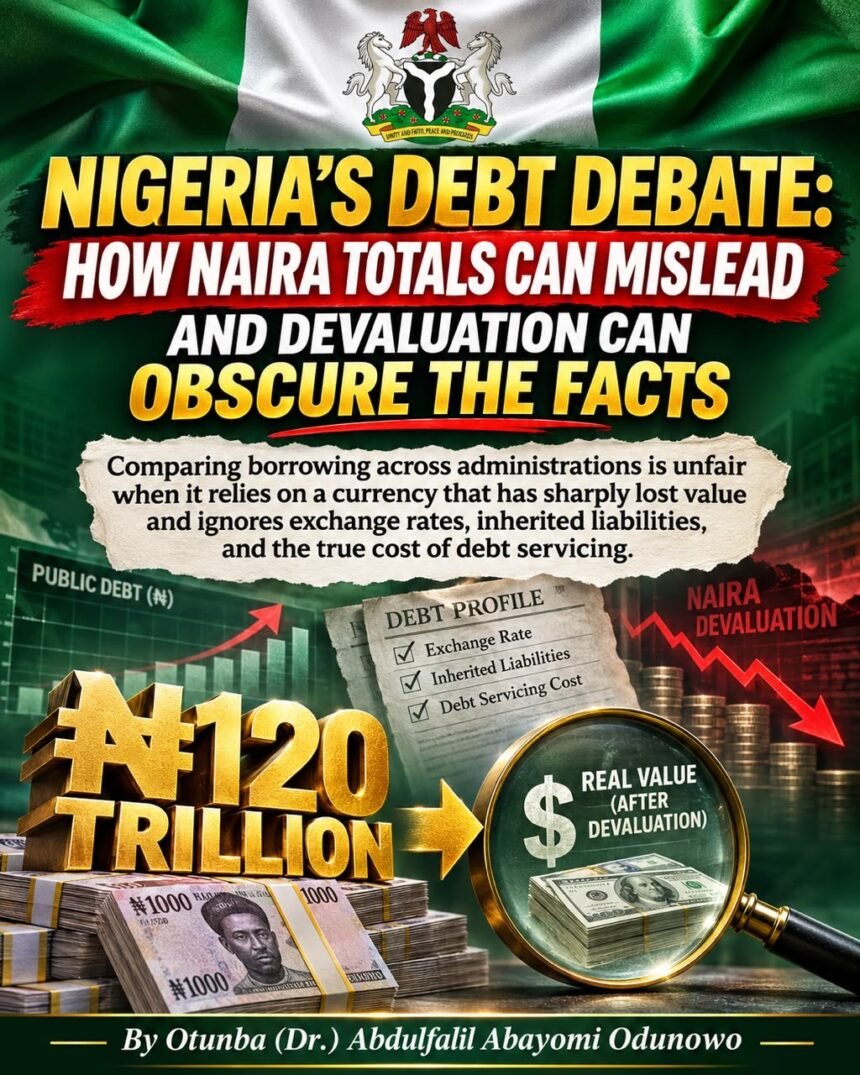
Comparing borrowing across administrations is unfair when it relies on a currency that has sharply lost value and ignores exchange rates, inherited liabilities, and the true cost of debt servicing.
A troubling pattern has emerged in Nigeria’s public conversation: huge naira figures are being thrown around without the context needed to interpret them properly. One widely shared graphic asserted that 16 Nigerian leaders borrowed ₦46 trillion over 63 years, while President Bola Ahmed Tinubu borrowed ₦120 trillion in only three years, despite removing petroleum subsidies. On the surface, that comparison appears damning. It suggests that one administration borrowed nearly three times as much as all earlier governments combined over more than six decades. The available evidence does not justify that claim.
The issue is not simply that the numbers are large. The deeper problem is the failure to separate outstanding debt stock from fresh borrowing, inherited obligations, and the effects of currency depreciation. When the value of the measuring unit shifts dramatically, comparing raw naira figures stops being sound economic analysis and becomes political misinformation.

The ₦46 Trillion Question
Debt Management Office data show that Nigeria’s total public debt stood at about ₦46.25 trillion, or $103.11 billion, as of 31 December 2022. That amount represented the outstanding stock of domestic and external debt owed by the Federal Government, the 36 states, and the Federal Capital Territory. It did not represent the cumulative total of everything all Nigerian governments had borrowed since 1960.
Over time, different administrations borrowed, repaid, refinanced, obtained debt relief, and added new liabilities. A debt stock recorded on a single date cannot be presented as the total historical flow of all borrowing. Treating it that way is a fundamental analytical mistake.
₦46 Trillion Then, ₦120 Trillion Now: What Do Those Figures Actually Mean?
At the end of 2022, ₦46.25 trillion was worth about $103.11 billion. By 30 October 2026, the official exchange rate was approximately ₦1,346 to the dollar. At that rate, ₦120 trillion amounts to roughly $89.15 billion, which is lower in dollar terms than the 2022 debt stock. This does not mean borrowing has fallen, nor does it prove that ₦120 trillion was the amount newly borrowed by the Tinubu administration. It shows something more basic: during periods of steep currency depreciation, a standalone naira figure is a poor basis for comparing different periods. The worth of the money is as important as the nominal amount attached to it.
What the Official Records Actually Indicate
A more accurate picture comes from successive DMO reports. Total public debt was approximately ₦87.38 trillion ($113.42 billion) as of 30 June 2023. By 30 June 2026, it had risen to ₦166.79 trillion ($120.93 billion).
Measured in naira, the debt stock increased by around ₦79.41 trillion, or about 91 per cent. Measured in dollars, using the exchange rates on the respective reporting dates, it increased by only about $7.51 billion, or 6.6 per cent.
Those two measurements tell different stories. On their own, neither one shows precisely how much new money was borrowed. The dollar value of naira-denominated debt can decline when the currency weakens, even if the government still owes the same amount in local currency. Any serious economic assessment requires both views.
The ₦22.7 Trillion Inheritance
A significant share of the initial increase after May 2023 did not come from new borrowing by the current administration. Before Tinubu took office, the Federal Government had built up substantial Ways and Means advances from the Central Bank. In May 2023, the National Assembly approved the securitisation of about ₦22.7 trillion of those obligations. Their formal inclusion in the published debt stock, as the DMO expressly noted, explained a large portion of the increase recorded between March and June 2023.
Inherited liabilities do not remove the present government’s responsibility to borrow carefully and ensure that new debt delivers measurable returns. They do, however, make honest accounting essential.
Devaluation Is Not the Same as New Borrowing
Take a simple example. If Nigeria owes $10 billion, that liability appears as ₦4.5 trillion at an exchange rate of ₦450 to the dollar. If the naira falls to ₦1,350, that same $10 billion becomes ₦13.5 trillion. The naira value has tripled, but Nigeria has not borrowed an extra dollar.
This exchange-rate revaluation effect becomes especially pronounced when a country holds substantial foreign-currency debt during a period of rapid depreciation. At the same time, a weaker naira raises the local-currency cost of servicing external debt. The right approach, then, is to distinguish revaluation effects from fresh borrowing while also acknowledging the real fiscal pressure created by both.
Subsidy Removal Does Not Automatically Eliminate Deficits
The claim that the administration removed subsidies and still borrowed heavily carries political force, but it is analytically incomplete. Removing the petrol subsidy was meant to reduce a major fiscal burden. On its own, however, that step does not erase the budget deficit. Debt-service obligations, personnel costs, security spending, infrastructure, social programmes, and statutory transfers still remain.
The real questions are empirical: how much extra revenue has the Federation actually gained from subsidy removal? How has that revenue been used? What measurable improvements have followed in infrastructure, health, education, or productive capacity? These questions require audited figures and verifiable results, not slogan-driven arithmetic.
Judging Debt by Purpose and Capacity, Not by Size Alone
Borrowing for electricity, rail, agriculture, or industrial capacity can create assets that support future growth, provided projects are properly selected, transparently executed, and capable of generating sufficient returns. Borrowing that simply sustains inefficient spending shifts today’s obligations onto future taxpayers.
Meaningful indicators include how much of government revenue is absorbed by debt service, the debt’s currency mix and maturity structure, and the economy’s ability to generate the resources required for repayment. Neither the total naira figure nor its dollar equivalent is enough by itself.
Accountability Without Distortion
Those who back the current reforms should be the first to demand accurate statistics. Misleading comparisons should be rejected whether they help or hurt any administration. At the same time, the government needs to explain the pace of fresh borrowing, how the funds have been used, the weight of debt service, and the outcomes achieved.
Inherited problems should be acknowledged. But they cannot serve forever as a blanket explanation for every later result. In the end, governance is judged by outcomes.
Nigeria needs a clear, independently verifiable account of its debt position: what was inherited, what was newly borrowed, what resulted from exchange-rate movements, what has been repaid, and what productive assets have been created. Large naira figures presented without context cannot replace that accounting.
The central questions are not how many trillions appear in the debt tables, but what Nigeria owes, why it owes it, what the borrowed funds have produced, and whether the country is becoming better able to meet its obligations.
Let the debt debate be driven by evidence, context, and economic truth, not sensational arithmetic.
Otunba (Dr.) Abdulfalil Abayomi Odunowo
National Chairman AATSG
Public Affairs Commentator | Development Advocate
Verification notes
* 31 Dec 2022: ₦46.25 trillion ($103.11 billion) — DMO
* 30 June 2023: ₦87.38 trillion ($113.42 billion), including securitised Ways and Means — DMO
* 30 June 2026: ₦166.79 trillion ($120.93 billion) — DMO
* 30 Oct 2026 official rate: approximately ₦1,346 per dollar — CBN