By Okoi Obono-obla
Former Vice President and African Democratic Congress (ADC) presidential candidate Atiku Abubakar has not said he will step down. Reports on November 23, 2026, show that he and his aides rejected claims that he is withdrawing from the 2027 presidential race.
Atiku was categorical: “I do not need anyone to step down for me, and I am stepping down for no one.” His Director of Strategic Communication, Phrank Shaibu, described the withdrawal claim as a brazen, malicious and desperate falsehood. “I have not made such a decision. I am in this race to win,” Atiku said.
That denial did not occur in a vacuum. On November 5, the Federal High Court in Abuja, presided over by Justice Peter Lifu, nullified the David Mark-led leadership of the ADC and invalidated the processes that produced Atiku as its presidential candidate. Atiku is therefore fighting on two fronts at once: in court to save his candidacy, and in the public arena to save the perception that he remains a contender.
On the other hand, Peter Obi, the presidential candidate of the Nigeria Democratic Congress (NDC), has found himself explaining, rather than attacking, the conduct of supporters of his running mate, Rabiu Musa Kwankwaso.
Contrary to the impression created in some commentary, Obi did not allege that the Kwankwasiyya movement is responsible for a violent disposition among NDC supporters. He defended the movement. He said its supporters have a long-standing tradition of carrying sticks, and sometimes cutlasses, to political gatherings, but that he has never witnessed those items being used to attack anyone. He insisted that carrying sticks should not automatically be interpreted as evidence of violent intent.
He made that defence while condoling with the families of victims killed in the attack on the campaign team of Ovie Omo-Agege in Delta State, a context that made his remarks both sensitive and politically delicate.
This is not the first time Obi and Kwankwaso have disagreed. Both have taken sharply divided positions on the policy thrust of state police and fuel subsidy.
On state police, Obi supports its creation but wants implementation delayed until after the 2027 general election, because of concerns over possible political abuse by governors. Kwankwaso opposes state police outright, arguing that Nigeria should instead strengthen the federal security system. He fears governors would become emperors with private armies.
On fuel subsidy, the divergence is even starker. Obi insists that subsidy must not return, describing its return as bringing back leprosy. He maintains that removal was necessary, although he has criticised the management of the proceeds. Kwankwaso counters that subsidy must return in a modified form, warning that you cannot remove the roof in the rainy season and ask the tenant to smile.
These are not minor differences of emphasis. They go to the heart of federalism, security architecture, and economic philosophy.
Inter-party and intra-party spats
The disagreements are not confined to the NDC ticket. They cut across the opposition.
Atiku of the ADC and Seyi Makinde of the Allied Peoples Movement (APM) have both refused to step down for any candidate. The Coalition for Democracy, comprising opposition parties and factions, had scheduled its second summit for November 23 to discuss a possible consensus candidate. That meeting was postponed to November 30, reportedly because there is no consensus on the push for a consensus presidential candidate.
In other words, less than two months to the election, the opposition has not agreed on whether it will present one candidate, who that candidate will be, or even what that candidate will stand for on state police and subsidy.
Is this a recipe for disorder?
The question must be asked plainly: Are these major disagreements and public spats between major opposition figures, both inter-party and intra-party, not a recipe for disorder in the opposition camp, barely 51 days to the presidential and National Assembly elections? Do they not amply demonstrate that the opposition is in disarray?
The presidential and National Assembly elections will hold on Saturday, January 16, 2027. From today, November 26, 2026, that is 51 days away, not less than 50, but the point remains: time is almost gone.
An opposition that cannot agree on its candidate, cannot agree on its manifesto, and cannot present a coherent message on security and the economy, invites a legitimate question from voters: if you cannot organise yourselves, how will you organise Nigeria?
Nigerians are already exasperated by centripetal and centrifugal pulls: insecurity, economic hardship, ethnic and regional tensions, and a deep distrust of the political class. Will such Nigerians trust a disorderly opposition and take the risk of voting for it?
That is the central political question of this election.
A note of balance
Disagreement, by itself, is not disarray. Democracy thrives on debate. A presidential candidate and his running mate are entitled to hold different views, provided the ticket ultimately adopts a common programme. Likewise, rival opposition candidates are entitled to refuse to step down. No one has a divine right to a consensus.
But there is a difference between healthy debate and incoherence. Healthy debate produces a decision. Incoherence produces contradiction on the campaign trail, confusion among supporters, and ammunition for opponents.
The opposition still has a narrow window. The November 30 summit is its opportunity to show discipline: agree on a common minimum programme, agree on whether there will be a consensus candidate, and agree on how to conduct campaigns without violence or the appearance of violence.
If it fails, the conclusion many voters will draw may be harsh but understandable: that the opposition is not ready to govern because it is not yet ready to agree.
If it succeeds, the same disagreements that now look like disarray may be recast as the growing pains of a coalition learning to accommodate diversity.
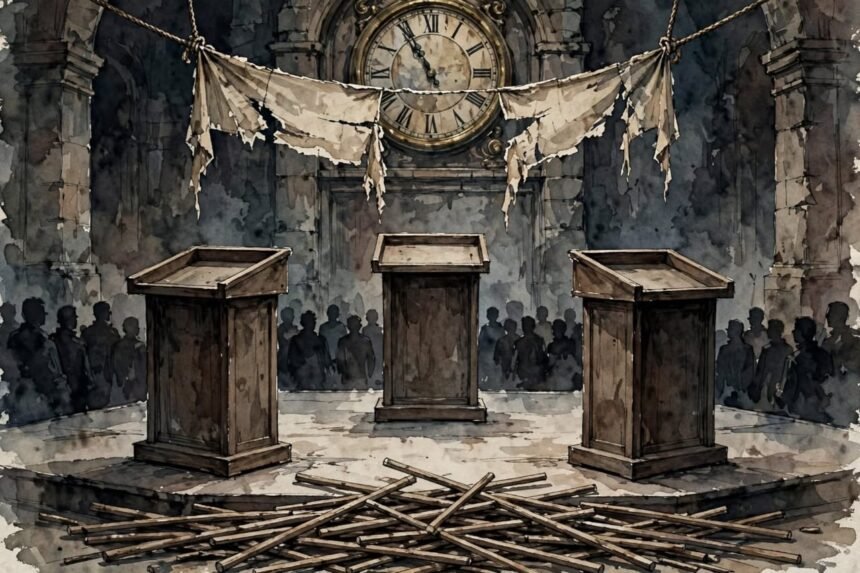
The clock, however, is no longer forgiving.