by Emmanuel Adegbite
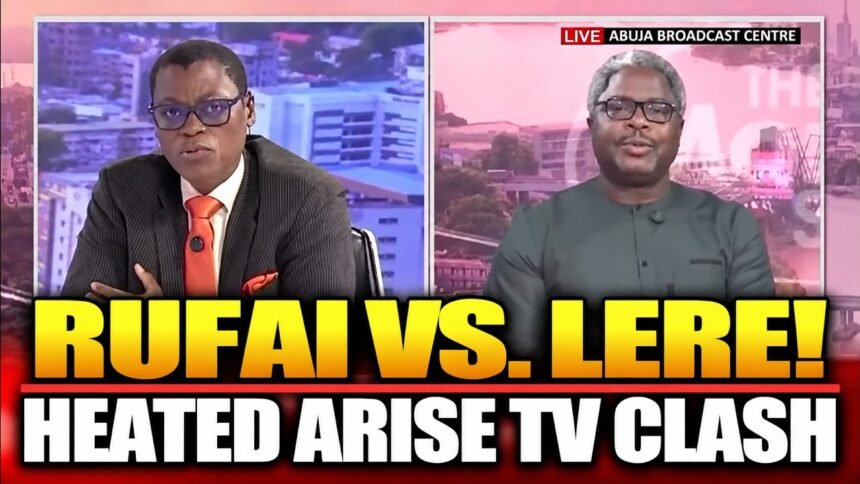
There is something profoundly revealing about the latest quarrel between Nigerian politicians and journalists. What was supposed to be another political conversation on ARISE TV’s The Morning Show recently descended into a confrontation between journalist Rufai Oseni and Lere Olayinka, media aide to FCT Minister Nyesom Wike. Olayinka objected to Oseni’s conduct and declared that he would not answer questions from him, insisting that he would rather engage with the other presenters. The exchange eventually became so tense that the interview was brought to an end. It was another spectacular moment for Nigerian television, another clip for social media and another opportunity for Nigerians to choose sides. But beneath the drama was a much larger and more uncomfortable question: what exactly should the relationship between the Nigerian journalist and the Nigerian politician look like in a democracy?
The instinctive response is usually predictable. The journalist is the watchdog; the politician is the person being watched. The journalist asks questions; the politician answers them. The journalist interrogates power; the politician submits to scrutiny. And, in principle, this is exactly how it should be. But Nigerian political journalism has never been as simple as that neat description suggests. The relationship between journalists and politicians has always been complicated by ownership, patronage, access, friendship, money, political allegiance, intimidation and the enormous power of information. Sometimes the journalist is genuinely standing between the public and the abuse of power. Sometimes the journalist is also carrying personal convictions into the newsroom. Sometimes the politician is attempting to evade accountability. At other times, the politician may have a legitimate complaint about the conduct or accuracy of a journalist. The uncomfortable truth is that both sides can be wrong.
The Rufai Oseni–Lere Olayinka confrontation is therefore important not because either man needs to be crowned the winner of a television argument, but because it captures a deeper crisis in Nigerian public discourse. We have become so accustomed to interpreting every disagreement politically that we have forgotten how to evaluate arguments independently of political allegiance. If a journalist asks an uncomfortable question of a politician we dislike, we call the journalist courageous. If the same journalist asks an uncomfortable question of a politician we support, we call him biased. If a journalist criticises the government, government supporters accuse him of working for the opposition. If he criticises the opposition, opposition supporters suddenly discover his alleged connection to the government. The question itself becomes secondary. What matters to many Nigerians is discovering whose side the journalist is on.

But journalism was never supposed to be a political party.
The journalist’s side ought to be the public. Not APC. Not PDP. Not Labour. Not the presidency. Not the opposition. Not a governor. Not a minister. Not a presidential candidate. The journalist may have personal political opinions, as every citizen is entitled to have, but professional journalism demands that personal preference should not become the measuring instrument for truth. If corruption is wrong when committed by an APC politician, it must remain wrong when committed by a PDP politician. If electoral manipulation is unacceptable when one party does it, it cannot suddenly become defensible when another party benefits. If human-rights abuses deserve condemnation under one administration, they must deserve condemnation under another. Anything else is not principle. It is partisanship wearing the clothing of journalism.
The history of Nigerian journalism makes this conversation even more complicated. The Nigerian press has never been a detached observer of politics. From the nationalist newspapers of the colonial era to the publications that challenged military dictatorship, journalism played an important role in shaping Nigeria’s political consciousness. Newspapers did not merely report the struggle for independence; many participated directly in it. During the years of military dictatorship, journalists repeatedly confronted governments that considered criticism a threat to authority. The press paid heavily for that courage. Journalists were arrested, detained, assaulted and prosecuted, while publications were shut down and media houses harassed.
The experience of Decree No. 4 of 1984 remains one of the most painful reminders of the dangers of unchecked political power. The military government of Muhammadu Buhari used the decree to punish publications deemed capable of embarrassing public officers, and journalists Tunde Thompson and Nduka Irabor were among those imprisoned. The history of the Nigerian press during the military years is filled with similar examples of state hostility towards journalism. The press also played a significant role in resisting the annulment of the June 12, 1993 presidential election and the authoritarian politics that followed. Journalists such as Dele Giwa, who was killed by a parcel bomb in 1986, became symbols of the terrible price that could accompany investigative and critical journalism in Nigeria.
It would therefore be dishonest to discuss Nigerian journalism as though journalists have simply been troublesome citizens looking for conflicts with politicians. Many Nigerian journalists have genuinely risked their lives to defend the public’s right to know. They have exposed corruption, challenged governments, investigated abuses and documented events that those in power would have preferred to bury. The press has, at different moments in Nigerian history, been one of the strongest obstacles standing between political power and absolute impunity.
But history should provide context, not immunity.
The sacrifices of journalists in previous generations do not mean that every contemporary journalist is automatically beyond criticism. A journalist can defend press freedom and still be wrong. A journalist can ask an important question badly. A television presenter can expose political hypocrisy and still become unnecessarily combative. A newspaper can publish an important investigation and still get some facts wrong. Professional courage does not eliminate the need for professional discipline.
This is where some of the contemporary Nigerian media culture deserves serious examination. There is a growing tendency to confuse aggression with courage. Some interviews have become competitions in which the journalist wants to demonstrate that he cannot be intimidated and the politician wants to demonstrate that he cannot be bullied. Voices rise, people interrupt one another, accusations are exchanged and eventually the entire encounter becomes a spectacle. Social media then produces its verdict. One side declares the journalist the winner; another side declares the politician victorious. Thousands of people share thirty-second clips without watching the full interview. Everybody gets a moment of entertainment. The public, however, may never get the answer to the original question.
That is not the highest form of journalism.
The most powerful journalist is not necessarily the loudest journalist. Sometimes the most devastating question is the calmest one, repeated patiently until the person being questioned is forced to confront it. Where is the document? How much was spent? Who authorised the expenditure? What was the evidence? When did it happen? These questions may not generate the same excitement as an argument, but they are the questions that hold institutions accountable. The journalist’s greatest weapon is not volume. It is evidence.
Politicians, however, must also accept an uncomfortable reality: being questioned is part of the price of holding public office. A politician cannot demand accountability when he is in opposition and suddenly become allergic to scrutiny after acquiring power. The journalist who was courageous when he was exposing your political opponent does not become irresponsible merely because he has now turned his microphone towards you. A government that believes in press freedom must be prepared to tolerate criticism from journalists it dislikes.
This is why political aides must be particularly careful when appearing on television. An aide does not become more powerful by insulting the journalist asking the questions. Neither does he answer an allegation by changing the subject to the alleged political allegiance of the interviewer. If a question is false, correct it. If the premise is inaccurate, dismantle it with facts. If the journalist has made an error, identify the error. But if the question is legitimate, answer it. Refusing to answer because you dislike the person asking the question does not make the question disappear.
At the same time, journalists must recognise that politicians are entitled to defend themselves. Press freedom does not mean journalists possess an unrestricted licence to insult, defame or deliberately misrepresent public officials. The journalist must be held to the same fundamental standards that he demands from politicians: accuracy, fairness, verification and accountability. A journalist who expects politicians to answer for their words must also be prepared to answer for his own.
This is where the Nigerian conversation often collapses into hypocrisy. Journalists demand accountability from politicians but sometimes resist accountability themselves. Politicians demand responsible journalism but sometimes attack journalists simply because the truth is uncomfortable. Both sides invoke principles when those principles serve their interests and conveniently forget them when they become inconvenient.
There is perhaps no better example of this contradiction than the politics of access. Nigerian journalists need political sources. Politicians need media exposure. The relationship can therefore become dangerously intimate. A reporter develops a close relationship with a politician because that politician provides information. The politician begins to trust the reporter. The reporter receives exclusive stories. The politician gets favourable access. Eventually, the journalist may become reluctant to publish something that could damage the source. The politician, meanwhile, begins to believe that access creates loyalty.
This is how independence can disappear without anyone explicitly announcing that it has disappeared.
It does not always involve money in an envelope. Sometimes it is a friendship. Sometimes it is an invitation. Sometimes it is a favour. Sometimes it is a trip. Sometimes it is access to an exclusive interview. Sometimes it is the promise of future opportunities. The journalist may not even consciously realise that the relationship has affected his judgement. But journalism becomes compromised whenever access to power becomes more important than accountability to the public.
Political ownership of media organisations creates another layer of difficulty. Nigeria’s media history has long contained connections between journalism and political interests. Newspapers and media organisations have sometimes been founded, financed or influenced by people with strong political ambitions. This does not automatically invalidate the journalism produced by such organisations, but it creates a legitimate question about editorial independence. When the owner of a media organisation has political interests, how confidently can the public assume that every political story will receive equal treatment?
The answer cannot simply be that every journalist must have no political opinion. That would be unrealistic. Journalists are citizens. They vote. They have convictions. They have families and friendships. They belong to communities. The real professional test is whether they can prevent those personal convictions from determining what they present as fact.
And this is where the current media environment has become even more complicated because journalism is no longer controlled by the traditional newsroom. Social media has created an enormous incentive for outrage. A calm, carefully researched political interview may receive less attention than a journalist shouting at a politician. A complicated investigation may attract fewer views than a thirty-second clip of an argument. A carefully qualified headline may generate less engagement than an inflammatory one.
The algorithm therefore rewards the very thing journalism should sometimes resist: outrage.
Politicians understand this. Journalists understand it too. And increasingly, both sides can become performers in the same attention economy. A politician may deliberately provoke an interviewer because he knows that the confrontation will generate publicity. A journalist may push an interview towards confrontation because the resulting clip will travel further online. The audience watches, reacts, shares and fights. The political message becomes secondary to the spectacle.
This is dangerous because democracy requires information, not merely excitement.
The Nigerian public deserves journalists who will challenge power without becoming intoxicated by the power of the microphone. It deserves politicians who will defend themselves without treating every journalist as an enemy. It deserves interviewers who can ask difficult questions without turning every disagreement into a personal battle. And it deserves politicians who can answer difficult questions without believing that the journalist must first prove political neutrality before being allowed to ask them.
There is also something deeply unhealthy about the tendency to reduce every journalist to a political label. Rufai Oseni should not have to be a supporter of Peter Obi before a question about the Tinubu administration can be considered legitimate. A journalist criticising Peter Obi should not suddenly become a Tinubu supporter. A journalist criticising Wike should not automatically be assumed to support his political opponents. The validity of a question should depend on its substance, not on the political identity Nigerians imagine belongs to the person asking it.
The same standard should apply to political commentators and media organisations. If a journalist consistently attacks one political party while excusing another, the public is entitled to question that pattern. If a media organisation repeatedly gives one political camp favourable treatment, it should expect scrutiny. But those conclusions should be reached through evidence and patterns, not simply because someone asked a question we did not like.
Nigeria cannot build a mature democracy if every disagreement becomes a tribal, partisan or ideological war over loyalty.
The real tragedy is that both politicians and journalists sometimes forget the people who are supposed to be at the centre of the relationship. The journalist may become obsessed with defeating the politician in an argument. The politician may become obsessed with defeating the journalist in public perception. Meanwhile, the ordinary Nigerian watching from home still wants to know why electricity is expensive, why insecurity persists, where public money is going, why schools remain inadequate, why hospitals fail, why young people cannot find meaningful employment and why political promises so often disappear after elections.
The citizen does not need the journalist to win a quarrel.
The citizen needs an answer.
That is why the Oseni–Olayinka confrontation should not ultimately be reduced to the question of who insulted whom or who won the exchange. The more important question is whether Nigerian political journalism is becoming better at informing the public or merely better at producing viral confrontations. If the journalist’s question disappears beneath the journalist’s personality, something has gone wrong. If the politician’s answer disappears beneath the politician’s attack on the journalist, something has also gone wrong.
The journalist must therefore remember that the microphone is not a weapon of personal authority. It is an instrument of public accountability. The politician must remember that the television studio is not a private office where inconvenient questions can simply be dismissed. It is a public forum, and public office carries public obligations.
There should be no permanent friendship between journalism and political power. Nor should there be permanent hostility. The relationship should be permanently uncomfortable. The journalist should be close enough to power to understand how it works but independent enough to challenge it. The politician should respect the journalist’s role without surrendering the right to challenge inaccurate reporting.
The Nigerian journalist does not have to hate politicians to hold them accountable. He does not have to support the opposition to criticise the government. He does not have to support the government to criticise the opposition. He only needs the courage to apply the same standard when the political jerseys change.
And perhaps that is the standard Nigerian journalism urgently needs to recover: not neutrality without conviction, but independence without allegiance; not hostility to power, but suspicion of unchecked power; not sensational confrontation, but persistent interrogation; not journalism designed to produce heroes and villains, but journalism designed to establish facts.
The politician’s responsibility is equally clear. Stop asking whether the journalist is on your side. Stop assuming that criticism is conspiracy. Stop treating every uncomfortable question as political persecution. If the allegation is false, prove it false. If the question is unfair, expose its unfairness. If the journalist is wrong, correct him. But do not demand silence simply because you dislike the person holding the microphone.
At the end of the day, neither Rufai Oseni nor Lere Olayinka is the real constituency of Nigerian democracy. Neither is Tinubu, Wike, Adeleke, Obi, Atiku or any other politician. The constituency is the Nigerian people.
The journalist’s duty is to them.
The politician’s duty is to them.
And when the cameras go off, the studio lights disappear and the social-media arguments finally become yesterday’s noise, it is the Nigerian public that remains behind to live with the consequences of everything said, everything concealed and everything left unanswered.
That is the side Nigerian journalism must choose.
That is the side Nigerian politics must serve.
And if both sides genuinely remember that, perhaps the next confrontation will not be about who defeated whom on television, but about whether the Nigerian people finally got the answers they deserved.