


By Eneojo Herbert Idakwo
For the people of Ibaji in Kogi State and their neighbours in Anambra State, the announcement was more than another government policy. It was the revival of a long-held hope.
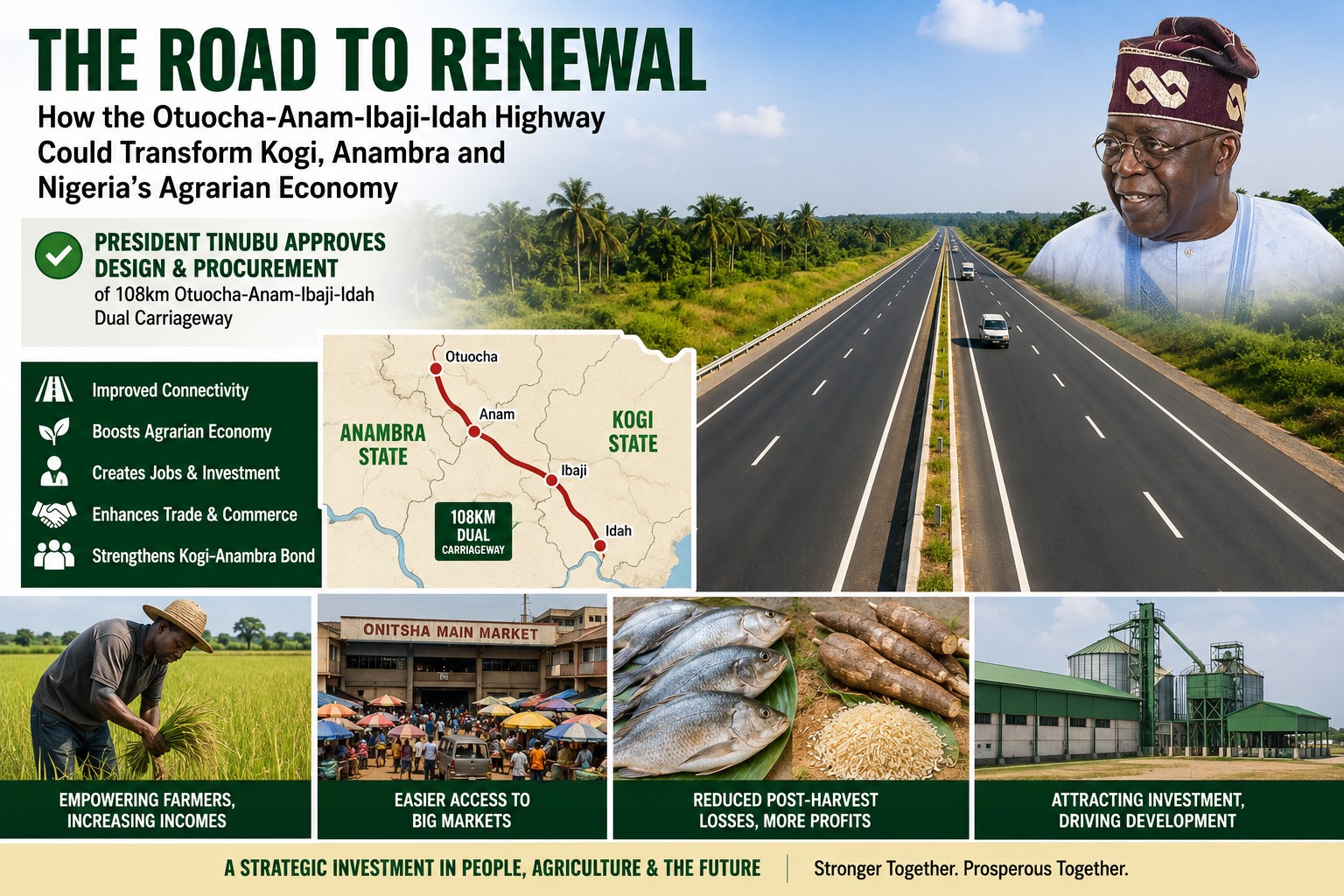
President Bola Ahmed Tinubu’s approval of the design and procurement process for the proposed 108-kilometre Otuocha-Anam-Ibaji-Idah dual carriageway has been widely welcomed as one of the most significant infrastructure decisions affecting the eastern flank of the River Niger in recent years. Though the project remains at the design and procurement stage, its strategic importance has already captured the imagination of communities that have endured decades of poor road connectivity and limited economic opportunities.
If eventually completed, the highway will connect Otuocha and Anam in Anambra State with Ibaji and Idah in Kogi State, creating a modern transport corridor between the South East and the North Central regions. More importantly, it promises to unlock the enormous agricultural potential of Ibaji, strengthen trade with Anambra’s commercial centres and promote inclusive economic development across the two states.

The approval followed discussions between President Tinubu, Anambra State Governor, Prof. Chukwuma Soludo, and the Federal Ministry of Works on priority infrastructure projects in the South East. Governor Soludo later announced that the President had approved the design and procurement of the strategic road project, alongside other federal highways intended to improve regional connectivity.
More Than a Road
Roads are often measured in kilometres, budgets and engineering specifications. Their true value, however, lies in the opportunities they create.
A good road connects farmers to markets, children to schools, patients to hospitals, businesses to customers and communities to the wider economy. It attracts investment, creates jobs and improves the quality of life.
The proposed Otuocha-Anam-Ibaji-Idah Road embodies all these possibilities.
For decades, residents of Ibaji and surrounding communities have depended on waterways and deteriorating roads to transport agricultural produce and conduct business. During the rainy season, many rural roads become impassable, making travel difficult and increasing transportation costs.
The result has been slower economic growth, limited private investment and the isolation of communities that possess enormous productive potential.
Ibaji: Unlocking the Potential of Kogi’s Oil-Producing Agricultural Heartland
Among the greatest beneficiaries of the proposed highway will be Ibaji Local Government Area, a land of immense promise that has remained constrained by decades of poor infrastructure. Endowed with vast fertile floodplains along the River Niger and recognised as Kogi State’s only oil-producing local government area, Ibaji possesses enormous agricultural and natural resource wealth. Yet, despite these advantages, it has remained one of the state’s most underserved areas in terms of road infrastructure and access to markets.
For generations, the people of Ibaji have depended on farming and fishing as their principal means of livelihood. The local government is a major producer of rice, cassava, yam, maize, vegetables and fish, supplying food to markets within Kogi State and neighbouring states. Its fertile soil and favourable climate make it one of the state’s most productive agricultural zones, with the capacity to contribute even more to Nigeria’s food security.
Unfortunately, poor road connectivity has prevented the area from realising its full economic potential. During the rainy season, many roads become impassable, leaving farming communities isolated for weeks. Transporting agricultural produce to markets in Idah, Onitsha, Lokoja and other commercial centres is often slow, expensive and risky. As a result, farmers suffer heavy post-harvest losses, while buyers are discouraged by the high cost of moving goods.
This paradox has persisted for decades. Despite being blessed with fertile land, rich fishing waters and crude oil deposits, Ibaji has lacked the infrastructure needed to stimulate investment and improve the quality of life of its people. The absence of reliable road access has discouraged agro-processing industries, increased the cost of doing business and limited access to healthcare, education and other essential services.
The proposed highway offers a rare opportunity to change that narrative. By providing a direct all-weather link between Ibaji, Idah and the commercial centres of Anambra State, the project will significantly reduce travel time and transportation costs. Farmers will be able to move fresh produce to markets more quickly, reducing spoilage and increasing their earnings. Traders will gain easier access to agricultural commodities, while investors will find the area more attractive for rice mills, cassava processing plants, fish processing facilities, grain storage centres and other agro-allied enterprises.
The road will also strengthen economic ties between Kogi and Anambra States. Onitsha, one of West Africa’s largest commercial centres, provides a ready market for agricultural products from Ibaji. Improved connectivity will enhance trade, encourage private sector investment and create new opportunities for employment, particularly for young people.
Beyond agriculture, the road will improve access to schools, hospitals, financial institutions and government services, bringing long-overdue development closer to communities that have remained on the margins of national infrastructure planning.
For the people of Ibaji, this project is more than a highway. It is an opportunity to transform an oil-producing, agriculturally rich local government into a thriving centre of commerce, agro-industrial development and regional trade.
A New Economic Corridor
The significance of the Otuocha-Anam-Ibaji-Idah Road extends beyond the communities through which it will pass. It has the potential to establish a new economic corridor linking two regions whose strengths naturally complement each other.
On one side is Anambra State, home to Onitsha, one of Africa’s largest commercial cities and a major distribution hub for manufactured goods and agricultural produce. On the other is Kogi East, particularly Ibaji and Idah, an area endowed with fertile agricultural land, abundant fisheries and significant opportunities for agro-industrial expansion.
Long before the creation of modern state boundaries, the River Niger served as a major commercial artery linking the Igala Kingdom with communities in present-day Anambra State. Agricultural produce, fish, palm products and other commodities moved freely across the river, sustaining thriving local economies and fostering enduring cultural ties.
The proposed highway promises to strengthen these historic relationships by providing a faster, safer and more reliable means of transportation. Farmers will gain easier access to major markets, while traders will enjoy more dependable supplies of agricultural commodities. Manufacturers, logistics companies and investors will also find new opportunities for business expansion.
Boosting Food Security
Nigeria’s quest for food security depends not only on increased production but also on efficient transportation.
Each year, farmers across the country lose substantial quantities of produce because of poor road networks and inadequate logistics. In agrarian communities like Ibaji, these losses reduce incomes, discourage investment and contribute to higher food prices.
A modern highway connecting farms directly to commercial centres can significantly reduce these challenges. Lower transportation costs mean higher earnings for farmers, more affordable food for consumers and stronger incentives for commercial agriculture.
Improved access will also encourage government agencies, financial institutions and agricultural extension services to reach rural communities more effectively, promoting the adoption of improved farming technologies and better production practices.
A Catalyst for Rural Industrialisation
Infrastructure creates confidence. Investors are more likely to establish industries where transportation is reliable and operating costs are predictable.
The Otuocha-Anam-Ibaji-Idah Road therefore has implications far beyond agriculture. It can stimulate the establishment of rice mills, cassava processing factories, fish processing centres, cold storage facilities, warehouses, packaging industries and logistics hubs.
Such investments would create employment, increase internally generated revenue and encourage young people to pursue productive economic activities within their communities instead of migrating in search of opportunities.
Strengthening National Integration
The project also carries important national significance.
By improving connectivity between the South East and the North Central regions, the highway will facilitate commerce, tourism, cultural exchange and social interaction. It will provide an alternative transport route, improve security operations and strengthen economic cooperation between neighbouring states.
In this sense, the road represents more than infrastructure. It is an investment in national unity and balanced regional development.
A Promise That Must Be Fulfilled
For the people of Ibaji, Idah, Anam and Otuocha, the approval of the Otuocha-Anam-Ibaji-Idah Road represents more than a government announcement. It rekindles hope that communities long separated by poor infrastructure will finally be connected to the opportunities that development brings.
For decades, successive administrations acknowledged the strategic importance of this corridor, yet the vision remained unrealised. President Bola Ahmed Tinubu’s approval of the design and procurement process has revived expectations that this critical link will move from the drawing board to reality. It is a significant first step, but only the successful completion of the project will fulfil the aspirations of the people whose lives stand to be transformed.
If delivered to specification and within a reasonable timeframe, the highway will do far more than shorten travel distances. It will open new markets for farmers, encourage investment in agro-processing and logistics, improve access to healthcare and education, stimulate tourism, strengthen security operations and deepen economic cooperation between Kogi and Anambra States. For Ibaji in particular, it offers the opportunity to shed the burden of isolation and emerge as a thriving centre of agriculture, commerce and enterprise, reflecting both its status as Kogi State’s oil-producing local government and one of its richest food-producing areas.
The project also serves a broader national purpose. It demonstrates that infrastructure can be a powerful instrument for inclusive development when it reaches communities that have historically remained on the margins of economic growth. By linking productive rural communities with major commercial centres, the road has the potential to strengthen food security, expand regional trade and reinforce national cohesion.
History will remember this initiative not simply because a road was proposed, but because it had the capacity to transform lives. The true measure of its success, however, will not be found in official approvals or ceremonial announcements. It will be found in the day heavy trucks carry rice from Ibaji to the markets of Onitsha without delay, when investors establish processing plants in communities once considered inaccessible, when young people find employment close to home, and when families travel safely and confidently along a road that for generations existed only as a promise.
That is the future the Otuocha-Anam-Ibaji-Idah Road makes possible. It is now the responsibility of the Federal Government, contractors, host communities and oversight institutions to ensure that this promise is translated into reality.
For the people of Kogi and Anambra States, the journey has begun. The destination must be completion.















Thank you for this detailed and explicit write up on the proposed Otuocha – Anam – Ibaji – Idah highway.