By Eneojo Herbert Idakwo
A Rejoinder to “The Constitutional Coup That Must Not Stand” by Hassan Husaini mni
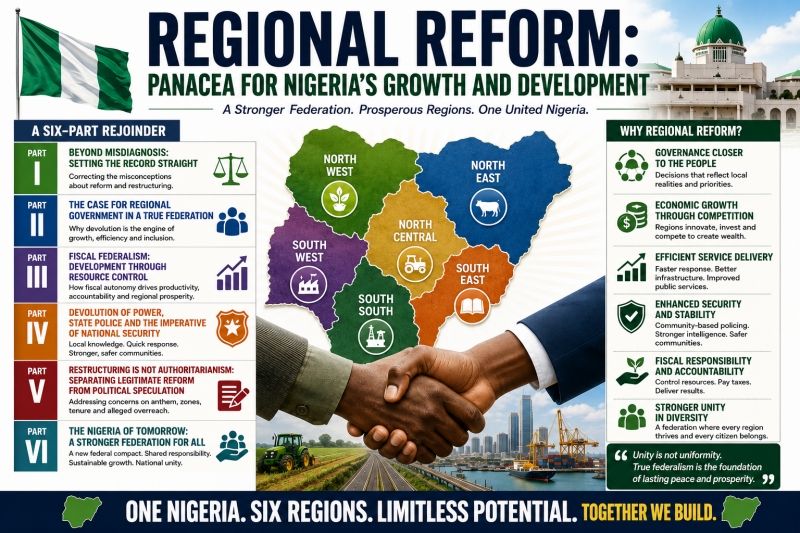
Part II: Constitutional Reform Is Not Constitutional Subversion
The strongest pillar upon which “The Constitutional Coup That Must Not Stand” rests is its constitutional argument. It asserts that proposals for regional government, state police, fiscal decentralisation and geo-political zones amount to a deliberate violation of the 1999 Constitution. At first reading, this appears persuasive. However, a closer examination reveals that the article conflates constitutional amendment with constitutional violation. They are fundamentally different legal concepts.
No serious advocate of restructuring argues that the President, the National Assembly or any other authority can simply suspend or ignore the Constitution. That would indeed be unconstitutional. The real argument is that the Constitution itself provides a lawful process for altering its provisions. Seeking to use that process cannot reasonably be described as a constitutional coup.

Every Constitution Provides for Its Own Amendment
No democratic constitution is permanent. Every enduring democracy recognises that constitutional arrangements must evolve to meet changing national realities.
The Constitution of the United States has been amended twenty-seven times since 1789. Canada has undertaken several constitutional reforms since patriation in 1982. India has amended its Constitution more than one hundred times. Australia has amended its Constitution through referendums. Germany has repeatedly adjusted its Basic Law to respond to changing political and economic conditions.
None of these amendments amounted to an assault on democracy. They represented democracy functioning as intended.
Nigeria’s Constitution follows the same principle.
Section 9 expressly provides procedures for constitutional amendment. It does not say that certain subjects are permanently beyond discussion. Instead, it prescribes the rigorous process through which changes may lawfully occur.
Therefore, discussing regional government, proposing constitutional amendments or introducing restructuring bills is not unconstitutional. It is part of constitutional democracy.
The legality of any proposal depends not on its ambition but on whether it ultimately complies with the amendment procedures prescribed by the Constitution.
Section 8 Does Not Prohibit Reform
The rejoinder correctly cites Section 8 regarding the creation of states.
Indeed, the Constitution imposes stringent conditions before any new state can emerge. Those safeguards exist to prevent arbitrary fragmentation of the federation.
However, acknowledging those constitutional requirements does not invalidate discussions about creating new constitutional arrangements.
If any proposal seeks to create additional states or redesign internal boundaries, those provisions must undoubtedly be followed.
That is precisely why advocates of restructuring consistently call for constitutional amendment rather than executive proclamation.
The constitutional process is the solution, not the obstacle.
One should therefore distinguish between proposals placed before the National Assembly for debate and actual constitutional implementation.
The former represents democratic deliberation.
The latter requires constitutional approval.
There is no contradiction.
Geo-Political Zones Already Exist in Practice
The article presents the geo-political zones as though they are entirely unknown to Nigeria’s constitutional practice.
This ignores decades of administrative reality.
Nigeria has operated six geo-political zones for many years.
Federal appointments are routinely balanced across these zones.
Political parties organise themselves according to the six zones.
Security agencies use them.
Federal ministries structure programmes around them.
The National Youth Service Corps frequently relies upon them in planning.
Development commissions increasingly reflect zonal arrangements.
The Constitution may not expressly establish the six geo-political zones as federating units, but they have long become recognised administrative and political realities.
The current debate is therefore not about inventing entirely new geographical entities.
It is about whether those existing zones should eventually acquire constitutional recognition and clearer governance responsibilities.
That question deserves national conversation rather than outright dismissal.
Fiscal Federalism Is the Missing Link
Perhaps the most important issue ignored by opponents of restructuring is the severe imbalance within Nigeria’s fiscal architecture.
The Federal Government currently collects the overwhelming majority of nationally generated revenues before redistributing them to states and local governments.
This arrangement has produced what economists describe as vertical fiscal imbalance.
The level of government that controls the largest share of national revenue is not always the level responsible for delivering most public services.
State governments bear enormous responsibilities for education, healthcare, roads, agriculture and local development.
Yet they possess limited independent revenue sources.
This mismatch encourages excessive dependence on federal allocation.
A governor who relies almost entirely on monthly transfers from Abuja has little incentive to expand productive sectors within his state.
Restructuring seeks to reverse that dependency.
Instead of waiting for allocations, regions would be encouraged to generate wealth through agriculture, mining, manufacturing, tourism, technology and industrialisation.
Revenue generation would become the foundation of governance rather than revenue sharing.
Resource Control Is an Economic Necessity
The concentration of natural resource ownership in Abuja has remained one of the most contentious issues in Nigerian federalism.
Communities where resources are extracted often experience environmental degradation without corresponding economic development.
At the same time, states lacking natural resources become entirely dependent upon centrally distributed oil revenues.
This arrangement has weakened both accountability and productivity.
True federalism encourages each federating unit to develop its comparative advantages.
Some regions possess fertile agricultural land.
Others have vast mineral deposits.
Some enjoy extensive coastlines suitable for maritime commerce.
Others possess enormous tourism potential.
Still others have thriving commercial centres capable of driving manufacturing and technological innovation.
Regional government would encourage every part of Nigeria to maximise its economic strengths instead of competing merely for federal allocations.
State Police and the Logic of Federalism
The article relies heavily upon Section 214 of the Constitution, which presently establishes a single Nigeria Police Force.
That citation is legally correct.
However, it does not answer the central policy question.
Should Nigeria continue with a policing structure that many security experts agree has become increasingly overstretched?
Nigeria has a population exceeding two hundred million people spread across diverse geographical, cultural and security environments.
No single command headquartered in Abuja can effectively understand every local conflict, criminal network or communal tension across 774 local government areas.
Modern federal systems recognise this reality.
The United States operates federal, state, county and municipal police agencies.
Canada maintains federal, provincial and municipal policing arrangements.
Germany operates federal and state police services.
Australia combines federal policing with state police forces.
India also maintains central and state police organisations.
These countries remain united because multiple policing structures exist within clear constitutional limits.
Nigeria can adopt similar safeguards.
Independent Police Service Commissions.
Judicial oversight.
Professional recruitment standards.
Federal investigative jurisdiction over national crimes.
Constitutional protection of fundamental rights.
Strong legislative supervision.
The possibility of abuse should inspire better institutional design, not permanent resistance to decentralisation.
After all, abuse is possible within every institution, including the present central police structure.
Good governance depends on accountability, not merely centralisation.
Regional Government Will Reduce the Politics of Dependency
Perhaps the greatest political consequence of Nigeria’s present constitutional arrangement is that every election increasingly becomes a struggle for control of Abuja.
Why?
Because political power at the centre largely determines access to national resources.
When wealth is centralised, politics naturally becomes centralised.
When opportunities are decentralised, political competition shifts toward governance and economic performance.
Regional government would gradually transform Nigerian politics.
Citizens would judge their leaders less by their influence in Abuja and more by their ability to create jobs, attract investment, improve schools, strengthen healthcare, modernise agriculture and build infrastructure.
That transition represents one of the strongest arguments for restructuring.
It encourages productive leadership rather than distributive politics.
Constitutional Democracy Requires Courage
The framers of every constitution understood one important truth.
No constitutional arrangement remains perfect forever.
Societies evolve.
Economies change.
Security challenges emerge.
Population growth creates new pressures.
Technology transforms governance.
Constitutions survive precisely because they contain lawful mechanisms for reform.
Nigeria now stands at such a moment.
The question is no longer whether reforms are necessary.
The real question is whether Nigerians possess the constitutional maturity to pursue those reforms through dialogue, legislative action and broad national consensus.
That is not constitutional subversion.
It is constitutional democracy in its highest form.