By Eneojo Herbert Idakwo
A Rejoinder to “The Constitutional Coup That Must Not Stand” by Hassan Husaini mni
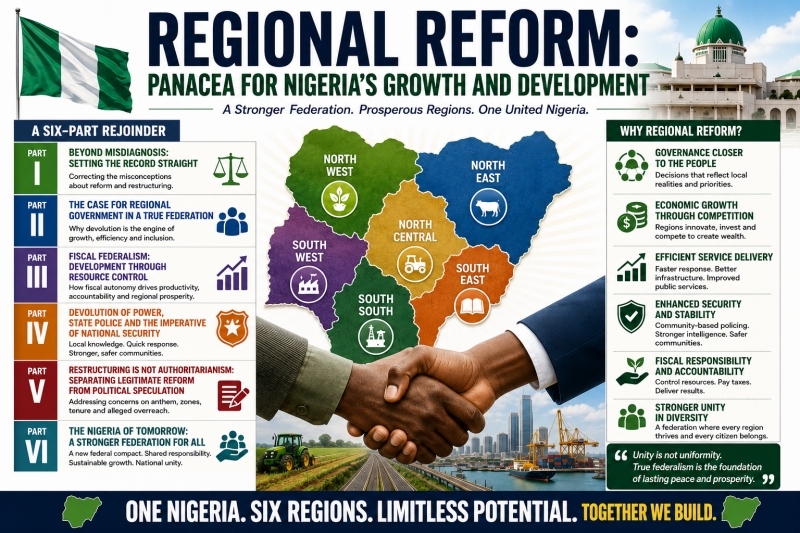
Part III: Fiscal Federalism and Regional Government as Catalysts for Economic Growth
If there is one lesson Nigeria should draw from over six decades of nationhood, it is that no country has ever achieved sustainable development by concentrating political authority, economic power and fiscal resources almost entirely in one central government. Nations prosper when governance is decentralised, innovation is encouraged, and sub-national governments have both the authority and the incentive to create wealth.

Nigeria’s greatest economic challenge today is not the absence of natural resources or entrepreneurial talent. It is the structural framework within which those resources and talents are managed. The current federal arrangement has fostered a culture of dependency rather than productivity, consumption rather than production, and competition for federal allocations rather than competition in economic performance.
This is where regional government offers a compelling alternative.
The Economic Consequences of Over-Centralisation
The Nigerian federation operates a fiscal system in which the Federal Government collects the overwhelming share of nationally generated revenue before distributing it among the three tiers of government. Although this arrangement was originally intended to promote national cohesion, it has gradually created unintended consequences.
For many states, monthly allocations from the Federation Account have become the principal source of public finance. Internally Generated Revenue remains relatively low in a significant number of states. Rather than developing industries, expanding agriculture, promoting exports or attracting long-term investments, governments often focus their attention on securing larger allocations from Abuja.
This dependence has weakened economic creativity.
It has also reduced healthy competition among states.
Instead of asking, “How do we create wealth?” the recurring question has become, “How much allocation will we receive this month?”
No nation can build a prosperous economy on that foundation.
The First Republic Offers Valuable Lessons
Nigeria need not search beyond its own history to understand the benefits of decentralised development.
During the First Republic, each region pursued economic policies based on its comparative advantage.
The Western Region became synonymous with cocoa production. Revenue from cocoa exports financed free primary education, rural development, healthcare facilities, road construction and landmark infrastructure such as Cocoa House and Liberty Stadium.
The Eastern Region expanded palm produce exports, established industrial estates and invested heavily in manufacturing. Under Dr. Michael Okpara’s leadership, agriculture and industry complemented one another, creating employment and increasing regional income.
The Northern Region transformed agriculture into a major economic engine. Groundnuts, cotton, hides, livestock and other agricultural commodities generated substantial export earnings. Institutions such as the Northern Nigeria Development Corporation promoted commercial investment across multiple sectors.
What distinguished these regions was not merely their natural endowments.
It was their constitutional authority to develop those endowments.
Because they retained significant portions of the wealth they generated, they had every incentive to increase production, diversify their economies and invest in long-term development.
Economic success depended on productivity rather than political proximity to the Federal Government.
Oil Wealth Changed the Incentive Structure
The discovery and commercial exploitation of petroleum fundamentally altered Nigeria’s political economy.
Oil revenues increasingly replaced agriculture as the dominant source of national income.
As more resources flowed into the Federation Account, states became progressively dependent on federally distributed revenue.
Agriculture declined.
Solid mineral development stagnated.
Manufacturing lost competitiveness.
Exports became heavily concentrated in crude oil.
Over time, the struggle for political control of the Federal Government intensified because whoever controlled Abuja also controlled the nation’s principal source of public revenue.
This transformation shifted Nigeria from a productive federation to a distributive federation.
Rather than creating wealth, governments increasingly concentrated on sharing existing wealth.
The consequences remain evident today in high unemployment, limited industrialisation, weak export diversification and persistent fiscal pressures.
Fiscal Federalism Encourages Responsibility
One of the defining features of successful federations is fiscal responsibility.
Governments that generate a substantial portion of their own revenue tend to spend more prudently because they remain directly accountable to the taxpayers who finance public expenditure.
When citizens know that their taxes fund public services, they demand greater transparency, better infrastructure and improved governance.
Conversely, governments that depend largely on externally generated revenue often face weaker public scrutiny.
Regional government can restore this vital connection between taxation, accountability and service delivery.
Regions that generate greater revenue through agriculture, mining, manufacturing, tourism, technology or commerce would possess stronger incentives to invest wisely and manage public resources efficiently.
Productivity would replace dependency.
Unlocking Nigeria’s Agricultural Potential
Nigeria possesses over 70 million hectares of agricultural land, yet a significant proportion remains underutilised.
Different regions enjoy distinct ecological advantages.
The North is suited for grains, livestock, cotton and tomatoes.
The Middle Belt has enormous potential for yam, cassava, rice and soybean production.
The South-West remains favourable for cocoa, oil palm and horticulture.
The South-East has strengths in commerce, agro-processing and manufacturing.
The South-South possesses abundant fisheries, oil and gas resources, maritime opportunities and rich biodiversity.
A regional governance structure would enable each region to design agricultural policies that reflect its climatic conditions, market opportunities and comparative advantages.
Rather than implementing uniform policies from Abuja, regional governments could invest directly in irrigation, extension services, research institutions, commodity exchanges, storage facilities and agro-processing industries tailored to local needs.
Such flexibility would significantly improve food security while expanding exports.
Harnessing Solid Minerals Beyond Petroleum
Nigeria is richly endowed with gold, lithium, tin, limestone, coal, iron ore, bitumen and numerous other mineral resources.
Yet many of these resources remain underdeveloped because licensing, regulation and major policy decisions are highly centralised.
Regional governments with clearly defined constitutional responsibilities could partner with private investors, establish processing industries and develop mining value chains while operating within national environmental and regulatory standards.
Instead of exporting raw minerals, regions could encourage local beneficiation and manufacturing, thereby creating employment and increasing revenue.
Economic diversification would become a practical reality rather than a recurring policy slogan.
Healthy Competition Produces Better Governance
Competition is one of the greatest strengths of federal systems.
When constituent units possess meaningful autonomy, they naturally compete to attract investment, improve infrastructure, strengthen education, modernise healthcare and create employment.
Citizens compare performance across regions.
Investors seek jurisdictions with better infrastructure and more efficient governance.
Leaders become accountable not merely through elections but through measurable economic outcomes.
This competition benefits the entire federation.
During Nigeria’s regional era, governments competed in education, industrial development and agriculture.
Today, much of that competition has been replaced by lobbying for greater federal allocations.
Regional government would restore a culture of performance.
Success would depend less on political influence in Abuja and more on the quality of governance within each region.
Infrastructure Development Becomes More Efficient
One of the recurring criticisms of Nigeria’s development model is the slow pace of infrastructure delivery.
Roads, railways, electricity projects, dams and industrial corridors frequently encounter delays arising from excessive federal bureaucracy.
Regional governments could assume greater responsibility for planning and executing infrastructure projects that directly affect their economies.
Transportation networks could be integrated around regional economic priorities.
Power generation and distribution could expand through regional initiatives.
Industrial parks could be developed closer to production centres.
Agricultural processing facilities could be located near farming communities.
Infrastructure would increasingly reflect local economic realities rather than central administrative priorities.
Reducing Regional Inequality Through Productivity
Critics often argue that stronger regions would increase inequality.
Experience suggests otherwise.
The current system has not eliminated regional disparities despite decades of centralised revenue distribution.
Regional government does not require the abandonment of national solidarity.
Equalisation mechanisms can still ensure that less-developed regions receive targeted support for education, healthcare and strategic infrastructure.
What changes is the primary source of growth.
Instead of depending almost exclusively on federal transfers, every region becomes responsible for expanding its own productive capacity while contributing agreed revenues to the federation.
This balance between autonomy and solidarity characterises many successful federal systems.
A Federation That Rewards Enterprise
The future prosperity of Nigeria depends on building institutions that reward innovation, enterprise and productivity.
No constitutional arrangement can guarantee development on its own.
However, constitutional structures can either encourage or discourage economic initiative.
The present system has encouraged dependence on centrally distributed revenues.
Regional government offers the opportunity to reverse that trend by restoring fiscal responsibility, encouraging competition, promoting local innovation and expanding economic opportunities across every part of the federation.
The objective is not to weaken the Federal Government.
It is to strengthen every level of government by assigning responsibilities to the institutions best positioned to discharge them effectively.
A prosperous federation is not one in which every decision originates from the centre.
It is one in which every constituent unit possesses both the authority and the responsibility to contribute meaningfully to national development.
That is the enduring promise of fiscal federalism.
That is the economic foundation upon which a stronger, more competitive and more prosperous Nigeria can be built.