By Okoi Obono-Obla
Last week, something dramatic that caught and jolted international media attention and headlines happened in the city of Ceuta, which was described as the entry point between Morocco, an African country, and Spain, a European country, two different countries seemingly separated by the Mediterranean Sea, when thousands of unemployed Moroccan young people looking for opportunities in Europe stormed Ceuta and destroyed the barriers erected there by Spain to prevent crossing from Morocco to Ceuta, which prompted the Spanish government to deploy its armed forces to assist the civil police in maintaining law and order.
The matter was reported as if it were the usual story of people from Africa crossing dangerous waters to flee Africa and enter Europe as migrants. But in the real sense, this was not the case; it was the battle to end centuries of colonialism by European powers over Africa, even though we are made to believe that the period of colonialism has come to an end.
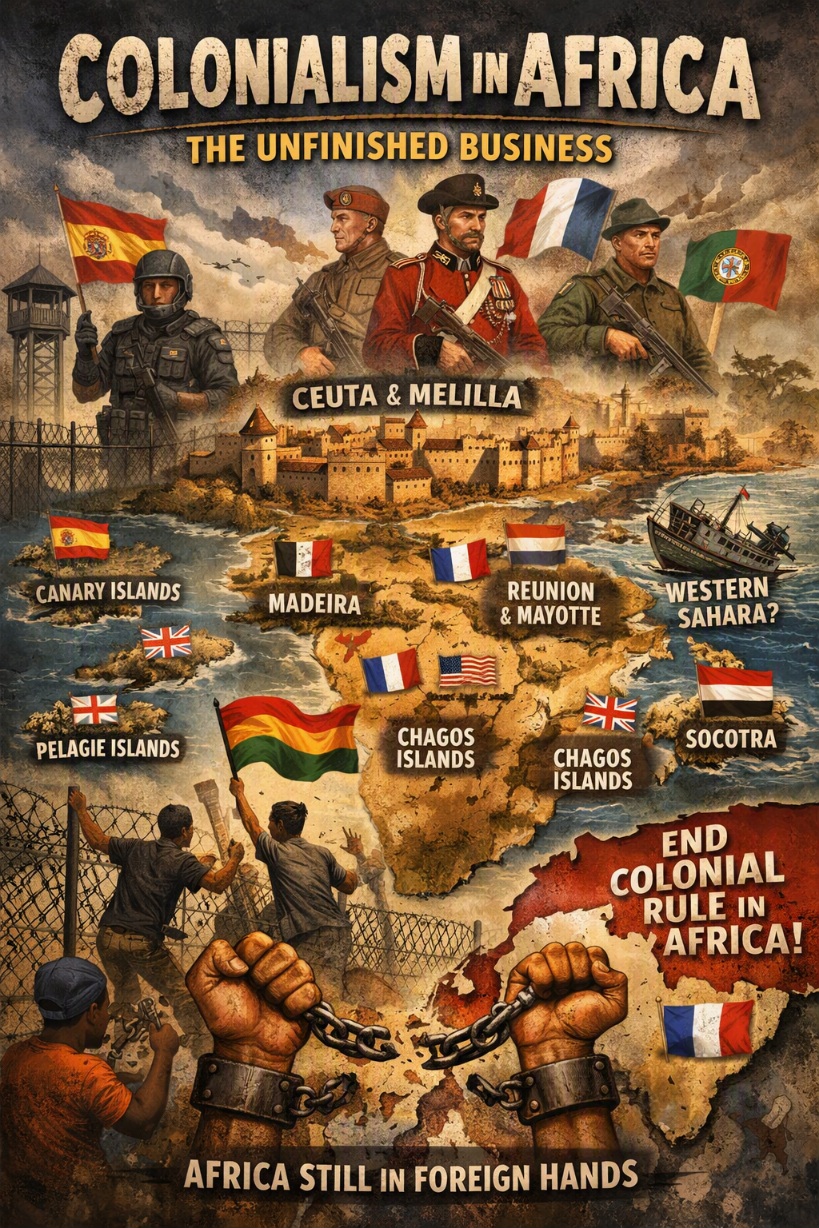
The truth of the matter is that Ceuta is in Morocco, on the continent of Africa, and does not belong to Spain, but Spain is holding onto it. There are also other parts of the continent of Africa which should rightly belong to Morocco but are under the sovereignty of Spain. They are Melilla and the Canary Islands.

It is not only Spain that is still holding onto territories located in Africa in the 21st century; some other European powers such as France, the United Kingdom, and Portugal are holding territories in Africa. Yemen is also presently holding an African territory.
The full extent of these holdings shows that this is not an isolated case.
Spain holds: Ceuta, a city of about 85,000 people opposite Gibraltar, taken by Portugal in 1415 and ceded to Spain by the Treaty of Lisbon in 1668; Melilla, captured in 1497 by the Crown of Castile and confirmed by treaties in 1859 and 1862; the Canary Islands, an archipelago of over 2 million people off the Moroccan coast, inhabited originally by the Guanche people and conquered by Castile between 1402 and 1496 with Portuguese recognition in the Treaty of Alcáçovas in 1479; and the Plazas de Soberanía, five tiny islands including the Chafarinas, Peñón de Alhucemas and Peñón de Vélez de la Gomera, taken as military outposts between 1508 and 1848.
France holds: Réunion, an island of 900,000 people east of Madagascar colonized in 1665; Mayotte, an island in the Mozambique Channel historically part of the Comoros, bought by France in 1841 and kept after the Comoros voted for independence; and the Scattered Islands – Bassas da India, Europa, Glorioso, Juan de Nova and Tromelin – uninhabited islands around Madagascar taken for strategic and economic reasons.
The United Kingdom holds: Saint Helena, Ascension and Tristan da Cunha in the South Atlantic, colonized from 1659 as a shipping station, and the British Indian Ocean Territory, the Chagos Archipelago including Diego Garcia, detached from Mauritius in 1965.
Portugal holds: The Madeira Archipelago, including Madeira and the Savage Islands off Morocco, discovered uninhabited in 1419.
Italy holds: The Pelagie Islands – Lampedusa, Linosa, Lampione – and Pantelleria, islands on the African continental shelf administered as part of Sicily.
Yemen holds: The Socotra Archipelago off the Horn of Africa, geographically African but politically part of Yemen since 1967.
Why would international law make such a despicable distinction between colonies and so-called UN Self-Governing Territories? Why would international law allow a situation whereby powerful countries from another continent use force to acquire and gain territories in other continents and then make a distinction to differentiate it from colonialism? It doesn’t make any sense. It is plain colonialism still at play in the 21st century and being accorded protection by rules of international law formulated and designed in the 16th to 20th century when most African, South American and Asian countries were still evolving and at the mercy of these occupying powers.
The reason this is allowed to continue is that current international law protects these holdings by refusing to list them as colonies. Under UN Resolutions 1514 and 1541, only territories on the UN list of Non-Self-Governing Territories are considered pending decolonization. The list today contains only 17 territories, and in Africa, only Western Sahara. Because Ceuta, Melilla, Réunion, Mayotte and others have been integrated, given citizenship and voting rights, and because their current populations have been made to vote to remain, the UN treats them as integral parts of European states, not as colonies. Self-determination is then used to justify the status quo, while the principle of territorial integrity of African states is ignored.
This calls for the evolution of new rules and principles of international law that will be equitable and non-discriminatory. As long as international law continues to protect territories acquired by force centuries ago and calls them integral parts of Europe while they sit geographically in Africa, the events we saw in Ceuta will not be about migration. They will be what they truly were – a people storming a fence to reclaim their continent.
In conclusion, the storming of Ceuta should not be misread as a simple migrant crisis. It is a stark reminder that the map of Africa is still not fully in African hands and that colonialism did not end with independence in the 1960s. Until international law evolves to confront this contradiction, the fences of Ceuta and the other enclaves will remain symbols of an unfinished decolonization.