By Okoi Obono-Obla
From Reformation to Secularism: Lessons for Nigeria’s Governance
The Church was powerful and the leading authority in the Middle Ages, serving as the government and dominating every aspect of society. However, when it became clear that the Church could not combine spirituality and religiosity with political authority and secularism—encompassing executive, legislative, and judicial powers—a movement for reformation arose. This gave impetus to fundamental changes in Europe.
The Protestant Reformation of 1517 shattered the unity of Christendom, leading to wars of religion across Europe. The Thirty Years’ War (1618–1648) devastated much of Germany, and its conclusion with the Peace of Westphalia established the principle of state sovereignty and religious pluralism. By the Enlightenment, secularism had become entrenched, with reason and civic authority replacing religious dominance in governance. These historical struggles between the Church and secularism laid the foundation for modern political systems where religion and state are distinct.

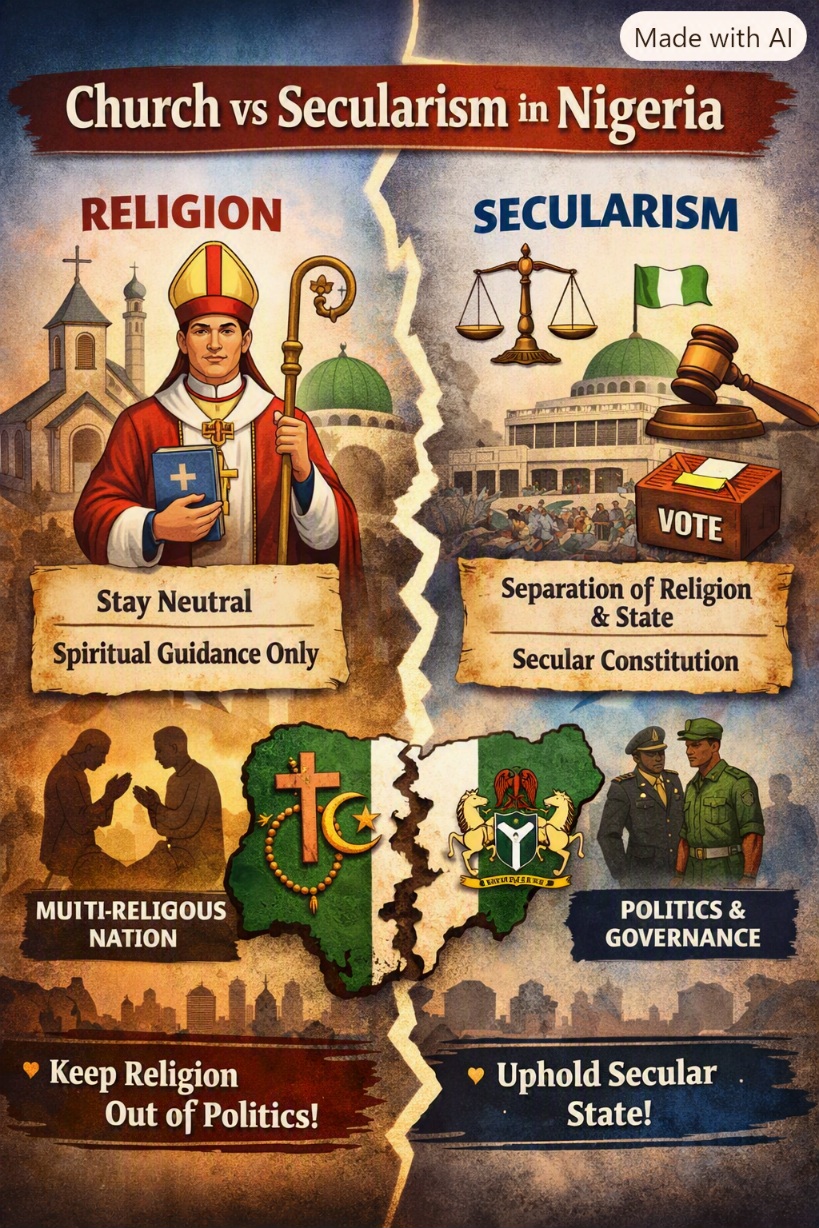
Nigeria, by contrast, is in Africa, and at the time those changes were taking place in Europe, it was not even conceptualized. It was only in 1914 that Nigeria came into being, and by then the Church had long lost its power to influence the State. The consensus had already been established that there must be separation between secularism and political authority. Moreover, Nigeria is a multi‑religious nation, made up of adherents of different faiths and religions. This fact is stated unequivocally in the Constitution, even though the governing elites, in their pretentiousness, may wish to turn a blind eye to Nigeria’s secular character.
Therefore, it should be clear to Catholic Bishops and other religious clergy that religion has no place in the governance of the country. They should remain apolitical, neutral, and focused on spiritually guiding only those who seek such guidance. Any clergy—of whatever hue, color, or persuasion—who is so concerned with politics that he desires to cross the line of spirituality into the realm of political governance should derobe himself and step into the arena of political contestation. In that case, any dust raised from such a political wrestling match would rightly touch him. Otherwise, they should steer clear of politics altogether.
Conclusion
The lessons of Europe’s long struggle between the Church and secularism remind us that governance thrives when religion remains a matter of personal faith rather than political authority. Nigeria’s constitutional secularism must be upheld, ensuring that clergy remain spiritual guides, not political actors.