By Okoi Obono-Obla
Frugality, austerity, prudence and conservatism may be necessary ingredients for leadership, particularly in personal conduct and public probity, but they are not the prerequisites for good and transformative leadership. In fact, when mistaken for an economic philosophy, tightfistedness becomes an obstacle to transformation.
Frugality is essentially a defensive virtue. It is good for stabilization — it stops leakage, curbs waste and balances books. It preserves what exists. Transformative leadership, however, is offensive. It requires vision, risk-taking, massive investment, and the courage to build what did not exist before.
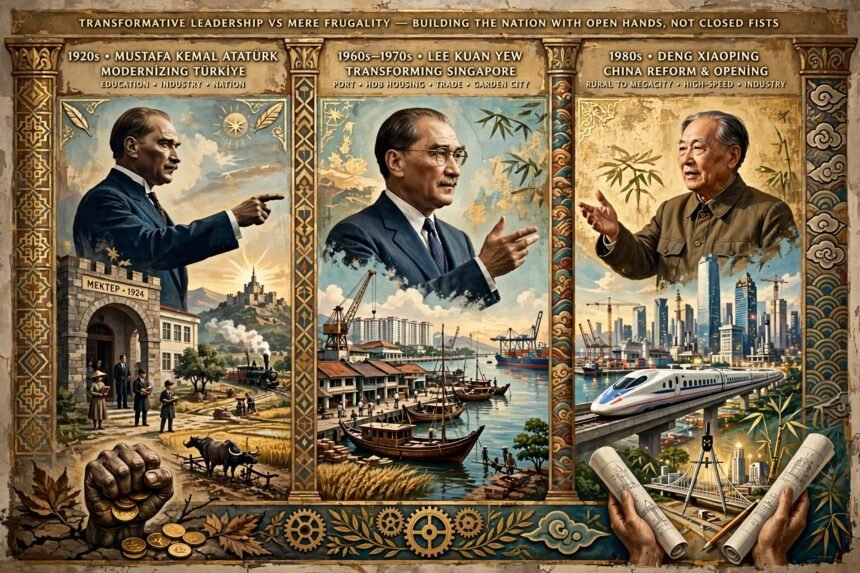
We saw such leadership in Mustafa Kemal Atatürk, who transformed the Ottoman Empire — derided at the time as the “sick man of Europe” — into the modern, secular and progressive Republic of Türkiye in 1923. Atatürk was personally austere, but his project was not frugal. He abolished the Sultanate and Caliphate, replaced Sharia with a secular civil code, changed the Arabic script to Latin, and built new institutions, schools and industries from scratch. A merely tightfisted conservative could never have attempted it.
We saw it in Lee Kuan Yew, who transformed Singapore from a colonial trading outpost at independence in 1965 into a First World, industrialized and technologically advanced nation within a generation. He was famously disciplined and incorruptible, but his strategy was based on extravagant productive investment — in public housing, in Changi Airport and the port, in English-language education, and in incentives to attract multinational corporations. He saved on corruption and consumption, but spent heavily on capacity.
We saw it also in China, where leadership from Mao Zedong’s unification in 1949 to Deng Xiaoping’s reforms from 1978 onwards transformed a poor, feudal and fractious nation into the world’s second-largest economy by 2010. That transformation was the opposite of austerity. It was achieved by abandoning self-reliance for special economic zones, massive infrastructure, and the wholesale import of foreign capital and technology.
The lesson is clear: transformative leaders are frugal with consumption, but extravagant with investment in institutions, infrastructure, human capital and national vision. Where leadership fails is when it mistakes not spending money for good governance.