

By Professor Anthony Ejiofor
“Righteousness exalts a nation, but sin is a reproach to any people.” — Proverbs 14:34
Nigeria stands today at yet another defining moment in her democratic journey.
Our nation has survived military dictatorships, civil unrest, constitutional crises, electoral violence, and deep ethno-religious divisions. Through every storm, our greatest national asset has remained the hope that democracy, however imperfect, would continue to provide peaceful avenues for resolving our differences.

That hope must never be taken for granted.
Today’s judicial developments surrounding the registration of the Nigeria Democratic Congress (NDC) have understandably generated anxiety across the country. Whether viewed strictly through the prism of law or through the wider lens of politics, the implications extend far beyond the fate of one political party. They touch the very soul of Nigeria’s constitutional democracy.
This letter is, therefore, not an attack on any institution or political party. It is a patriotic appeal—a plea to every custodian of our democracy to appreciate the enormous weight of the present moment and to act with wisdom, restraint, transparency, and fidelity to the Constitution.
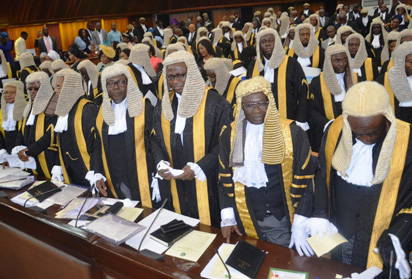
To the Nigerian Judiciary
The judiciary occupies a sacred position in every constitutional democracy.
It commands neither armies nor police forces. Its authority rests entirely upon public confidence in its impartiality.
Every judgment of the courts may satisfy one side and disappoint another. That is inevitable. But when judicial decisions touching the political destiny of the nation appear inconsistent, arrive in rapid succession, or produce consequences that dramatically reshape the electoral landscape, the courts carry an even greater responsibility to ensure that justice is not only done but is manifestly seen to have been done.
The recent reversal of the judgment leading to the registration of the NDC may well be legally defensible on procedural grounds. Questions surrounding the right of an interested party to be heard are genuine legal issues deserving judicial attention.
Yet legality alone does not exhaust judicial responsibility.
Courts must also remain conscious of the broader constitutional environment in which their decisions operate. Judicial rulings do not occur in a political vacuum. They influence public confidence, democratic participation, and national stability.
In a nation already burdened by deep mistrust of public institutions, every politically significant judgment inevitably becomes a referendum on judicial independence.
The judiciary must therefore continue to guard its most precious possession—its credibility.
To the Independent National Electoral Commission
The framers of our Constitution envisioned INEC as an impartial umpire—not as an interested participant in political contests.
Its independence is indispensable to democracy.
Millions of Nigerians must continue to believe that the Commission administers elections fairly, treats every political association equally, and applies the law without fear or favor.
Whatever legal disputes arise regarding party registration should be handled with scrupulous transparency and constitutional fidelity.
The Commission should avoid every action, omission, or appearance that could reasonably fuel public suspicion that the electoral playing field is being tilted in favor of any political interest.
Democracy survives not only on legality but also on legitimacy.
Legitimacy depends upon trust.
Trust depends upon transparency.
To the Federal Government
Governments are judged not merely by what they do but also by what citizens believe they are capable of doing.
The administration of President Bola Ahmed Tinubu bears a profound constitutional responsibility to reassure Nigerians that the democratic space will remain open, competitive, and inclusive.
The Government may insist—and perhaps sincerely believe—that it has no hand in ongoing judicial proceedings.
Yet statesmanship demands more than legal denials.
It requires actively nurturing public confidence that political competition will be decided by the sovereign will of the people and not by institutional advantage.
Nigeria’s democracy cannot flourish if significant segments of the population begin to believe that opposition parties are being weakened through administrative, judicial, or procedural means rather than defeated at the ballot box.
Whether such perceptions are accurate is almost secondary to the damage they can inflict if left unaddressed.
Perceptions shape trust.
Trust shapes stability.
Stability sustains nations.
The Danger of Democratic Perception
History teaches us that democracies rarely collapse overnight.
They weaken gradually whenever citizens begin to lose faith that elections can genuinely change governments.
Nigeria’s young population is increasingly politically conscious, technologically connected, and deeply invested in questions of accountability and good governance.
Many of these young Nigerians rallied behind alternative political visions during the 2023 elections.
Many continue to place their hopes in opposition politics.
If future legal and administrative developments are widely interpreted—rightly or wrongly—as calculated attempts to narrow political competition or frustrate the emergence of viable alternatives, such perceptions could deepen public cynicism, fuel voter apathy, and intensify political tensions.
This concern is especially acute because supporters of Mr. Peter Obi and other opposition figures already believe that the events surrounding the 2023 elections were deeply contentious. Against that backdrop, any development affecting opposition parties is likely to be viewed through an already skeptical lens.
It is therefore in the national interest that public institutions conduct themselves in ways that minimize, rather than reinforce, suspicions of partisan advantage.
Healthy democracies require robust competition.
Strong governments are strengthened—not weakened—by credible opposition.
History across the world demonstrates that dominant-party systems often begin not with constitutional amendments but with the gradual shrinking of political space.
Nigeria’s constitutional democracy was never designed to produce permanent rulers or permanent opposition.
Its genius lies precisely in allowing the people to determine, through free and fair elections, who governs and who does not.
Every institution of state should therefore zealously protect—not inadvertently diminish—that democratic competition.
The Stakes for 2027
The 2027 general elections are no longer a distant event.
Political parties are organizing.
Coalitions are emerging.
Citizens are making decisions.
Investors are watching.
The international community is observing.
Every judicial decision, every administrative action, and every political signal sent today contributes to the credibility—or otherwise—of those elections.
Nigeria cannot afford another electoral cycle overshadowed by widespread allegations of institutional bias.
The country deserves an election in which every contestant enters the race on equal constitutional footing.
Only such an election can confer unquestionable legitimacy upon its eventual winners.
Let Peace Be Given a Chance
Nigeria has paid dearly for political arrogance.
We have paid for exclusion.
We have paid for intolerance.
We have paid for institutional mistrust.
We should not pay again.
Our ethnic diversity is delicate.
Our religious diversity is delicate.
Our regional balance is delicate.
Our democracy itself remains a work in progress.
Every institution entrusted with constitutional authority must,therefore, act with extraordinary wisdom.
The Judiciary must remain fiercely independent.
INEC must remain unquestionably impartial.
The Government must remain visibly committed to democratic openness.
These are not favors to the opposition.
They are obligations owed to Nigeria.
History Is Watching
One day, future generations will read the story of this era.
They will ask whether our institutions rose above partisan interests.
They will ask whether those entrusted with power defended democracy or merely administered it.
They will ask whether Nigeria chose constitutional statesmanship over political expediency.
May our answers be worthy of history.
May justice never become vulnerable to suspicion.
May elections never become vulnerable to manipulation.
May democracy never become vulnerable to despair.
Above all, may every arm of government remember that political power is temporary, but the Republic is permanent.
Let justice remain blind.
Let democracy remain open.
Let the people decide.
Only then shall Nigeria truly move forward in peace, unity, and constitutional dignity.
—-
Prof. Anthony Ejiofor is an academic, public intellectual, and community leader engaged in issues of governance, development, and the future of Nigeria