
By Okoi Obono-Obla
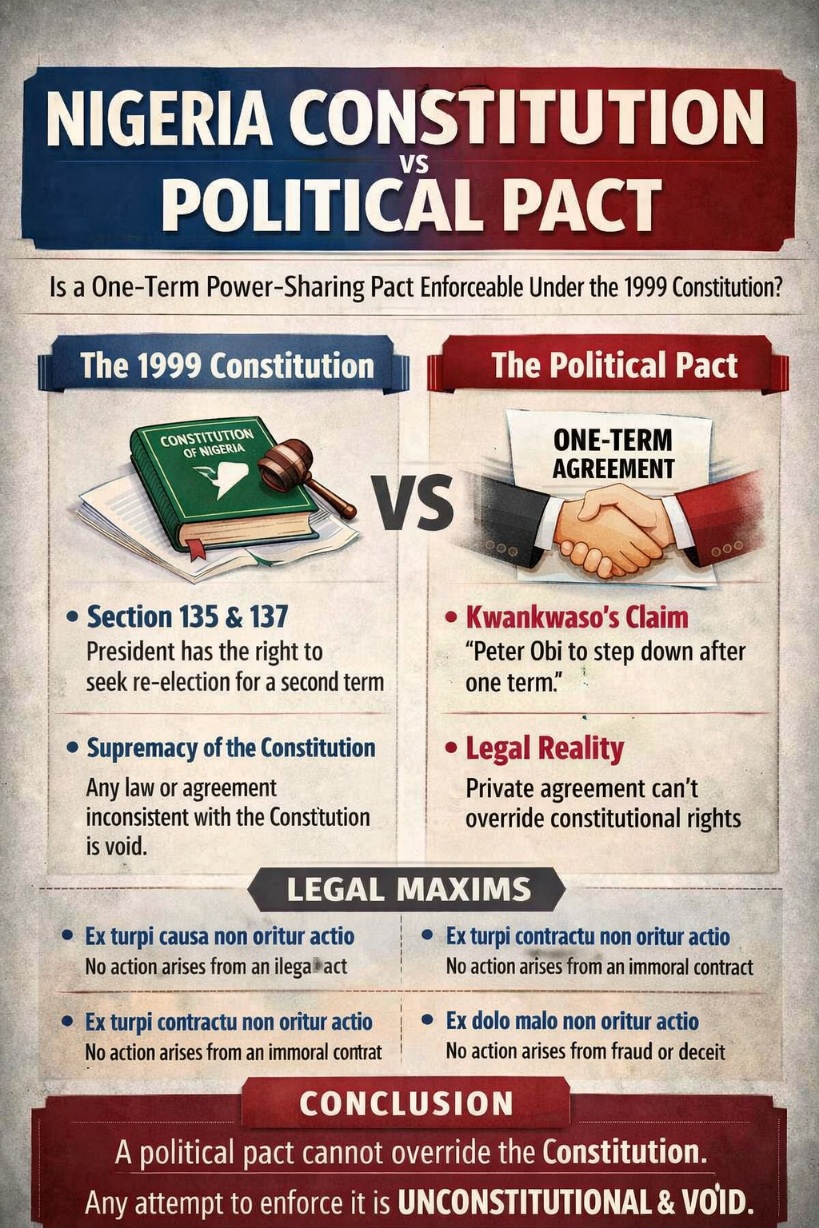
Is a One-Term Power-Sharing Pact Enforceable Under the 1999 Constitution?
In his interview with Channels Television on 20th July, 2026, H.E. Rabiu Kwankwaso, the Vice Presidential candidate of the Nigerian Democratic Congress [NDC], stated that there was a written agreement to the effect that H.E. Peter Obi will transmit power to the North after spending one term in office.

The apposite question is: will the purported agreement be enforceable in the eyes of the law?
Section 135(2) of the Constitution of the Federal Republic of Nigeria, 1999 (as amended) provides for a four-year tenure for the office of the President, while Section 135(2)(b) and Section 137(1)(b) of the Constitution explicitly guarantee the right of an incumbent President to seek re-election for a second and final term of another four years. Section 135 provides thus: “Subject to the provisions of this Constitution, a person shall hold the office of President until – (a) when his successor in office takes the oath of that office; (b) he dies whilst holding such office; or (c) the date when his resignation from office takes effect; or (d) he otherwise ceases to hold office in accordance with the provisions of this Constitution.”
Let us project into the future to 2031. In the event that Mr. Peter Obi wins the 2027 presidential election and becomes President of the Federal Republic of Nigeria and thereafter decides to renege on the agreement, can this agreement be enforced against him, considering his constitutional right to re-contest for a second term?
It is a fundamental principle of law that any contract or agreement that is at variance with the Constitution or any statute is void and unenforceable. Section 1(1) and (3) of the 1999 Constitution declares its supremacy and provides that: “If any other law is inconsistent with the provision of this Constitution, this Constitution shall prevail, and that other law shall to the extent of the inconsistency be void.”
A private political agreement cannot circumscribe, abridge or waive a constitutional right expressly conferred by the grundnorm. An agreement that seeks to prevent a qualified citizen from exercising his right to contest under Section 137 is inconsistent with the Constitution and is void ab initio. The Courts will not lend their judicial powers to enforce it.
This position is fortified by the well settled Latin maxims: Ex turpi causa non oritur actio – out of a base or illegal cause, no action can arise; Ex turpi contractu non oritur actio – no action arises from an immoral or illegal contract; and Ex dolo malo non oritur actio – no action can arise from fraud or deceit. Political arrangements that seek to subvert constitutional order are regarded as contracts contrary to public policy.
CONCLUSION
In sum, the purported one-term written pact, even if duly executed, is a political understanding with no legal enforceability. It is at best a moral obligation founded on political trust, not a justiciable contract. It cannot override Section 135 and Section 137 of the 1999 Constitution. Any attempt to enforce it in 2031 would be struck down as unconstitutional, void and unenforceable.