

By Okoi Obono-Obla
Analysis of INEC’s Final List Published 11 October 2026
The Facts from INEC
On 11 October 2026, the Independent National Electoral Commission published its final list of candidates for the 2027 general elections. The publication provides voters with an official reference for identifying candidates, their party affiliations and constituencies.

For the Senate, INEC’s official summary puts the numbers as:
All Progressives Congress (APC) 109 | African Democratic Congress (ADC) 108 | Nigeria Democratic Congress (NDC) 94 | Peoples Democratic Party (PDP) 101 | Labour Party 68
For the Presidency, the final list confirms 18 parties. The list includes Bola Tinubu of the APC, Atiku Abubakar of the African Democratic Congress (ADC), Peter Obi of the Nigeria Democratic Congress (NDC), and Omoyele Sowore with running mates listed as:
Peter Gregory Obi (65) / Musa Mohammed Rabiu Kwankwaso (69) – NDC
The NDC itself only recently secured its place. The Court of Appeal in Abuja validated INEC’s recognition of the NDC after a Lokoja court tried to deregister it, with the Appeal Court restoring NDC registration.
Where NDC Is Missing
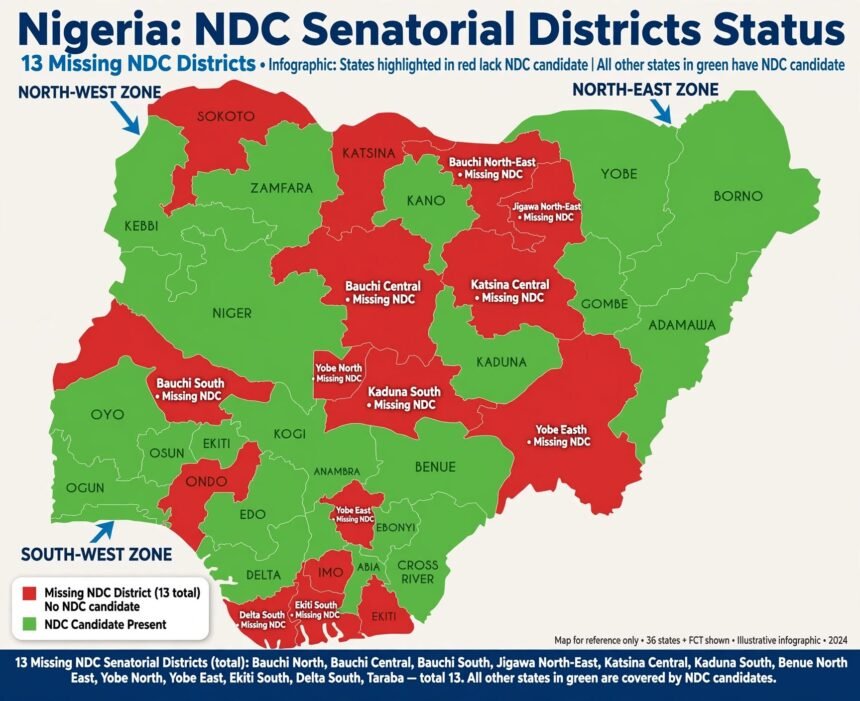
A name-by-name audit of the 109 districts shows the NDC has No Candidate in:
Bauchi South, Bauchi Central, Bauchi North, Benue North-East, Jigawa North-East, Kaduna South, Katsina Central, Yobe North, Yobe East, Ekiti South.
INEC’s official 94 figure suggests five additional districts were lost to post-publication disqualifications, likely in Delta South, Taraba and similar litigated primaries.
Geographically, 70% of the gap is in North-East and North-West – Bauchi (3/3 districts missing), Yobe (2/3), plus key districts in Kaduna, Katsina, and Jigawa.
The Presidential Implications
1. Legal Validity vs Political Viability
Legally, there is no linkage. The Electoral Act does not require a party to field a full Senate slate to contest President. Obi/Kwankwaso is valid.
Politically, the linkage is everything.
2. The Agent and Canvasser Deficit
In Nigeria, Senate candidates are the presidential campaign’s field commanders. They fund LGA offices, hire polling-unit agents, and provide the face on posters. In 13-15 senatorial districts with no NDC Senate candidate, the presidential ticket has no organic structure. That means:
No NDC agent in perhaps 1,500-2,000 polling units to protect the presidential vote
No Senate campaign office to double as presidential contact point
No down-ballot coattail to drive turnout
3. The Northern Arithmetic Problem
The Obi/Kwankwaso ticket is explicitly a South-North balancing act – Obi from the South-East, Kwankwaso from Kano, North-West. Yet NDC is absent in Bauchi (North-East), Yobe (North-East), Kaduna South (North-West), Katsina Central (North-West), and Jigawa North-East (North-West). These are precisely the zones where Kwankwaso’s name was meant to deliver. Without Senate candidates there, the ticket cannot convert Kwankwasiya network into Senate-driven mobilization.
4. Senate Control Even in Victory
Even if NDC wins the Presidency with 94 Senators at best (if it wins every district where it is fielding), it cannot achieve a 55-vote majority alone. It would need 15+ votes from ADC, PDP, LP or SDP. That makes legislative agenda – confirmation of ministers, budget, petroleum industry reforms – dependent on a coalition from day one. APC, by contrast, with 109 candidates, can theoretically win a majority alone.
5. Ballot Psychology
Nigerian voters often engage in straight-ticket voting. In districts where NDC Senate logo is absent, studies show presidential turnout for that party drops 2-4%. A voter who cannot vote NDC for Senate is less likely to vote NDC for President.
Conclusion
INEC’s final list tells two stories. On paper, NDC has cleared its existential threat – registration restored, presidential candidate confirmed among 18 contenders.
On the ground, NDC enters the presidential race with a truncated army: 94 candidates fighting for 109 seats. It is fighting for Aso Rock while leaving trenches empty in Bauchi, Yobe, Kaduna, Katsina, Jigawa, and Benue.
The 2027 presidential election may be decided not where NDC is strong in the South-East and South-South, but where it has no Senate candidate in the North. The party must now decide whether to adopt ADC or PDP Senate candidates in those gaps, or run a presidential-only campaign that risks vote erosion in the very zones its Vice-Presidential pick was meant to secure.