By Okoi Obono-Obla
From Beecroft Street to Bioko: The Man Who Renamed Ugep and Mapped Colonial Power in the Bight of Biafra
The popular street in Calabar, Cross River State, known as Beecroft Street, was named after John Beecroft (1790 – 10 June 1854) — a British mariner, explorer, and colonial administrator who played a major role in advancing British colonial interests in Nigeria in the 19th century. It is on this historic street that the Methodist Church, Wesley Cathedral, is situated.
John Beecroft was born near Whitby, Yorkshire, England. In 1829, he was appointed Master of Works in Fernando Po, an island in the Gulf of Guinea nominally belonging to Spain but which the British were using as a base against the slave trade. Demonstrating a talent for negotiation, he was made Acting Governor by Spain in 1830. Although the British officially left the island in 1833, he effectively continued in office. In 1843, Spain formally appointed him Governor of Fernando Po and two other Spanish possessions.

In 1849, he was appointed by the British Government as Consul of the Bights of Benin and Biafra — a vast consular district stretching from present-day Gabon to the Republic of Benin — a position he held alongside his governorship of Fernando Po until his death. The local people of Cross River State knew Fernando Po as “Panya.” Today it is known as Bioko Island in Equatorial Guinea.
As Consul, Beecroft enforced treaties against the slave trade, mediated succession disputes — including reinstating Oba Akintoye in Lagos during the British bombardment of 1851 — negotiated and signed the Treaty Between Great Britain and Lagos of 1 January 1852, and projected naval power to curb human trafficking and piracy. His tenure exemplified gunboat diplomacy, blending modern steam navigation with pragmatic local alliances.
During his time as Governor, he explored the interior of Africa using steamships to navigate far up the Niger River, the Cross River and the Benin River — areas official British expeditions had failed to penetrate. He succeeded because he employed local Africans as crew who had greater resistance to malaria.
He was probably one of the first Europeans to navigate the Cross River from Calabar, a distance of about 120 miles, passing through Itu in present-day Akwa Ibom State, through present-day Odukpani, Akamkpa, and Biase to Abi, Yakurr, Obubra and Ikom.
Oral tradition credits him with the change of name from Umor to Ugep in Yakurr Local Government Area. According to the account, when his steamer reached Ediba in present-day Abi LGA, he sighted Umor and asked the natives there, who belong to the Bahumono group, what country he was sighting. They told him “Ohep” but he recorded it as “Ugep” in his diary. Ugep is just about 10 kilometres from Ediba. That is how the name Ugep came to be, although the people still call it Umor Otutu.
I was therefore pleasantly surprised when someone reacting to my earlier post on Agwagwune and its role as middlemen in the slave trade suggested that John Beecroft never sailed along the Cross River. I was glad that Professor Frank Enor of the Department of History and International Studies, University of Calabar, confirmed Beecroft’s expedition:
“Fascinating read; your research on Atam, the slave trade, and Agwagwune’s role as middlemen is well-supported by history. Also noteworthy is John Beecroft’s 1840s expedition to the Cross River, where he served as British Consul to oversee trade at the Bights of Biafra and Fernando Po, adding depth to your narrative. During the voyage up the river, a lad on board pointed to Atam, his village. He informed the crew that he was taken away from there and sold into slavery at the demise of his parents.”
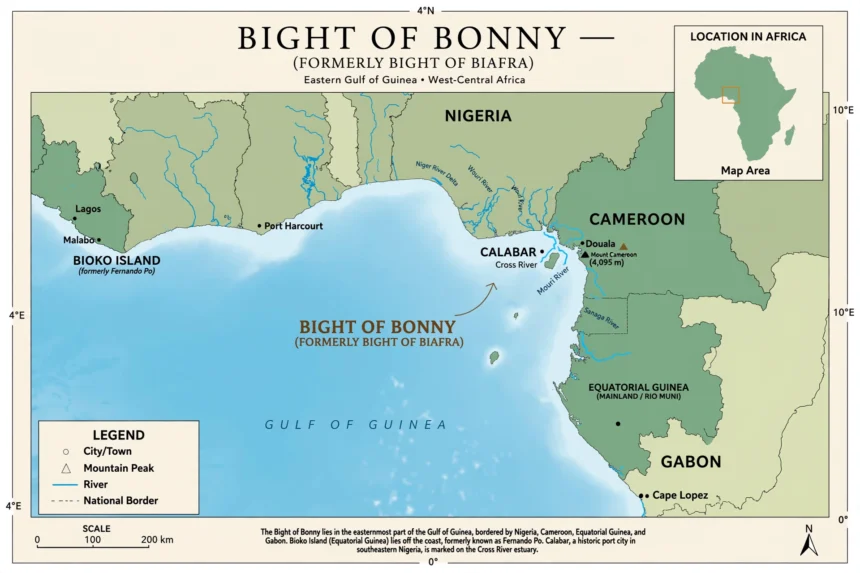
The straight-line distance from Calabar to Fernando Po is about 87 miles (140 kilometres) across the Bight of Biafra. When we were growing up in the 1970s, there were many people from Cross River who went to Equatorial Guinea as indentured labourers. This culminated in the 1976 Evacuation, when Nigeria famously evacuated over 30,000 of its citizens following extreme exploitation and violence under the regime of Francisco Macías Nguema.
It is important to note that the Nigerian Government promulgated a law in 1975 officially changing the name of the Bight of Biafra to the Bight of Bonny. By the Bight of Bonny Act of 1975, which commenced on 17th January 1975, it was provided that “the bight on the south-east coast of Nigeria hitherto known as the Bight of Biafra shall from henceforth and for all purposes be known as the Bight of Bonny”. This was done to erase the name Biafra, which evokes sharp memories of the secession of Eastern Nigeria in 1967. In that year, the Eastern Region seceded and adopted the name of its coastline, becoming the independent Republic of Biafra, resulting in the civil war fought from 1967 to 1970.
John Beecroft died on 10 June 1854 in Clarence, Fernando Po, after 25 years of residence in Africa, and was buried with full naval honours. His career marks the transition from informal British commercial influence to formal colonial control — from the exploration of the Cross River to intervention in Lagos. Today, Beecroft Street, the Bight of Bonny, and the name Ugep itself remain physical reminders of that complex history.