By Okoi Obono-Obla
I appeared on Silverbird Television today to discuss the remarks made by the President when Catholic Bishops paid him a courtesy visit.
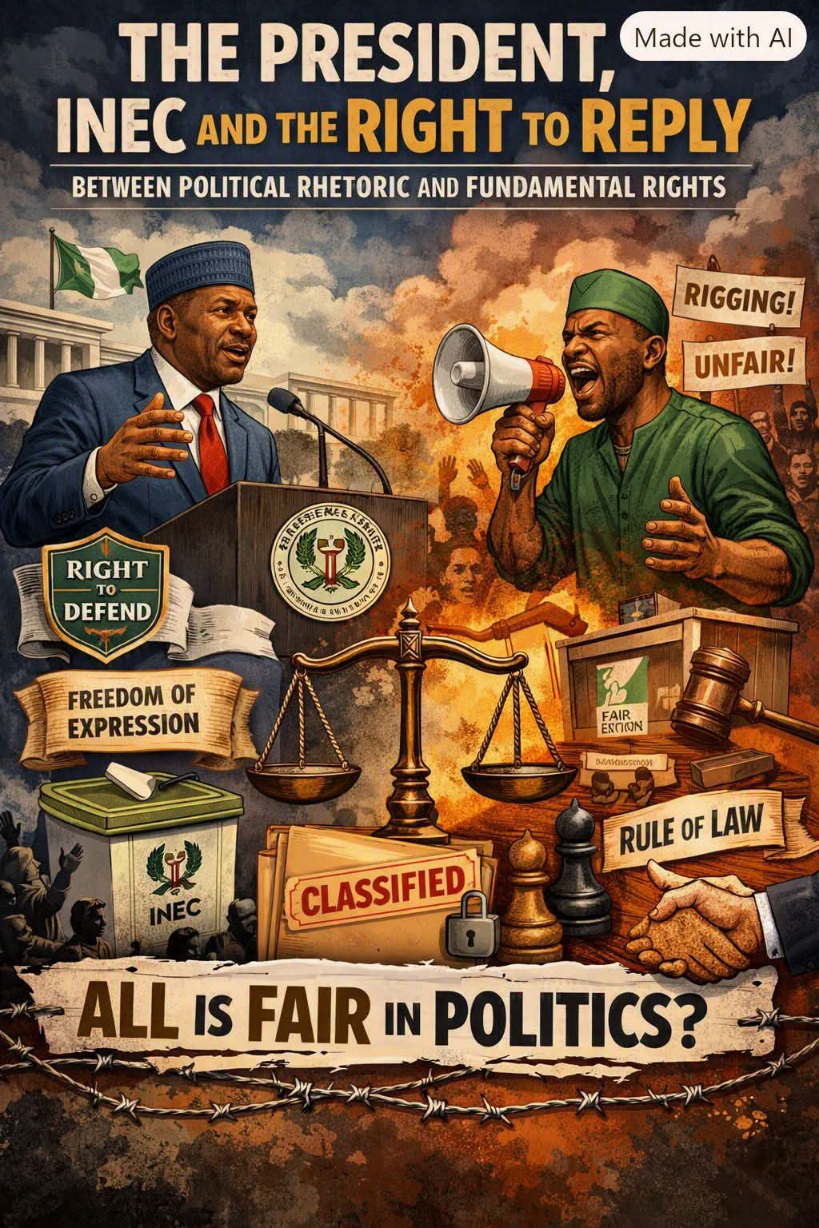
The anchor asked me whether it was acceptable for the President, while responding to the Bishops, to have said that he is not intimidating the opposition, that INEC is not intimidating the opposition, and that in politics, all is fair.
My answer was clear: the President’s statement has two possible interpretations, depending on the context from which one chooses to view it.

In my view, the President was merely defending himself and defending an important institution of government such as the Independent National Electoral Commission, INEC, against an allegation made by the opposition. He was also advising the opposition to go and mobilize, organize itself, and persuade the electorate to support it, rather than expecting the President to do that for it.
The anchor then countered that as a leader of a household, I am required to weigh certain things before I say them before members of my household or children.
I responded that the President did not say anything outrageous.
It is important to remember a fundamental legal principle: becoming President of a country does not strip a person of his fundamental human rights. The President retains his right to freedom of expression, to hold an opinion, and to defend himself against allegations made against him and against institutions of government.
What changes with the Presidency is not the existence of these rights, but the manner of their exercise. By virtue of his exalted office, the President voluntarily accepts certain constitutional limitations. He cannot conduct private business, his privacy is drastically reduced, and his movements are circumscribed by security protocol. But he does not lose his right to speak.
Defending himself and INEC when accused of intimidating the opposition falls squarely within permissible political speech. It would only become impermissible if, in doing so, the President disclosed classified information, prejudiced a pending judicial proceeding, or ordered unlawful action against the opposition. To simply say “the allegation is not correct” does not cross that line.
As for the phrase “all is fair in politics,” it is a common political idiom. Read descriptively, it only means that politics is a fierce, no-holds-barred contest where accusations will fly. Read literally and normatively, it could be misinterpreted to suggest that lawlessness is permissible, which would be contrary to the President’s oath to uphold the Constitution.
That is a question of prudence in communication, not a question of legality or of outrageous conduct. The President was engaged in political rhetoric, defending his administration and urging the opposition to do the hard work of democratic competition.
At that point, the anchor called off the conversation and suggested that another day would be set aside to conclude the discussion on what the President said to the Catholic Bishops and its appropriateness.
I look forward to that continued conversation.