
By Okoi Obono-Obla
Non-Conviction Forfeiture and Criminal Trial under the Proceeds of Crimes (Recovery and Management) Act, 2022
The Proceeds of Crimes (Recovery and Management) Act, 2022 establishes a unified legal framework for the seizure, confiscation, forfeiture, and management of assets or properties reasonably suspected of being acquired through unlawful activity or obtained illegitimately. A central innovation of the Act is the Non-Conviction Forfeiture Procedure, which is distinct from the traditional criminal trial.
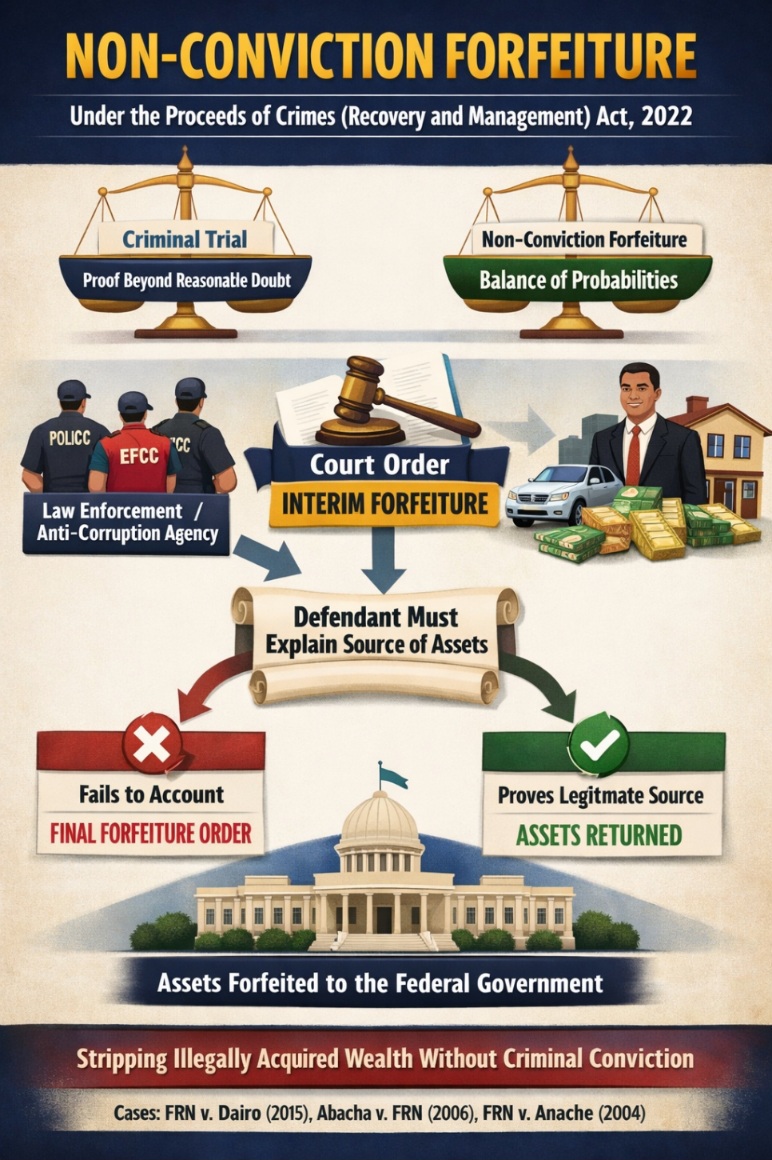
In a criminal trial, proceedings commence through the filing of an information or charge against a defendant who has been investigated and against whom a prima facie case has been established by the prosecuting agency. The defendant is then required to face a full trial, during which the prosecutor must adduce evidence and prove the allegations beyond reasonable doubt.

By contrast, under the non-conviction forfeiture procedure, the burden of proof is based on the balance of probabilities (Section 73 of the Act). This civil standard allows the court to determine whether assets are reasonably suspected of being proceeds of crime without requiring a criminal conviction.
A common misconception is that forfeiture under this procedure amounts to punishment without trial. However, the Act makes clear that forfeiture proceedings do not preclude subsequent criminal prosecution. Where law enforcement agencies or anti-corruption bodies reasonably suspect that a defendant has illegally acquired assets—through activities such as money laundering, drug trafficking, arms dealing, human trafficking, corruption, or other economic and financial crimes—they are empowered under Sections 61–65 to approach the court through an ex parte application.
The court may then order an interim forfeiture of such assets pending when the defendant is put on notice to explain how they were acquired. If the defendant fails to satisfactorily account for the acquisition, the court may order their forfeiture to the Federal Government. The essence of this procedure is to strip the defendant of the benefit of enjoying assets derived from unlawful activity and to deprive him of their use.
Judicial Affirmation in Nigerian Courts
This mechanism has been judicially affirmed in several Nigerian cases:
– FRN v. Dairo (2015) LPELR-25906(CA) – The Court of Appeal upheld forfeiture where the defendant failed to establish lawful acquisition of assets.
– Mohammed Abacha v. FRN (2006) 4 NWLR (Pt. 970) 239 – The Supreme Court recognized the state’s power to recover proceeds of crime even outside the strict confines of criminal conviction.
– FRN v. Anache (2004) 14 NWLR (Pt. 894) 243 – The court emphasized that forfeiture proceedings are civil in nature and distinct from criminal liability.
– FRN v. Ikedi Ohakim (Unreported, 2021) – The Federal High Court ordered interim forfeiture of assets linked to corruption allegations, reinforcing the preventive purpose of the Act.
– More recently, forfeiture orders have been upheld in proceedings involving public figures such as Abubakar Malami, Godwin Emefiele, and Aisha Achimugu, underscoring the deterrent effect of the law.
Conclusion
The Proceeds of Crimes (Recovery and Management) Act, 2022 thus creates a dual framework:
– Criminal trial requiring proof beyond reasonable doubt, and
– Non-conviction forfeiture determined on the balance of probabilities.
Together, these mechanisms ensure that crime does not pay, and that illicitly acquired assets are swiftly recovered for the benefit of the state. Nigerian courts, through decided cases, have consistently affirmed the legitimacy of forfeiture proceedings, thereby strengthening the anti-corruption and asset recovery regime.