By Okoi Obono-Obla
FRSC and the Distortion of Nigerian Federalism
The Federal Road Safety Corps (FRSC), Kano Sector Command, has announced its intention to appeal the judgment of the Federal High Court in Kano, which barred its personnel from operating on state and local government roads, restricting their jurisdiction strictly to federal highways. The ruling, delivered on Thursday by Justice M. S. Shuaibu, followed a suit filed by Barrister Abba Hikima, a Kano-based lawyer, and was reported in the Daily Trust online edition of 20 July 2026.
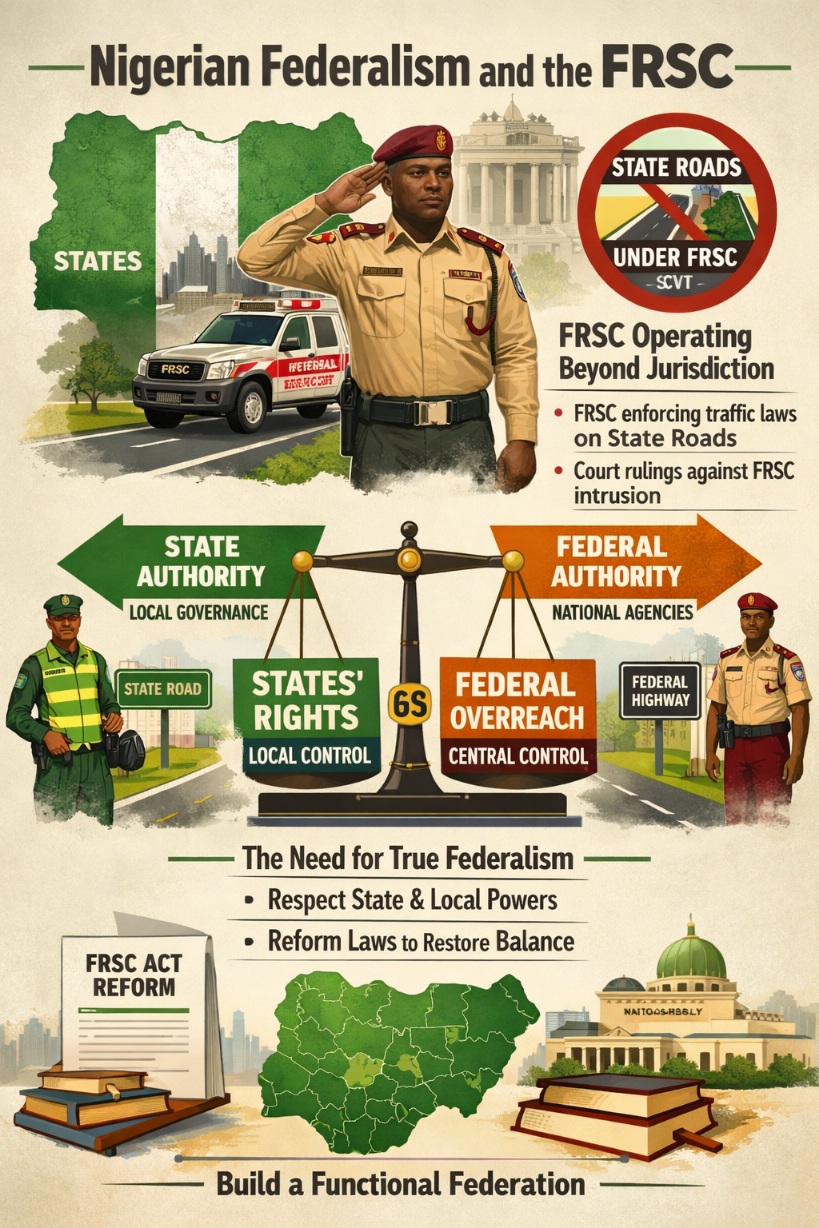
There have been numerous judgments against the FRSC on the issue of its lack of jurisdiction to operate on intercity and state roads construed by state governments, including decisions of the Court of Appeal. These should have guided the FRSC by now, but the agency remains adamant, clinging to its centralized and unified mindset despite Nigeria’s federal system, which clearly demarcates governmental authority and responsibilities between the federal government and the states.

In 2005, my driver was arrested along Marian Road, Calabar, Cross River State, on an alleged traffic offence and fined by FRSC officers. The vehicle was impounded and taken to the FRSC office. I filed an action in the Federal High Court, Calabar seeking a declaration that the FRSC had no power to operate, arrest, and prosecute traffic offenders on a state road maintained by the Cross River State government. I also sought a declaration that the FRSC could only operate along federal highways.
The Federal High Court found in my favour, declaring the arrest and impoundment of my vehicle illegal and unconstitutional. The Court awarded damages of ₦500,000 against the FRSC. Dissatisfied, the FRSC appealed to the Court of Appeal, seeking to overturn the judgment. However, the Court of Appeal dismissed the appeal and upheld the lower court’s decision. The case is reported in the Nigerian Weekly Law Report (2010) as FRSC vs. Barrister Okoi Obono-Obla. The FRSC has since further appealed the judgment to the Supreme Court.
The importance of this case to Nigerian constitutional development cannot be overstated, as it touches on the vexed question of devolution of powers in a federal configuration. Why should the FRSC, an agency of the federal government, enforce traffic laws on state roads and collect revenue from traffic offenders on roads constructed and maintained by state governments? This case underscores the distortion of federalism in Nigeria and the overbearing influence of the federal government on the states.
There is no reason why states should surrender their right to enforce traffic laws on roads they construct and maintain. Nothing prevents state governments from establishing agencies similar to the FRSC within their jurisdictions.
The Federal Road Safety Commission Act is not the only legislation that infringes on the powers and responsibilities of state and local governments. Numerous such laws exist, and they must be repealed or reformed to make the country work optimally. The time has come for the National Assembly to reform all laws that distort the practice of federalism, so that the federal government can concentrate on areas within its legislative competence and avoid encroaching on matters that fall within the ambit of state and local governments. States and local governments must remain vigilant to ensure that the federal government does not encroach on their constitutional responsibilities.
Conclusion
The FRSC’s insistence on operating beyond its constitutional jurisdiction highlights the urgent need for Nigeria to realign its federal structure. True federalism requires respect for the autonomy of states and local governments. Reforming laws that distort this balance is essential for building a functional federation where each tier of government operates within its rightful domain.