

By Okoi Obono-Obla
Nigeria is once again approaching a defining moment. As we prepare to go to the polls to elect a President and members of the National Assembly, we must speak plainly about the forces that threaten our peace, our unity and our stability.
I listened with keen interest to Senator Smart Adeyemi on TVC. He spoke not merely as a politician, but as a seasoned journalist, a former President of the Nigerian Union of Journalists, and a man who understands the weight of words. His message was timely, courageous and profoundly patriotic.
Senator Adeyemi reaffirmed what geography and history have long established: he is a Yoruba man and a Northerner, because Kogi State is geographically one of the Northern States of Nigeria, in the North Central geopolitical zone. That identity matters, because it demolishes the lazy assumption that the North is one ethnic bloc, or that a demand for fairness must come only from the South.
His central message was about Atiku Abubakar, and it deserves the attention of every Nigerian.
A Dubious Position on Zoning
Atiku’s position on zoning has become dubious, shifting with the political season.
At one time, he told Nigerians that there is no zoning in the Constitution, that the Constitution has not barred anyone from running, and that he, as a member of the constituent assembly that drafted the current Constitution, knew there was nothing like zoning in it.
At another time, he has said there is no universal agreement on zoning, that only the PDP has zoning in its constitution.
And yet at another time, he has said he supports rotation and would even pursue a constitutional amendment to make rotational presidency a formal provision if elected.
Then, when the question becomes whether the opposition should zone its 2027 ticket to the South so that the South can complete its turn, he calls that idea self-defeating and intellectually dishonest.
Which Atiku should Nigerians believe?
A principle that changes to suit ambition is not a principle. It is convenience. And a man who treats a national understanding as disposable whenever it stands in the way of his ambition cannot be trusted with the unity of this country.
The 1998 Understanding
Senator Adeyemi reminded us of what many younger Nigerians may not know: in 1998, Nigerian leaders reached an accord to zone the presidency between the North and the South.
Atiku Abubakar was in that meeting.
So were men like Alhaji Adamu Ciroma, Dr. Alex Ekwueme, Professor Jerry Gana, Chief Sunday Awoniyi and other patriots who understood that Nigeria could only survive if power was shared fairly, if no section felt permanently excluded, and if the wounds of June 12 were healed through inclusion rather than domination.
That understanding was not written in the Constitution as a clause, but it was written in the conscience of the nation. It was a moral compact. It produced stability. It gave every part of Nigeria a sense of belonging.
To now pretend that no such understanding existed, or that it means nothing, is not merely dishonest. It is dangerous. It tells Nigerians that agreements mean nothing when ambition is at stake.
Ethnic Sentiment Instead of Statesmanship
Even more troubling is the manner in which Atiku has pursued this ambition.
Rather than rising above ethnicity, Senator Adeyemi argues, Atiku has invoked ethnic sentiment. Rather than building a national consensus, he has appealed to sectional feeling to justify cutting short the turn of the South.
That is the opposite of statesmanship.
A statesman unites. A statesman calms fears. A statesman tells his own people hard truths when necessary, even when those truths are politically inconvenient.
What we have seen instead is a politics driven by vaulting ambition — an ambition that has taken the better of judgment, and now poses a grave danger to national stability and peace.
Silence Where Courage Was Needed
But the most painful part of Senator Adeyemi’s intervention is this: while Atiku has been loud about his ambition, he has been strangely muted where moral leadership was most needed — the crisis in the North.
The North has bled. Communities in the North-West, North-Central and North-East have suffered banditry, kidnappings, mass killings, displacement and the destruction of livelihoods. Hausa communities and Northern minority communities have buried their dead in numbers too painful to recount.
Where was the thunderous condemnation? Where was the sustained moral outrage of a man who claims he wants to lead the North and Nigeria? Where was the leadership that should have stood with victims, named the evil for what it is, and demanded action without fear or favour?
A man who wants to be President cannot be selective in his compassion. He cannot be energetic about his ambition and lethargic about the pain of his people.
Senator Adeyemi is right: if you cannot condemn the slaughter of your own people, you have no moral authority to ask for their votes.
If the South Is Denied Its Turn
Let us be clear about the consequence.
If the South is denied a second chance to lead the country — if the turn of the South is truncated to satisfy one man’s ambition — it will destabilise Nigeria. It will revive old suspicions. It will confirm the fear that some people believe they are born to rule, and that agreements are made only to be broken.
Nigeria survived because leaders in 1998 chose fairness over domination. Nigeria will only continue to survive if leaders today choose the same path.
The South gave the North eight years under President Buhari. The North must allow the South to complete its eight years under President Tinubu. That is fairness. That is equity. That is stability.
The Lesson of Macbeth: When Vaulting Ambition Destroys a Man
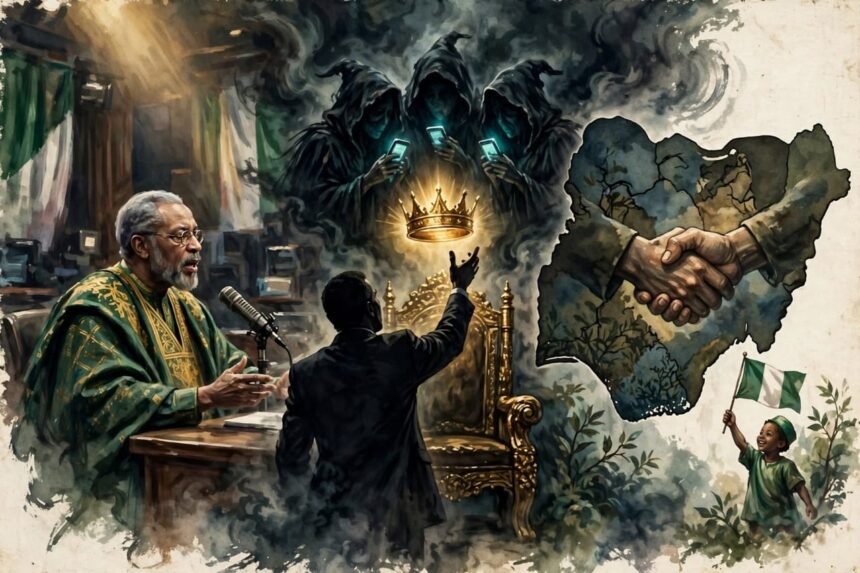
There is a timeless warning in Shakespeare’s Macbeth that fits this moment in Nigeria perfectly.
Macbeth was a brave soldier, a loyal subject, a man of honour. But he had one fatal flaw: vaulting ambition.
The witches did not put a sword in his hand. They only whispered a prophecy: “Thou shalt be king hereafter.”
That whisper was enough. It entered a mind already nursing ambition, and it began to grow.
Then came Lady Macbeth — the voice that egged him on, that mocked his hesitation, that told him a real man does not wait, does not reason, does not respect moral boundaries. She took the prophecy line, hook and sinker, and pushed him to make it come true by any means necessary.
And Macbeth, instead of rejecting the temptation, embraced it.
He murdered Duncan, his king, his guest, his kinsman, to seize the throne. He murdered Banquo, his friend, to secure it. He murdered Macduff’s wife and children to keep it. Each crime was meant to bring peace to his ambition, but each crime only bred more fear, more blood, more tyranny.
In the end, the prophecy destroyed the very man it promised to elevate. The crown he killed to win became a crown of thorns. The ambition that promised greatness delivered madness, isolation and ruin.
That is the lesson for Nigeria today.
Atiku Abubakar, like Macbeth, has heard a prophecy of power — not from witches on a heath, but from sycophants, ethnic champions and political fortune-tellers whispering: “It is your turn. The North must have it now. The South can wait. Break the agreement. Take it.”
And like Lady Macbeth, ambition has whispered to him: Do not be weak. Do not wait. Do not honour the old understanding. Seize the moment.
He has taken it line, hook and sinker.
But Nigeria is not a kingdom to be seized by murder of an agreement. Nigeria is a covenant of peoples. And when a man pursues power by breaking faith, by inflaming ethnic sentiment, by trampling on the understanding that has kept us together since 1998, he does not build a nation — he unmakes it.
Macbeth teaches us that vaulting ambition always overleaps itself. It jumps too far. It destroys the very thing it seeks to possess. The man who will do anything to be king ends up unfit to rule anyone, not even himself.
Nigeria must not become Macbeth’s Scotland — a land turned into a graveyard by one man’s refusal to wait, to respect limits, to honour agreements.
We must reject the politics of the witches’ prophecy — the politics that says power must come now, by any means, at any cost.
We must choose instead the politics of patience, of fairness, of covenant. The South must be allowed to complete its turn. The 1998 understanding must be honoured. The North must be healed, not merely used as a ladder to power.
For if we allow vaulting ambition to have its way, we will learn, as Macbeth learned too late, that the crown gained by betrayal is never worth the blood it costs.
And Nigeria is worth far more than any man’s ambition.