By Okoi Obono-Obla
The interlocutory decision of the Federal High Court, Lokoja, setting aside its previous order directing the Independent National Electoral Commission (INEC) to register the National Democratic Congress (NDC), carries serious implications for all activities previously undertaken by the Party. These include congresses to nominate candidates and the subsequent issuance of access codes by INEC to political parties for uploading names, particulars, and other documents to its website, which commenced today, 26 June 2026.
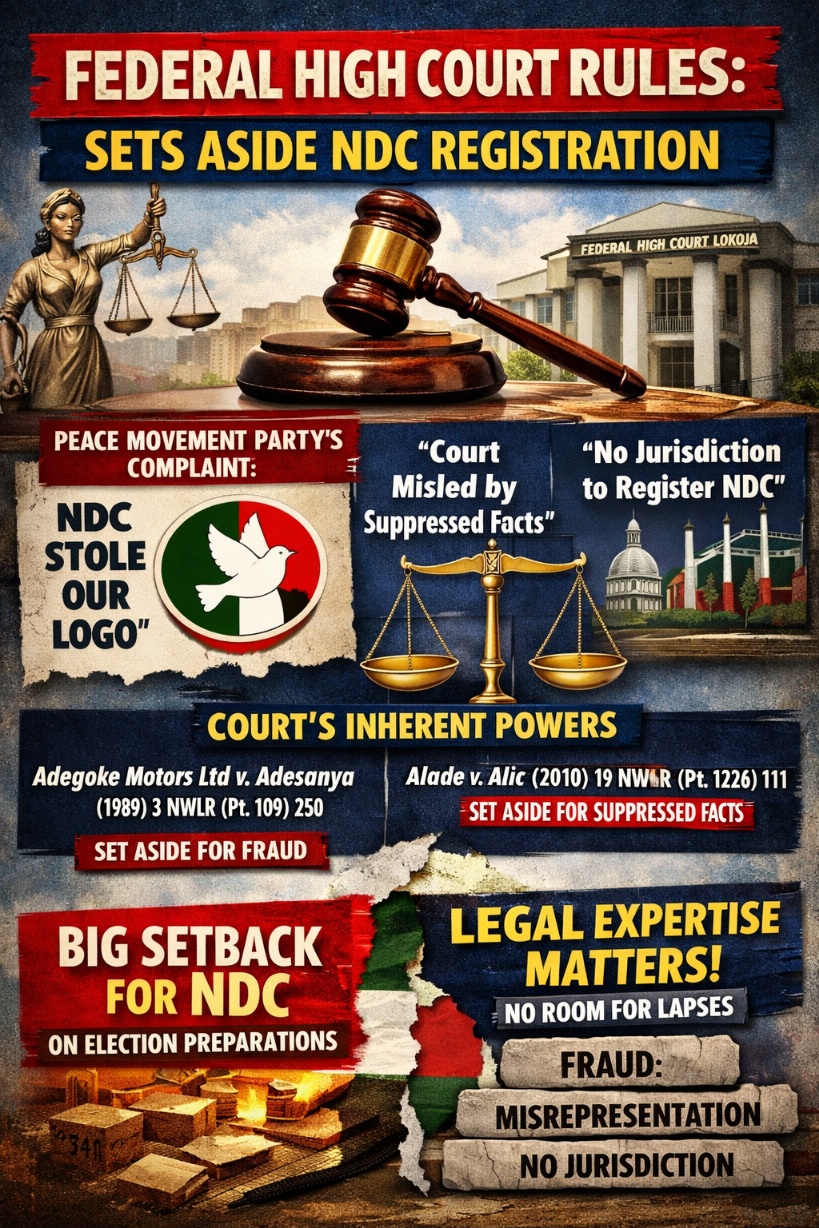
This reversal arose from the granting of an application filed by a political association known as the Peace Movement Party, which alleged that the NDC had stolen its victory logo. The court, unaware of this fact when it initially ordered INEC to register NDC, exercised its inherent jurisdiction to set aside the earlier decision.
It is well established that every court of competent jurisdiction possesses inherent powers to set aside its previous decision where it was misled, where vital facts were suppressed, or where jurisdiction was lacking at the time the order was made. In Adegoke Motors Ltd v. Adesanya (1989) 3 NWLR (Pt. 109) 250, the Supreme Court affirmed that a court has the power to revisit its decision if obtained by fraud or misrepresentation. Similarly, in Alade v. Alic (2010) 19 NWLR (Pt. 1226) 111, the court emphasized that suppression of material facts can justify setting aside an earlier ruling.

Unfortunately, many political parties in Nigeria are run rather casually. Political parties are public institutions regulated by the Electoral Act, with INEC vested as their overseer. One would expect such parties to retain strong legal advisers with cognate experience. Ideally, the national legal adviser of a political party should be a legal practitioner with more than ten years post-call experience, having practiced law extensively. Law is a versatile and broad profession, and advising a national political party or an association seeking registration requires such depth of expertise.
Regrettably, however, many parties appoint lawyers not on merit but due to the influence of political potentates or oligarchs, who foist their protégés, lackeys, or stooges into such critical positions. This undermines the legal strength of the party and exposes it to setbacks such as the one NDC now faces.
This ruling is a significant setback for NDC at a crucial hour when it ought to be consolidating its preparations for the 2027 general elections. It underscores the importance of professionalism, due diligence, and experienced legal representation in the management of political parties.
Conclusion:
The Federal High Court’s decision serves as a reminder that courts will not hesitate to set aside their own rulings where fraud, suppression of facts, or lack of jurisdiction is established. For political parties, the lesson is clear: legal expertise cannot be compromised if they are to withstand the rigors of electoral law and judicial scrutiny.