By Eneojo Herbert Idakwo
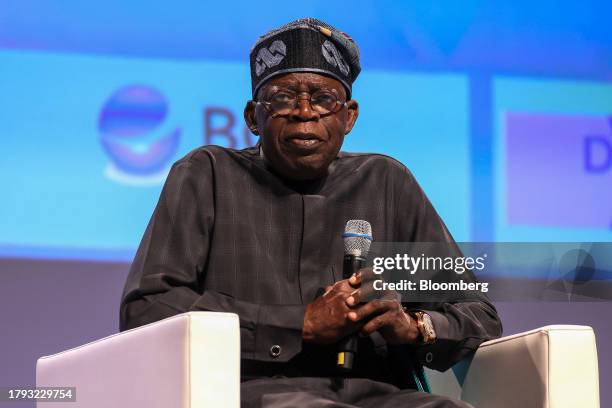
When President Bola Ahmed Tinubu mounted the podium on May 29, 2023, and declared that “fuel subsidy is gone,” the statement lasted barely a few seconds. Yet those few words instantly altered the economic direction of Africa’s most populous nation.
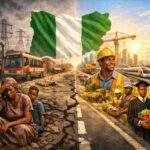
For millions of Nigerians, the announcement triggered immediate anxiety. Transport fares rose sharply. Food prices climbed. Inflation deepened. Businesses struggled with rising operational costs. Public anger spread across cities and rural communities alike. To many citizens already burdened by years of economic hardship, the reforms appeared sudden, harsh, and unforgiving.
But within government circles and among economic analysts, a different fear had long existed. The fear was not merely about hardship. It was about collapse.

According to the administration of President Bola Ahmed Tinubu, Nigeria in 2023 stood dangerously close to a fiscal and structural crisis that demanded urgent intervention. Mounting subsidy obligations, shrinking public revenue, multiple exchange-rate windows, rising debt-service burdens, low investor confidence, and widespread market distortions had created an economy that many experts believed was no longer sustainable.
The Tinubu administration insists that the difficult reforms introduced since 2023 were not acts of political convenience. They were emergency measures designed to prevent deeper national decline.
The Burden of an Unsustainable System
For years, fuel subsidy remained one of the most politically sensitive issues in Nigeria. Successive administrations acknowledged that the policy was financially damaging, yet few were willing to confront its consequences directly.
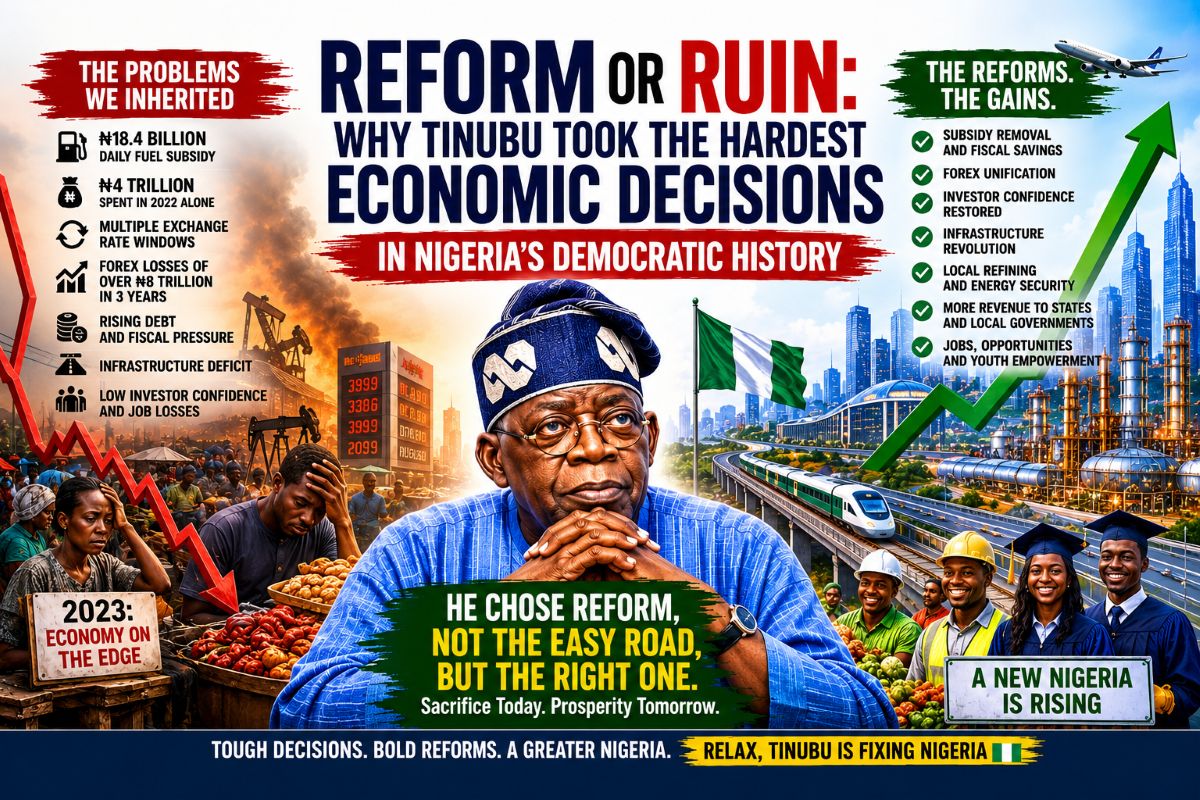
At its peak, Nigeria reportedly spent as much as ₦18.4 billion daily subsidizing petrol consumption. In 2022 alone, subsidy expenditure exceeded ₦4 trillion. Critics argued that the system became a massive drain on public finances while benefiting smugglers, middlemen, and corrupt networks more than ordinary Nigerians.
The paradox was difficult to ignore. Africa’s leading oil producer was spending enormous resources importing refined petroleum products while basic infrastructure, healthcare systems, schools, and power supply suffered chronic underfunding.
At the same time, Nigeria’s foreign exchange regime had become heavily distorted. Multiple exchange-rate windows created opportunities for arbitrage and rent-seeking. Businesses struggled to access foreign exchange transparently. Investors lost confidence in market predictability. Economic productivity weakened under the pressure of uncertainty.
By the time the new administration assumed office, government officials argued that the economy had reached a point where postponing reform would only deepen future pain.
The easy political option would have been to maintain the old structure temporarily, delay confrontation with vested interests, and preserve short-term public comfort. But the administration chose a more difficult path.
Choosing Reform Over Political Convenience
Supporters of the reforms often frame the Tinubu presidency as an administration that inherited structural distortions accumulated over decades and decided to confront them head-on.
The government’s central argument has remained consistent. Nigeria could either continue borrowing to sustain consumption and subsidy payments or redirect resources toward productive sectors capable of supporting long-term growth.
The removal of fuel subsidy and the unification of the foreign exchange market became the defining pillars of this strategy.
From the administration’s perspective, the reforms were intended to achieve several objectives:
- Reduce fiscal leakages
- Improve public revenue
- Restore investor confidence
- Stabilize foreign exchange management
- Encourage local production
- Promote energy self-sufficiency
- Reposition Nigeria for long-term growth
The reforms were economically ambitious, but politically dangerous.
Across the country, many Nigerians experienced immediate hardship. Inflation accelerated sharply. The value of household income weakened. Transportation and food costs surged. Small businesses struggled to adapt. Organized labour repeatedly voiced opposition. Public frustration became visible both offline and online.
Critics questioned the sequencing of the reforms and argued that adequate social protection mechanisms were not fully established before implementation.
Even some supporters of the administration admitted that the transition period would be painful.
The Human Cost of Economic Adjustment
One of the defining realities of the Tinubu reforms has been the widening gap between macroeconomic optimism and the daily experiences of ordinary citizens.
Economic indicators may improve on paper, but families still confront rising living costs in markets, transport parks, schools, and hospitals.
This tension has shaped public debate over the administration’s policies.
For many Nigerians, the immediate concern is survival, not economic theory. A trader facing increased transportation costs or a salary earner battling food inflation naturally evaluates reforms through the lens of daily hardship rather than long-term projections.
The administration appears aware of this political and social reality.
In his third anniversary address, President Tinubu acknowledged the burden citizens have carried since the reforms began. He admitted that the measures triggered painful adjustments across households and businesses. Yet he maintained that avoiding reform would have produced even more devastating consequences for the country.
The President’s argument is essentially historical. Nations facing structural economic breakdown rarely escape recovery without difficult transitions.
Around the world, governments that confronted subsidy distortions, debt crises, currency instability, or energy-sector inefficiencies often experienced temporary social pain before long-term stabilization emerged.
The Tinubu administration believes Nigeria is undergoing such a transition.
Signs of Recovery or Early Stabilization?
Three years into the administration, government officials increasingly point to signs that the reforms are beginning to produce measurable outcomes.
Public finances have reportedly improved. State governments now receive larger allocations. Investor confidence has shown signs of recovery. The Nigerian stock market has witnessed significant growth. Oil and gas investment commitments have increased. Infrastructure projects are expanding nationwide.
Large-scale road construction projects, including the Lagos-Calabar Coastal Highway and the Sokoto-Badagry Super Highway, have become visible symbols of the administration’s development agenda.
The government also argues that local refining capacity is improving energy security while reducing pressure on foreign exchange demand previously driven by fuel imports.
In the telecommunications sector, renewed investment is gradually strengthening digital infrastructure and expanding connectivity.
The administration further points to education loans, housing initiatives, agricultural interventions, and consumer credit programs as evidence that reform savings are being redirected toward social and economic development.
Still, questions remain.
Can economic stabilization translate into direct relief for ordinary Nigerians quickly enough?
Can wages catch up with inflation?
Will food prices continue moderating?
Can insecurity be reduced sufficiently to support agriculture and commerce?
Will power sector reforms finally improve electricity reliability?
These questions remain central to the public’s judgment of the administration.
The Politics of Patience
Perhaps the greatest challenge confronting the Tinubu administration is not merely economic. It is psychological and political.
Economic reforms often demand public patience at a time when citizens are exhausted by years of hardship. Governments ask people to endure present pain for future gain, but trust becomes difficult when previous promises by political leaders failed to produce expected results.
This explains why public skepticism remains strong despite growing optimism within government circles.
Yet supporters of the administration argue that abandoning reforms midway could reverse emerging gains and return Nigeria to fiscal instability.
For advocates of continuity, the current moment represents a turning point in Nigeria’s economic history. They believe the country is attempting to dismantle long-standing structural distortions that successive governments lacked the political courage to confront decisively.
To them, the reforms are not merely about one administration. They are about redefining the future sustainability of the Nigerian state itself.
A Nation in Transition
Nigeria today stands between discomfort and expectation.
The pain of reform is visible. So too are signs of structural adjustment gradually taking shape.
Roads are being built. Investments are returning. Local refining capacity is expanding. Public revenues are improving. Digital infrastructure is growing. Agricultural reforms are widening. Yet inflationary pressures and economic hardship continue to test public confidence.
The success or failure of the Tinubu reforms will ultimately depend not only on economic indicators but also on whether ordinary Nigerians eventually feel meaningful improvement in their daily lives.
History may judge this period as one of the most difficult and consequential transitions in Nigeria’s democratic journey.
For now, the debate continues.
Was the country pushed into painful reform because there was no alternative?
Or could the hardship have been managed differently?
That argument will remain part of Nigeria’s political conversation for years to come.
But one thing is increasingly clear: the administration of President Bola Ahmed Tinubu has chosen a path of aggressive structural reform whose outcome may shape Nigeria’s economic direction for a generation.