By Eneojo Herbert Idakwo
In markets across Nigeria, the story has become painfully familiar.
The trader who once restocked her shop weekly now buys in smaller quantities. The commercial driver who once filled his tank comfortably now calculates every journey carefully. Families that previously managed three meals daily have adjusted to survival economics. Employers struggle with rising operating costs. Young graduates search anxiously for opportunities in an economy undergoing painful transition.
For millions of Nigerians, the economic reforms introduced since 2023 have not been abstract policy debates discussed in conference rooms or television studios. They have been deeply personal experiences felt in transportation costs, school fees, electricity bills, food prices, rent, and everyday living.

This reality explains why the reforms of President Bola Ahmed Tinubu remain among the most debated policies in Nigeria’s democratic history.
Supporters describe the measures as courageous and unavoidable. Critics call them harsh, poorly timed, and insufficiently cushioned. Ordinary Nigerians, meanwhile, continue to endure the difficult consequences of economic adjustment while waiting for promised relief.
Yet beneath the political arguments lies a larger national question: can a country repair decades of economic distortions without first enduring discomfort?
That question sits at the heart of Nigeria’s current transition.
A Nation Already Under Pressure
Long before the Tinubu administration took office in May 2023, Nigeria’s economy was already under strain.
Public debt had increased significantly. Revenue generation remained weak relative to national expenditure. Fuel subsidy payments consumed trillions of naira annually. Foreign exchange management suffered deep structural distortions. Inflationary pressures were rising. Infrastructure deficits remained severe. Investor confidence weakened under uncertainty and policy inconsistency.
By the time the new administration assumed office, government officials argued that the economy had become dangerously fragile.
The administration insists that continuing the old system would have pushed the country toward a deeper fiscal crisis.
According to official figures repeatedly cited by government authorities, Nigeria spent trillions sustaining fuel subsidy payments while critical sectors struggled for investment. Multiple exchange-rate systems also created opportunities for arbitrage, corruption, and speculative profiteering.
To reform advocates, the situation had become economically unsustainable.
But while economists may debate fiscal models and structural adjustments, citizens experience policy through daily life.
And daily life became harder.
The Shock of Sudden Adjustment
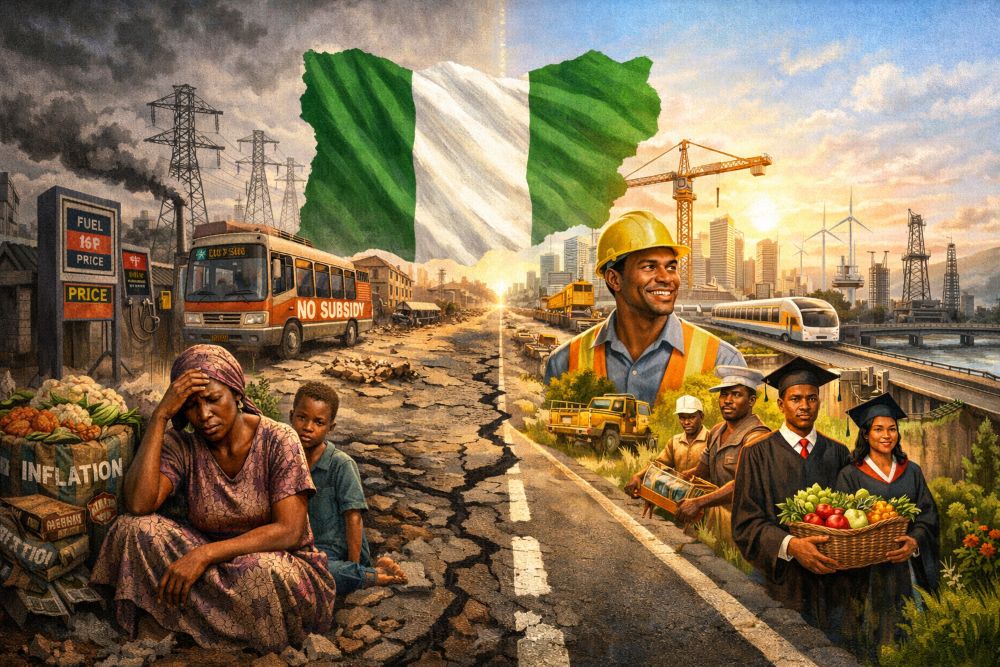
The removal of fuel subsidy immediately triggered increases in transportation and logistics costs nationwide. Since transportation affects almost every aspect of economic activity, the impact spread rapidly through the economy.
Food prices climbed sharply.
Manufacturers faced higher production costs.
Small businesses struggled with energy expenses.
Salary earners saw purchasing power weaken under inflation.
The foreign exchange reforms also contributed to rising import costs as the naira adjusted under market realities.
For many Nigerians, the speed and intensity of the transition created fear and frustration.
Across cities and rural communities, people asked difficult questions:
Why must ordinary citizens bear the burden of reform?
Why should sacrifice always begin with the masses?
Could the transition have been managed differently?
These questions continue to shape public opinion.
Critics of the administration argue that reforms should have been accompanied by stronger social protection systems before implementation. Labour unions repeatedly demanded wage adjustments and expanded relief measures. Civil society groups warned about worsening poverty levels. Opposition politicians accused the government of imposing hardship without sufficient safeguards.
The anger was real.
The hardship was real.
And even within government circles, there was recognition that the reforms would impose painful short-term consequences.
Why the Government Says the Pain Was Necessary
The Tinubu administration’s defense rests on one central argument: delaying reform would have produced even greater national suffering later.
Government officials frequently compare Nigeria’s situation to a patient requiring difficult surgery. The procedure may be painful, they argue, but postponing treatment could become fatal.
According to the administration, subsidy payments had become a major fiscal drain that enriched criminal networks and encouraged inefficiency. Resources that could have supported roads, healthcare, agriculture, education, housing, and infrastructure were instead consumed by recurrent subsidy obligations.
Likewise, foreign exchange distortions weakened investor confidence and damaged productive economic activity.
The administration therefore argues that reform was not a matter of political preference but national survival.
Supporters of the reforms point to several emerging indicators:
- Increased allocations to states and local governments
- Rising investor interest
- Expanding infrastructure projects
- Improvements in local refining capacity
- Renewed activity in the oil and gas sector
- Growth in the Nigerian stock market
- Increased digital and telecommunications investment
To reform advocates, these are early signs that the economy is gradually stabilizing after years of structural imbalance.
But economic transitions are rarely judged by statistics alone.
People judge reform by whether life becomes more bearable.
The Human Side of Reform
One of the major political challenges confronting the administration is that macroeconomic improvements often take time before they translate into visible household relief.
This creates a dangerous gap between policy optimism and public emotional reality.
An economist may celebrate improved fiscal stability, but a parent struggling to afford school transportation experiences a different reality entirely.
This tension explains why many Nigerians remain skeptical despite growing signs of institutional recovery.
In his third anniversary address, President Tinubu acknowledged this burden directly. He admitted that the reforms placed enormous pressure on citizens and businesses. Yet he insisted that the sacrifices would ultimately produce a more stable and prosperous country.
The administration has also introduced several intervention measures aimed at cushioning hardship:
- Student loan programs
- Consumer credit initiatives
- Agricultural support schemes
- Housing programs
- Expanded health insurance coverage
- Investments in public transportation alternatives
- CNG conversion initiatives
Government officials argue that these measures are designed to soften the impact of transition while laying the foundation for broader economic recovery.
Still, many Nigerians continue waiting for stronger relief at the grassroots level.
The Challenge of Public Trust
Perhaps the greatest obstacle facing the reforms is not economic theory but public trust.
Over the years, Nigerians have repeatedly heard promises that sacrifice would eventually produce prosperity. Many citizens therefore approach new reform programs with caution and doubt.
Trust becomes difficult when previous administrations failed to deliver expected improvements despite years of promises and policy adjustments.
This historical disappointment shapes current public attitudes.
For the Tinubu administration, sustaining confidence may depend less on speeches and more on visible improvements in daily living conditions.
Can food inflation continue to moderate?
Can transportation become more affordable?
Can electricity improve sufficiently to support businesses?
Can job creation expand meaningfully?
Can insecurity reduce enough to support farming and commerce?
The answers to these questions will determine how history judges the current reforms.
Between Hardship and Hope
Nations rarely undergo major economic restructuring without experiencing periods of discomfort.
From Asia to Latin America and parts of Africa, countries that implemented aggressive fiscal and structural reforms often endured difficult transitions before achieving stabilization and growth.
Nigeria now finds itself within such a moment.
The country is attempting to confront decades of subsidy dependence, weak productivity, infrastructure deficits, and institutional distortions while simultaneously managing the expectations of over 200 million people.
It is an enormous task.
The pain is visible.
But so too are signs that the economy may be gradually repositioning itself.
Infrastructure projects are expanding. Investment discussions are increasing. Local refining is improving. Public revenues are strengthening. Agricultural interventions are widening. Digital infrastructure continues growing.
Whether these developments eventually outweigh present hardship remains the defining question of the Tinubu era.
For now, Nigeria stands in the difficult space between sacrifice and expectation.
And history will ultimately determine whether the pain endured during this period became the price of national recovery or simply another chapter in the country’s long struggle with economic reform.