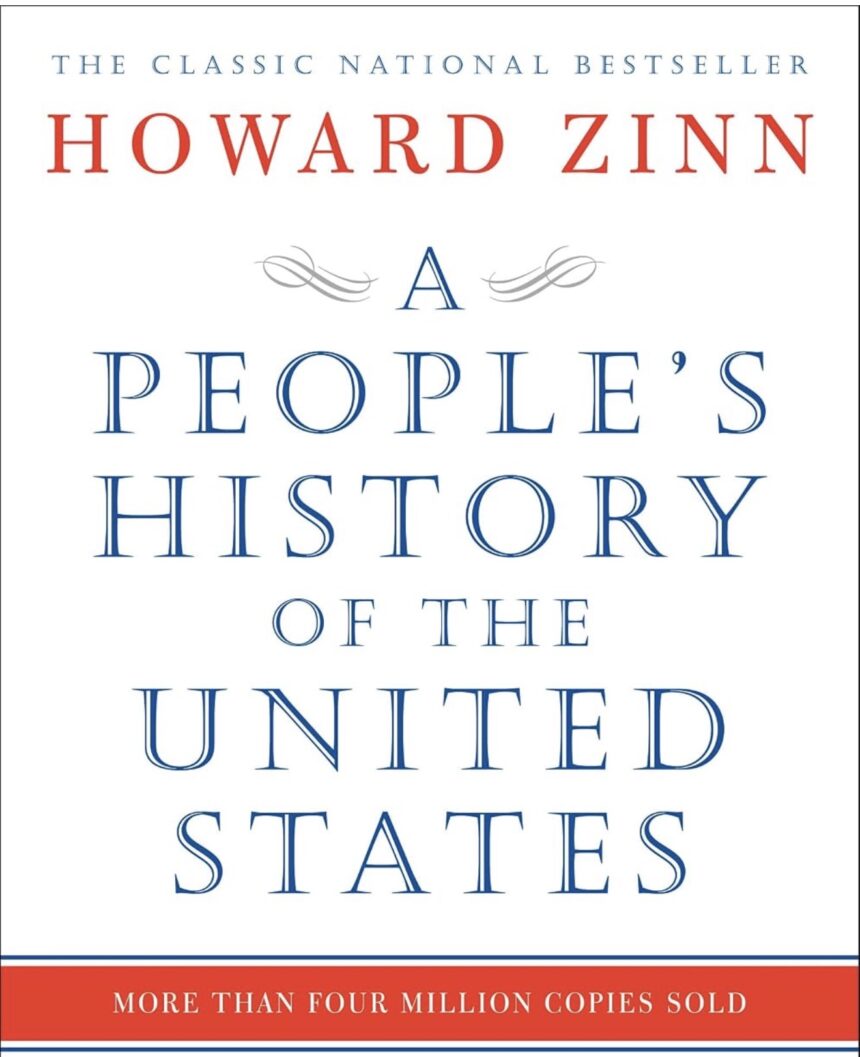
Howard Zinn (1980/2026). A People’s History of the United States. (New York: Harper & Row), 730 Pages.
By Ozodi Osuji Ph.D
I will be making several observations on Howard Zinn’s immensely popular book (several million copies have been sold), A People’s History of the United States. The book has twenty-five chapters; I will try to make observations on two chapters at a time for a total of about ten weekly observations. It would really be nice if many Africans read this book, so that they learn about the country that they think is heaven, the USA.
University history professors generally write about the small elite that rule most societies; in Europe that meant the kings and their chief ministers and in the last two hundred years when the kings of Europe are no longer center stage in the exercise of political power, they write about the Prime ministers/Presidents and key military generals who play key roles in the wars that European leaders seemed to exist to conduct; in the USA they write about the various Presidents of the country and key governors and senators and perhaps a few winningest generals, but by and large history is the documentation of the apex rulers of society.
Howard Zinn, a professor of history and political science at Boston University and before that at Spellman College, chose to write a different kind of history: to not just describe the activities of the less than one percent of people in every society that rule society but the ordinary people whose lives are impacted by what the psychopaths in political power did or did not do. Chapters one and two did not start by telling us who the rulers of Europe and the USA were, but ordinary people.
Chapter one began with Christopher Columbus and what he did to the Arawak Indians he met at the Bahamas and the other Indians in Hispaniola (now called Haiti and Dominican Republic) and Cuba, the first three Caribbean Islands that Columbus navigated, beginning with his landing at the Bahamas on October 12, 1492, AD.
Historical events are not isolated events; they are generally connected. You cannot understand Columbus’ travels unless you understand what was taking place in Europe and the Middle East, so let me briefly review that story.
Mohammad (570-632 AD) had established his new religion called Islam in 610 AD. Upon his death in 632 AD, his deputy (Caliph), Abu Bakr, and his militia used arms to take over all of Arabia (today’s Saudi Arabia), Mesopotamia (today’s Iraq), Syria, Jerusalem (in 638 AD), Persia, India, Central Asia all the way to Western China before the Chinese stopped them (Western China was converted to Islam and the people there are still Muslims).
In the West, the Mohammadians took Egypt in 643 AD, Libya, Tunisia, Algeria, Morocco, and swarmed into the Iberian Peninsula in 711 AD.
They got to Southern France before the Franks, under their king, Charles Martel, the hammer of God, in 732 AD, stopped them at the Battle of Tours (to the present Arabs still call Europeans Franks, but Franks are a particular Germanic tribe, who now live in what Rome called its province of Gaul).

Arabs converted the people wherever they conquered to Islam, including Central Asia, which includes the Turks.
The Turks eventually became the dominant soldiers of the Muslim army and actually fought with the Christian Crusaders aimed at retaking Jerusalem from the Muslims in the eleventh to fourteenth centuries.
The Turks established an empire called the Ottoman Empire and replaced Arabs and Persians as the leaders of Islam.
In 1453 AD, the Ottomans defeated the Byzantine Empire (Eastern Roman Empire) and took Constantinople, the capital of that empire. They changed the name Constantinople to Istanbul and converted the Cathedral of Sophia, the then-largest Christian cathedral, to a Muslim Mosque.
The Ottomans prevented Europeans from directly trading with India, China, and Japan through the land route, which they had been doing since Marco Polo began it around 1271-1292 AD.
Europeans could no longer go to Asia through the overland route and began looking for an alternative route to avoid paying the exorbitant tolls that Turks charged them.
The Portuguese thought that they could get to India and China by rounding Africa; hence, from around 1440 began selling around the coast of West Africa, got to Nigeria in 1460; Bartholomew Dias got to what he called the Cape of Good Hope, in South Africa, in 1488 AD, and finally to India in 1495 AD (by Vasco Dagama).
In the meantime, the Spanish under the Genoese sailor, Christopher Columbus, sailed west into the Atlantic Ocean, hoping to get to India and China in so doing. After three months in the Atlantic, they got to the Bahamas on October 12, 1492, AD.
What the Spanish did upon getting to the Caribbean can give you nightmares (it depressed me). The Arawaks saw Columbus’s three ships and came to the seashore to welcome them with all manner of gifts. They were fed by the Arawaks. Columbus kept asking them where they could get gold because they came all the way from Europe to get gold for their king. The Indians had no idea where to get gold. They indicated that occasionally some people picked up gold nuggets from the various rivers on the Island. Columbus immediately used force to commandeer the natives’ labor and had them go panning the various rivers seeking gold. He also put them to work digging in hills looking for gold.
The Arawaks and Caribs were worked all day, and those who refused to work had their hands cut off and eventually killed. Not getting the level of gold he desired, Columbus kidnapped 49 natives and took them to Madrid, Spain, and used them as evidence that he got to a new world, so that his king would believe him. He was made an admiral of the seas and the governor of the new land.
He was outfitted for another trip; this time he was given twenty-five ships and hundreds of soldiers, colonists, horses, and other animals. They landed in the Bahamas, Hispaniola, and Cuba and systematically worked the natives to death. In a few years, most of the estimated one million natives of the Caribbean and the Indies were dead, either through deliberate genocide or from the diseases that the Europeans brought with them.
Columbus made a third trip before he got into trouble with the authorities in Spain from the complaints of his sailors that he was authoritarian and killed them as he killed Indians.
Spain outfitted conquistadors to go seek gold in the New World. Hernando de Cortés and his men conquered the Aztec Empire (Mexico City) in 1519…he murdered Montezuma, the Aztec emperor, in 1521 AD; Pizarro conquered the Inca Empire of Peru in 1532 AD.
As these Spanish Conquistadors marched through Central and South America, they left a trail of death and destruction. Cortés deliberately destroyed the magnificent buildings in Tenochtitlan, now called Mexico City.
Word of the discovery of a New World, Mundus Novus, quickly spread throughout Europe. The European kings outfitted their sailors and bid them to get gold and land for them. The English King Henry VII sent an Italian, John Cabot, to the New World, and he landed in Newfoundland and Labrador in 1497 AD.
The German geographer, Amerigo Vespucci, drew a map of the New World, and his name, Amerigo, was transliterated to America, which became the name for the new world he mapped.
English colonists attempted to settle at Roanoke, Virginia, in 1585, and failed; in 1607 AD, Captain John Smith, with one hundred colonists, funded by the Virginia Company, landed at what is now called Jamestown, Virginia.
In 1620 AD, the Pilgrim Fathers, a bunch of Puritans, sailed from Amsterdam and landed at Plymouth, Massachusetts Bay.
In 1619 AD, a Dutch ship brought twenty African slaves and sold them to the English at Jamestown, and the drama of slavery in British North America began. Slaves were used to work in the incipient tobacco plantations.
The slaves were not considered human beings but were seen as a different variety of mules; they were worked until they dropped dead. More and more African slaves were subsequently brought to the English outposts in the New World.
Chapter Two of the text told the reader about how the English treated African slaves. I do not want to rewrite the book in these observations; let me just say that they were treated as less than animals; they were considered inferior to white folks and told that they ought to be happy they were brought to America to be close to allegedly superior white Christian colonists.
For now, you should just note that African slaves were considered less than animals and worked as workhorses until they died. (Years ago, I visited George Washington’s Mount Vernon, Thomas Jefferson’s Monticello, and Monroe’s slave plantation in Charlottesville, Virginia, and beheld with my own eyes how dreadful their slaves lived.)
The supposed Christians who did these horrible things to human beings did not feel bad about what they did because, to them, they were merely using a variety of cattle and horses to do work.
And how did these English colonists get their slaves? Demographic studies of the black population of today’s Virginia say that 80% of them are Igbos and other southern Nigerians.
So, how did Igbos manage to be preponderant among the slaves in Virginia and Maryland? It goes like this: as Europeans settled in the New World and needed more and more slaves to do their work and the natives kept dying on them or running into the woods to avoid slave work, the Portuguese came back to West Africa and bought the first batch of African slaves in 1503 AD and brought them to their colonies in the New World (mainly Brazil, which they had settled in 1500 AD).
The Portuguese and later the Spanish, Dutch, French, and finally the English negotiated with coastal Africans to go into the interior of Africa and buy slaves for them.
In the case of Igboland, the Efiks at Calabar and the Ijaws at Bonny arranged with the Igbos nearest to them, the Aros, and had those go get Igbo slaves and bring them to them, and those were kept in makeshift forts until European ships came by and picked them up and transported them to the New World.
Aro people recruited Abriba, Item, Ohafia, and other Igbos to roam around Igbo land, kidnapping Igbos (from age 12 to 30; age forty was deemed too old by the European buyers).
Thus, from the early 1500s, Aro and its kidnappers kidnapped Igbos and sold them to the Europeans who called at Calabar and Bonny; the same drama was taking place all the way from Mauritania to Angola.
For four hundred years (1500-1900 AD), Africans captured and sold their people to Europeans at the Atlantic coast, and other Africans captured their people and marched them northwards across the Sahara Desert and sold them at Egypt’s slave markets; in East Africa, Africans sold their people to the Arabs at Zanzibar and other Arab towns on the coast of East Africa and those were resold all over the Middle East.
(For a detailed description of Arab slavery in East Africa, see Thomas Pakenham, 1991, The Scramble for Africa.)
There is a substantial African population in Saudi Arabia, Iraq, Syria, Persia, and North Africa, such as Egypt and Libya.
Africans entered modern history by selling their people into slavery from about 500 to 1900 AD.
And if you heard them talk about slavery, you would think that they were angels and would not know that they captured and sold their people.
I first heard about slavery when I was eight years old and was sent to my village in Owerri to go learn the Igbo language. I lived with my grandparents, Joseph Osuji Njoku and his wife, Mather Osuji Njoku, and they told me all I wanted to know about slavery.
My kindred are the high priests of the people, so we still had residual slaves. During slave times, if anyone were being pursued by kidnappers and he ran into the Amadioha Temple, the kidnappers would leave him alone. He is now kept as a slave of the deity, essentially a servant working for the high priests.
Thus, it came to pass that there were slaves in our village when Frederick Lugard, the British colonial administrator, passed through Owerri in pursuit of Aro enslavers in 1902 AD. Lugard got to Arochukwu and demolished the town and its Long Juju oracle, and declared the end of slavery in Igboland.
Slavery continued in the Middle Belt part of Nigeria, and other British administrators battled it and finally stamped it out just as the Second World War began.
Slavery still exists in the Niger Republic, Mauritania, Libya, and the Darfur province of Sudan.
The slaves in our village were freed by the white man. Just think about that: it was not black Africans that freed them, but Englishmen!
In his book, The Dual Mandate in British Tropical Africa, Lugard called Southern Nigerians savages! Do you blame him?
The salient point that I have made is that Arabs, Europeans, and Africans were all in cahoots in the slave trading business; there are no innocents.
The victims were African Americans and African Arabs. Africans, Arabs, and Europeans ought to pay African Americans and African Arabs reparations.
We must all work together to make sure that slavery, a blight on humanity, does not repeat itself in our world. It is pointless to blame one group and not others who participated in the iniquitous traffic in capturing, selling, buying, and using human beings as mules.
Ozodi Osuji
August 9, 2026
You can reach Dr Osuji at:
ozodiosuji@gmail.com
(541) 635-6682