By Eneojo Herbert Idakwo
For decades, electricity has remained one of Nigeria’s greatest paradoxes.
Africa’s largest economy and most populous nation continues to struggle with a power supply crisis that has constrained industrial growth, weakened small businesses, discouraged investment, and forced millions of citizens into dependence on generators for daily survival.
From large manufacturing plants to roadside barbershops, from hospitals and schools to market stalls and residential homes, unreliable electricity has shaped the rhythm of Nigerian life for generations.

Businesses factor generator costs into prices. Families budget for fuel alongside food. Entire industries operate below capacity because stable power remains uncertain.
In many ways, Nigeria’s electricity crisis became more than an infrastructure problem. It evolved into a national productivity problem.
The administration of President Bola Ahmed Tinubu now argues that reversing this reality has become central to its long-term economic transformation agenda.
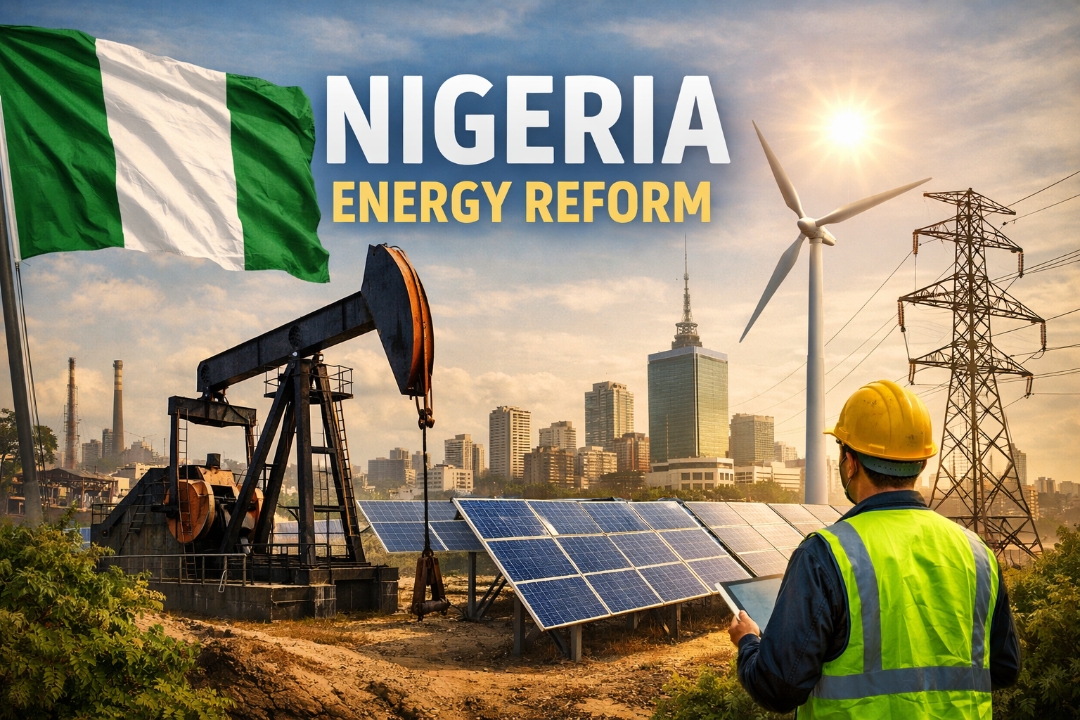
Three years into office, the Tinubu government is attempting to reposition the energy sector through reforms, investment expansion, transmission upgrades, renewable energy initiatives, and efforts to stabilize the national grid.
The administration’s message is simple:
No serious industrial economy can grow in darkness.
The Weight of a Long-Standing Crisis
Nigeria’s power sector problems are deeply rooted and historically complex.
For years, the sector struggled under the burden of:
- Aging infrastructure
- Weak transmission capacity
- Inadequate generation
- Poor distribution networks
- Liquidity challenges
- Legacy debts
- Vandalism and energy theft
- Regulatory uncertainty
- Underinvestment
Despite multiple reform attempts across successive administrations, electricity supply remained unstable for millions of Nigerians.
The consequences extended far beyond inconvenience.
Manufacturers faced high production costs.
Small businesses spent heavily on diesel and petrol generators.
Foreign investors questioned industrial viability.
Healthcare institutions struggled with operational stability.
Students studied under candlelight or fuel-powered generators.
Economic growth itself became constrained by energy limitations.
The Tinubu administration inherited this difficult landscape in 2023 amid broader economic pressure and national reform.
Energy as the Foundation of Economic Growth
The administration’s approach to the power sector appears tied directly to its wider economic agenda.
Government officials repeatedly argue that infrastructure development, industrial expansion, digital growth, manufacturing productivity, and job creation all depend heavily on reliable electricity.
Without stable power:
- Industries operate inefficiently
- Production costs rise
- Inflationary pressure increases
- Investment weakens
- Productivity declines
- Competitiveness suffers
This explains why energy reform has become closely linked to the administration’s broader narrative of economic recovery and national competitiveness.
The government appears convinced that long-term national growth cannot occur without confronting the electricity challenge directly.
Clearing Legacy Burdens
One of the major obstacles facing the power sector has been accumulated financial instability.
Over the years, liquidity shortfalls and unpaid obligations weakened confidence across the electricity value chain. Generation companies struggled with sustainability. Distribution inefficiencies expanded. Infrastructure investment slowed under uncertainty.
The Tinubu administration says it has begun addressing these inherited liabilities through efforts aimed at restoring confidence and improving operational stability within the sector.
Government officials argue that resolving legacy obligations is essential for attracting fresh investment and ensuring long-term sector viability.
The administration’s strategy appears focused on creating an environment where private capital can participate more confidently in energy expansion.
Expanding Transmission Infrastructure
For years, one of Nigeria’s greatest electricity limitations was not simply generation capacity but transmission weakness.
Even when electricity generation improved temporarily, the national grid often lacked sufficient capacity to distribute power efficiently across the country.
Transmission bottlenecks contributed to recurring system instability and grid collapses that repeatedly disrupted economic activity.
The current administration has therefore placed increased emphasis on strengthening transmission infrastructure.
According to government officials, investments are being directed toward:
- Expanding transmission lines
- Modernizing substations
- Improving grid stability
- Increasing nationwide distribution capacity
- Supporting regional connectivity
The administration argues that transmission expansion is necessary to unlock the full value of both existing and future generation capacity.
The Push for Renewable Energy
Another major component of the government’s energy agenda is renewable power development.
As global energy systems increasingly shift toward cleaner and more diversified sources, Nigeria faces growing pressure to modernize its own energy mix.
The Tinubu administration has signaled interest in expanding:
- Solar energy projects
- Rural electrification programs
- Alternative energy investments
- Decentralized power solutions
- Clean energy infrastructure
Renewable energy expansion carries both economic and social significance for Nigeria.
In rural communities where grid access remains limited, decentralized renewable systems may offer more practical electrification options than waiting for nationwide grid expansion alone.
For businesses and households, renewable alternatives may also reduce long-term energy costs and dependence on fuel-powered generators.
The Economic Cost of Darkness
Few national problems affect productivity as directly as unstable electricity.
Every hour of power failure carries economic consequences.
Factories lose production time.
Cold storage systems fail.
Digital businesses face interruptions.
Manufacturers increase operational expenses.
Consumers ultimately absorb these additional costs through higher prices.
Nigeria’s dependence on generators has created what many economists describe as a “self-generated economy,” where businesses privately provide the electricity government infrastructure fails to guarantee.
This reality has imposed enormous hidden costs on economic growth for decades.
The Tinubu administration argues that improving electricity reliability is therefore not simply about convenience. It is about restoring national productivity.
Industry, Manufacturing, and the Power Question
The administration’s industrial ambitions depend heavily on electricity reform.
Government officials have repeatedly emphasized manufacturing expansion, local production, digital innovation, and industrial competitiveness as central pillars of long-term economic growth.
But industrialization requires energy reliability.
A country cannot easily compete globally when manufacturers spend substantial portions of operating budgets generating their own electricity.
This is why energy reform sits at the center of broader conversations around:
- Job creation
- Export competitiveness
- Foreign direct investment
- SME growth
- Technological innovation
- Economic diversification
Without stable power, these ambitions remain constrained.
Public Expectations and Frustration
Despite policy discussions and infrastructure efforts, public frustration over electricity remains widespread.
Many Nigerians continue experiencing:
- Frequent outages
- High electricity tariffs
- Metering challenges
- Unstable supply
- Rising generator fuel costs
For ordinary citizens, promises of reform matter less than practical improvement.
Can electricity become more stable?
Can businesses reduce generator dependence?
Can households receive more reliable service?
Can energy costs become manageable?
These are the questions shaping public perception.
And they remain politically sensitive because electricity affects nearly every aspect of daily life.
Signs of Gradual Transition
Three years into the administration, the government insists progress is gradually emerging.
Officials point to:
- Increased sector investment discussions
- Ongoing transmission projects
- Renewable energy expansion
- Rural electrification efforts
- Grid improvement initiatives
- Policy reforms aimed at improving investor confidence
Supporters of the administration argue that the power sector requires long-term structural rebuilding rather than quick political fixes.
They believe Nigeria is currently in the difficult early stages of a broader energy transition whose full results may take years to mature.
Critics, however, insist that citizens need more immediate relief from persistent electricity instability.
Both positions continue shaping national debate.
Powering the Future
No modern economy achieves sustained growth without energy security.
The countries that industrialized successfully built stable power systems capable of supporting manufacturing, transportation, communication, healthcare, technology, and commerce at scale.
Nigeria now faces the same historical challenge.
The Tinubu administration appears determined to position electricity reform as a foundation for long-term national transformation.
Whether the effort ultimately succeeds will depend on:
- Policy consistency
- Infrastructure execution
- Regulatory discipline
- Investment sustainability
- Institutional coordination
- Public trust
For now, the struggle continues between a nation long accustomed to darkness and an administration promising a future driven by stable energy and industrial possibility.
The journey remains incomplete.
But the direction of policy is becoming increasingly clear.
The administration of President Bola Ahmed Tinubu is attempting not merely to improve electricity supply, but to redefine energy as the backbone of Nigeria’s economic future.