


By Eneojo Herbert Idakwo
Across Nigeria today, the sound of heavy machinery has become part of the national conversation.
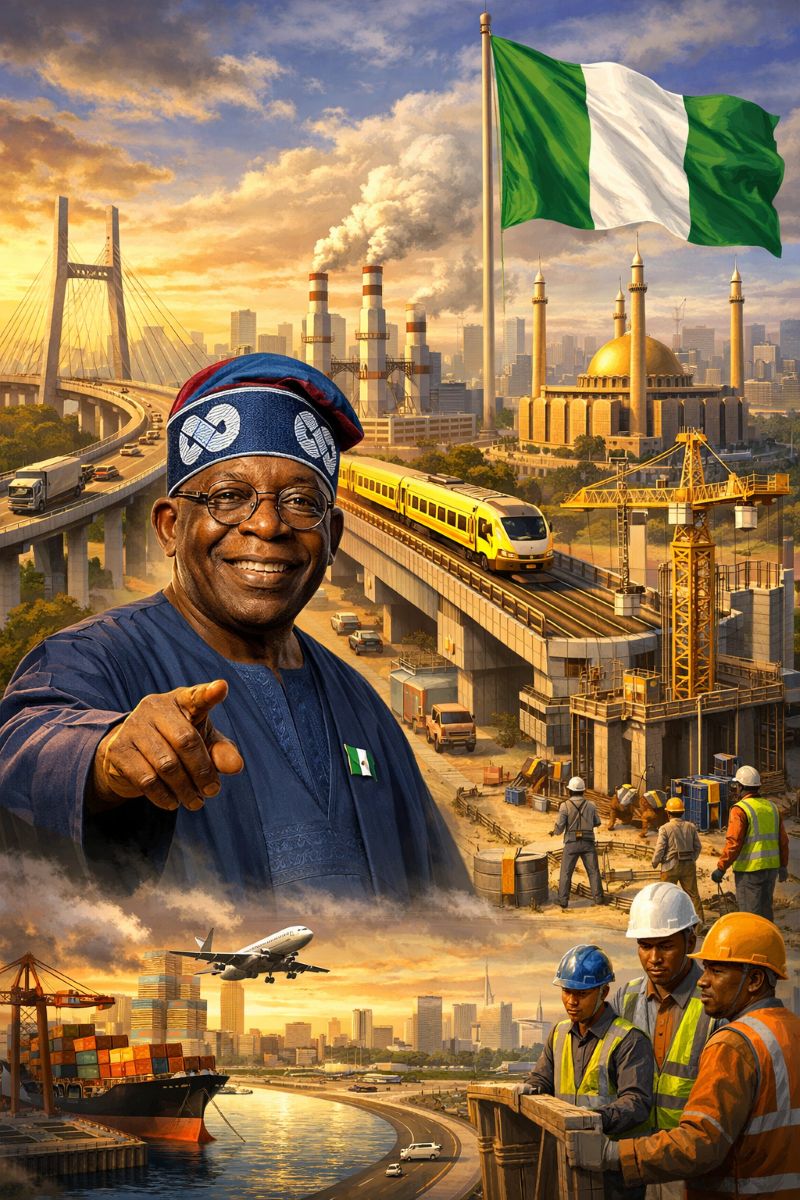
From the coastal stretches of the South to the commercial arteries of the North, from federal highways long abandoned to newly proposed transport corridors, infrastructure construction has emerged as one of the most visible signatures of the administration of President Bola Ahmed Tinubu.
For supporters of the government, these projects represent more than concrete, asphalt, and steel. They symbolize a strategic attempt to rebuild the physical foundation of the Nigerian economy after decades of infrastructure deficit, poor maintenance, and uneven national development.

For critics, questions remain about financing, transparency, prioritization, and whether ordinary Nigerians will feel the direct benefits quickly enough.
Yet regardless of political interpretation, one reality is increasingly difficult to ignore: infrastructure has become central to the Tinubu administration’s economic philosophy.
The government appears convinced that no nation can achieve sustainable prosperity without modern transport systems, efficient logistics, reliable connectivity, and integrated national mobility.
In this vision, roads and railways are not merely construction projects. They are instruments of economic restructuring.
A Nation Long Burdened by Infrastructure Deficit
Nigeria’s infrastructure challenges did not emerge overnight.
For decades, poor road networks, inadequate rail connectivity, weak maintenance culture, and underinvestment slowed economic productivity across the federation. Businesses faced high transportation costs. Farmers struggled to move produce efficiently. Interstate trade suffered delays. Logistics chains remained expensive and unreliable.
In many parts of the country, bad roads became symbols of state neglect.
Successive governments launched infrastructure programs with varying degrees of success, but rapid population growth and expanding economic demand often outpaced development.
By 2023, Nigeria’s infrastructure deficit remained one of the largest constraints on national competitiveness.
The Tinubu administration inherited not only aging roads and incomplete projects, but also the broader challenge of financing large-scale national reconstruction amid economic pressure.
Infrastructure as Economic Strategy
The administration’s approach to infrastructure appears rooted in a broader economic calculation.
Government officials frequently argue that transport infrastructure directly affects:
- Trade efficiency
- Agricultural productivity
- Industrial expansion
- National integration
- Job creation
- Foreign investment attraction
- Regional competitiveness
In practical terms, poor roads increase transportation costs, raise food prices, damage goods in transit, discourage investment, and reduce productivity.
Efficient infrastructure, by contrast, lowers the cost of movement and strengthens economic activity across multiple sectors simultaneously.
This explains why the administration continues presenting infrastructure development not simply as public works, but as a foundation for long-term economic growth.
The Lagos-Calabar Coastal Highway
Perhaps no project better symbolizes the administration’s infrastructure ambition than the Lagos-Calabar Coastal Highway.
Stretching across multiple coastal states, the proposed highway is designed to connect major economic zones while improving trade, tourism, transportation, and regional integration.
Supporters of the project describe it as transformational.
The government argues that the highway will:
- Improve interstate connectivity
- Reduce travel time
- Expand commercial activity
- Create employment
- Unlock coastal economic potential
- Strengthen logistics and freight movement
Critics, however, have questioned aspects of project costing, procurement processes, environmental implications, and national priorities.
Yet despite controversy, the project has become one of the administration’s most recognizable infrastructure symbols, representing its preference for ambitious and large-scale national projects.
Reviving National Transport Corridors
Beyond the coastal highway, the administration has expanded work on several strategic road corridors across the federation.
Among them are:
- The Sokoto-Badagry Super Highway
- Abuja-Kaduna-Zaria-Kano Road
- East-West Road
- Rural access and agricultural roads
- Rehabilitation of neglected federal highways
These projects are designed not only to improve mobility but also to strengthen economic integration between regions.
For farmers, transport efficiency can reduce post-harvest losses.
For traders, improved roads reduce vehicle maintenance and delivery delays.
For manufacturers, logistics costs become more manageable.
For communities, road access often determines economic opportunity itself.
Infrastructure therefore becomes deeply connected to national productivity.
Rail Modernization and Economic Integration
Roads alone cannot support the needs of a modern economy with Nigeria’s population scale and commercial potential.
This reality explains renewed attention toward rail modernization.
The administration has continued rail expansion and rehabilitation efforts aimed at improving cargo movement, passenger transportation, and regional economic integration.
Rail systems offer long-term advantages:
- Lower freight costs
- Reduced pressure on highways
- Improved bulk transportation
- Enhanced industrial logistics
- Faster interstate movement
For a country with vast territory and expanding urban centers, rail development may eventually become one of the most critical drivers of national efficiency.
Government officials argue that modern rail infrastructure is essential for reducing transportation bottlenecks and supporting industrialization.
Infrastructure and Employment
One of the administration’s strongest arguments in favor of infrastructure expansion is job creation.
Large-scale construction projects generate both direct and indirect employment opportunities:
- Engineers
- Construction workers
- Technicians
- Transport operators
- Suppliers
- Artisans
- Service providers
In a country facing significant youth unemployment pressure, infrastructure projects also function as temporary economic stimulants while long-term productivity gains are being developed.
The administration has repeatedly emphasized this connection between public works and economic participation.
The Financing Question
Despite visible progress, infrastructure financing remains one of the most debated aspects of the government’s development agenda.
Nigeria continues facing fiscal pressure, rising debt concerns, and competing social demands.
Critics argue that aggressive infrastructure expansion must be balanced carefully against debt sustainability and social welfare obligations.
Supporters counter that infrastructure investment is itself a long-term economic asset capable of generating productivity and future revenue growth.
This debate is not unique to Nigeria.
Around the world, governments frequently confront difficult decisions regarding how to finance large-scale development without overburdening public finances.
The Tinubu administration appears to be betting that infrastructure-led growth will ultimately justify the scale of current investment.
The Political Visibility of Construction
Infrastructure possesses one political advantage that many economic reforms lack: visibility.
Citizens may not immediately understand fiscal policy, monetary adjustment, or macroeconomic indicators. But they can see roads being constructed. They can observe bridges rising. They can experience reduced travel time.
This visibility matters politically.
At a time when many Nigerians continue enduring economic hardship, physical infrastructure projects offer tangible evidence that government activity is occurring beyond policy announcements.
For the administration, infrastructure therefore serves both economic and psychological purposes.
It projects momentum.
It signals national movement.
And it reinforces the government’s broader message that the sacrifices of reform are intended to produce lasting national assets.
Challenges That Remain
Despite growing construction activity, major challenges persist.
Many communities across Nigeria still suffer poor road access.
Urban congestion remains severe in several cities.
Maintenance culture continues to require institutional strengthening.
Project completion timelines often face pressure from inflation, financing difficulties, and logistical constraints.
Security concerns in some regions also complicate construction and transportation activities.
Furthermore, infrastructure alone cannot solve broader economic problems without complementary improvements in power supply, industrial policy, security, and institutional governance.
The administration therefore faces the challenge of ensuring that infrastructure expansion translates into broader economic transformation rather than isolated construction achievements.
Building Beyond the Present
Infrastructure projects are rarely judged fully within the political life of a single administration.
Their long-term value often becomes clearer years after completion through expanded commerce, improved mobility, industrial growth, and regional integration.
This appears to be the strategic logic driving the Tinubu administration’s infrastructure agenda.
The government is attempting to position transport and connectivity as foundations for future economic expansion.
Whether the full benefits materialize will depend on consistency, execution quality, maintenance, and complementary economic reforms.
But three years into the administration, one conclusion is increasingly evident:
Infrastructure has moved from the margins of governance discussion to the center of Nigeria’s national development strategy.
And in the vision of President Bola Ahmed Tinubu, roads, railways, bridges, and transport corridors are not simply construction projects.
They are the physical architecture of a new economic direction.










This is truly one of the most balanced piece that I have read on President Bola Ahmed Tinubu Renewed Hope Agenda, specifically as relates to infrastructural development. The writer objectively looked at the pros and cons and demonstrated cerebral grasp which is usually beyond the reach of many Nigerians, sorry to say. Kudos and well done