By Okoi Obono-Obla
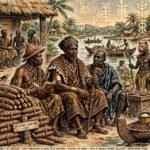
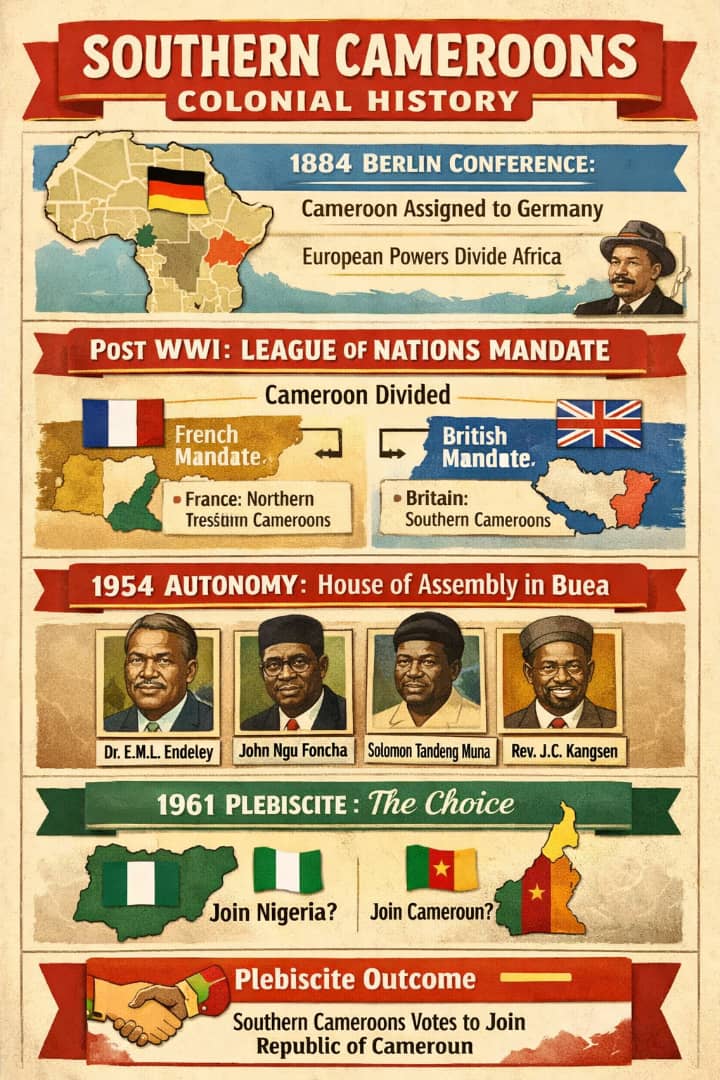
In 1884–1885, the European powers of the era — Germany, the United Kingdom, France, Spain, and Portugal — driven by imperial ambitions and the need for new markets after the saturation of European economies during the Industrial Revolution, convened in Berlin under the initiative of Chancellor Otto von Bismarck. The Berlin Conference sought to prevent conflict among these powers by amicably dividing African territories for colonization. At this conference, Cameroon was apportioned to Germany.
However, following Germany’s defeat in the First World War (1914–1919), the Treaty of Versailles and subsequent League of Nations mandates stripped Germany of its colonies, including Rwanda, Namibia, Tanganyika, and Cameroon. Cameroon was placed under a dual mandate: France administered the larger eastern portion, while the United Kingdom governed the western portion, known as Southern Cameroons. The British administered Southern Cameroons as part of Nigeria’s Eastern Region from the 1920s until 1961, applying their policy of minimizing administrative costs. Southern Cameroons shared ethnic ties with groups such as the Ekoi/Ejagham, Efik, Oron, and Ibibio, whose kin also lived in Nigeria’s Eastern Region.
Creation of an Autonomous Region:
In 1951, thirteen representatives from British Southern Cameroons sat in the Eastern Nigerian House of Assembly in Enugu. Key figures included:

– Dr. Emmanuel Mbela Lifafa Endeley — Leader of the Southern Cameroons delegation and Minister of Labour in the Eastern Region.
– John Ngu Foncha — Later became Premier of Southern Cameroons.
– Solomon Tandeng Muna
– Rev. J. C. Kangsen
A political crisis erupted when Dr. Nnamdi Azikiwe of the NCNC lost his bid to become Premier of Western Nigeria despite his party’s electoral victory. Following defections to the Action Group, Chief Obafemi Awolowo became Premier. Azikiwe returned to Eastern Nigeria, where NCNC leaders pressured Professor Eyo Ita of Calabar Province to resign as Leader of Government Business, paving the way for Azikiwe. This move angered representatives from Calabar, Ogoja, and Rivers provinces, who defected en masse to form their own party. Witnessing this marginalization, Southern Cameroons representatives realized their political future was insecure within Nigeria.
The Lyttleton Constitution of 1954 granted Southern Cameroons autonomy, separating it from Nigeria’s Eastern Region and establishing its own House of Assembly in Buea.
The 1961 Plebiscite:
On February 11, 1961, a United Nations–organized plebiscite offered Southern Cameroons two choices: integration with Nigeria or union with the newly independent Republic of Cameroun. The Northern Cameroons, with a Muslim‑majority population, voted to remain with Nigeria. Southern Cameroons, however, chose to join the Republic of Cameroun, marking a decisive moment in its political destiny.
Conclusion:
The history of Southern Cameroons reflects the complex interplay of colonial policies, ethnic affiliations, and political struggles. From its allocation to Germany at the Berlin Conference to its eventual union with the Republic of Cameroun in 1961, the region’s trajectory underscores the lasting impact of European imperialism and the challenges of postcolonial identity. The plebiscite of 1961 remains a pivotal event, shaping the political landscape of Cameroon and continuing to influence debates on autonomy and self‑determination.