By Ibrahim Bunu
Ibrahimbunu2520@gmail.com
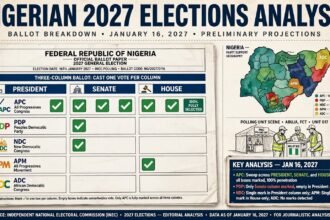
Nigeria is gradually entering one of the most dangerous and complicated political seasons since 1999. Beneath the public rallies, party slogans, defections, propaganda, and media battles, a deeper political realignment is quietly taking shape.
What many Nigerians are seeing today are only surface events.

The real storm is underneath.
The growing backlash from APC primaries, the widening frustration inside opposition parties, the collapse of ideological politics, the anger of young voters, the regional calculations ahead of 2027, and the rising economic hardship are all combining into a dangerous political mixture that may completely reshape Nigeria’s political map.
The truth is that 2027 may not look like previous elections.
And many politicians are still not reading the signs correctly.
1. WHY APC PRIMARY BACKLASH IS PUSHING MANY POLITICIANS INTO OTHER PARTIES
One of the biggest political realities today is the silent anger building inside the ruling APC.
Across many states, several politicians believe internal democracy within the party is gradually weakening. The growing complaints about the imposition of candidates, delegate manipulation, godfather influence, and favoritism are creating frustration among party members. Similar tensions have already triggered defections and coalition talks across the country.
The dangerous part is this:
Most defections are no longer driven by ideology.
They are now driven by political survival.
Many politicians believe:
“If I cannot secure a fair ticket inside APC, then I must move elsewhere before 2027.”
This is exactly how cracks began within the old PDP before 2015, when governors, senators, and major political blocs joined the APC and changed the entire election equation.
Today, history may be preparing to repeat itself — but differently.
Examples already emerging include:
* Former APC figures aligning with coalition platforms.
* Growing movement toward the ADC and SDP structures.
* Increasing strategic meetings among dissatisfied politicians.
* Quiet negotiations between northern blocs, southern blocs, and Middle Belt actors.
* Political heavyweights are trying to build alternative power structures ahead of 2027.
But there is another truth many are ignoring:
Not every defection translates into electoral victory.
Sometimes defections only create media noise without creating grassroots voter conversion.
2. THE MOST LIKELY OUTCOME NOW, TOMORROW, AND AFTER 2027
NOW: THE ERA OF CONFUSION
Nigeria is currently in a period of political transition.
No party is fully stable.
* APC faces internal pressure from economic hardship and candidate selection battles.
* PDP continues struggling with internal fragmentation and weakening national coordination.
* Labor Party still battles structural weakness despite strong emotional support among youths.
* ADC coalition efforts face internal suspicion, ambition clashes, and legal complications.
At the moment, many Nigerians are politically undecided.
Anger is high.
Trust in leadership is low.
But frustration alone does not automatically produce opposition victory.
That is the biggest misunderstanding in today’s politics.
TOMORROW: THE COMING REALIGNMENT
As 2027 approaches, Nigeria may enter three major political camps:
1. The APC Establishment Structure
This camp will rely heavily on:
* Incumbency power
* Federal structure
* Governors
* Security influence
* Political funding networks
* Existing grassroots party structures
This remains APC’s strongest advantage.
Even critics of the government admit that incumbency in Nigeria remains a powerful electoral weapon.
2. The Opposition Coalition Camp
This camp may include:
* Atiku’s political structure
* Obi movement
* Disgruntled APC members
* Some northern blocs
* Some Middle Belt actors
* Smaller opposition parties
But the biggest danger inside this camp is ego and ambition.
Everybody wants to lead.
Few want to sacrifice.
And Nigerian opposition coalitions historically collapse when personal ambition outweighs collective strategy.
Recent cracks already appearing inside coalition talks show this danger clearly.
3. The Angry Neutral Voters
This may become the most dangerous voting bloc in 2027.
These include:
* frustrated youths
* unemployed graduates
* economically struggling citizens
* first-time voters
* politically homeless Nigerians
They are not emotionally loyal to any party.
They are searching for credibility, sincerity, competence, and hope.
Whichever candidate connects emotionally and economically with this bloc may unexpectedly reshape the election.
3. WHAT THE OPPOSITION MAY BE FAILING TO SEE TODAY
The opposition currently believes that public anger automatically translates into electoral victory.
That assumption may turn out to be their biggest mistake.
The hidden reality is this:
Nigeria’s elections are not won only on social media outrage.
They are won through:
* polling unit structures
* state-level alliances
* rural mobilization
* election-day logistics
* security coordination
* agents across polling units
* grassroots financing
Many opposition movements remain urban-heavy and online-heavy.
But elections are still heavily influenced by rural political structures.
This is where APC still maintains deep strength in many states.
STATES AND REGIONAL DYNAMICS THAT MAY DECIDE 2027
APC Likely Strongholds
APC may still retain considerable strength in:
* Lagos
* Ogun
* Kwara
* Kogi
* parts of Kano
* parts of Katsina
* parts of Borno
* Ekiti
* Ondo
especially where governors and local structures remain loyal.
Opposition Opportunity Zones
The opposition may gain stronger momentum in:
* Anambra
* Enugu
* Abia
* Plateau
* parts of Benue
* Rivers
* Delta
* Adamawa
* parts of Kaduna urban centers
* youth-dominated urban areas nationwide
especially if economic hardship continues.
THE BIGGEST STATISTICAL SHOCK THAT MAY HAPPEN AFTER ELECTIONS
The greatest shock may not be who wins.
The greatest shock may be how divided the votes become again.
If the opposition fails to unite behind a single strong candidate, the APC may still win with a divided opposition vote — just as fragmented opposition dynamics benefited ruling structures in previous cycles.
The mathematics of Nigerian elections is brutal.
Three strong opposition candidates can destroy one another while the ruling party quietly consolidates enough states to win.
This is exactly the danger opposition leaders are underestimating today.
WHO MAY EVENTUALLY WIN?
As things stand today, no prediction is absolute.
But based on:
* incumbency,
* party structures,
* governor influence,
* financial networks,
* electoral experience,
* and fragmented opposition,
The APC still enters 2027 with a structural advantage.
However, that advantage can collapse if:
* economic hardship worsens,
* internal APC rebellion deepens,
* opposition suddenly unites,
* or voter anger reaches uncontrollable levels.
2027, therefore, remains highly fluid.
4. WHAT ALL THE CANDIDATES ARE FAILING TO TELL THEIR SUPPORTERS
This may be the deepest truth in Nigerian politics today.
Most politicians are mobilizing emotions.
Very few are preparing citizens for reality.
Nobody is honestly telling supporters that:
* elections alone do not magically fix nations,
* Governance is harder than campaigns,
* economic recovery takes time,
* institutions matter more than slogans,
* and tribal politics is slowly destroying national unity.
Supporters are being emotionally weaponized instead of politically educated.
The dangerous consequence is this:
After elections, many citizens become disappointed because expectations were built on emotion rather than realistic governance plans.
Another dangerous silence is this:
Many politicians are not warning their followers against political violence.
The desperation for power is rising again.
Hate speech is increasing.
Religious division is growing.
Ethnic suspicion is quietly expanding.
Nigeria must be extremely careful.
Because elections should never become a battlefield.
5. IN THE END, NIGERIA MUST SURVIVE ALL POLITICIANS
At the end of everything:
* APC will come and go.
* PDP will come and go.
* Coalitions will rise and collapse.
* Politicians will defect again.
* Alliances will change again.
But Nigeria will remain.
That is the deepest truth citizens must remember.
No politician is bigger than Nigeria.
No election is worth bloodshed.
No ambition is worth national collapse.
What Nigeria truly needs in 2027 is not only victory at the polls.
Nigeria needs:
* peace,
* justice,
* responsible leadership,
* institutional reforms,
* economic recovery,
* national healing,
* and leaders willing to unite rather than divide citizens.
The future of Nigeria cannot be built on hatred.
It cannot be built on propaganda alone.
And it cannot be built on tribal superiority.
The country is entering a dangerous political season.
But with wisdom, maturity, fairness, and national sacrifice, Nigeria can still avoid deeper instability.
History is watching.
And 2027 may become one of the defining elections of modern Nigeria.