By Otunba (Dr.) Abdulfalil Abayomi Odunowo
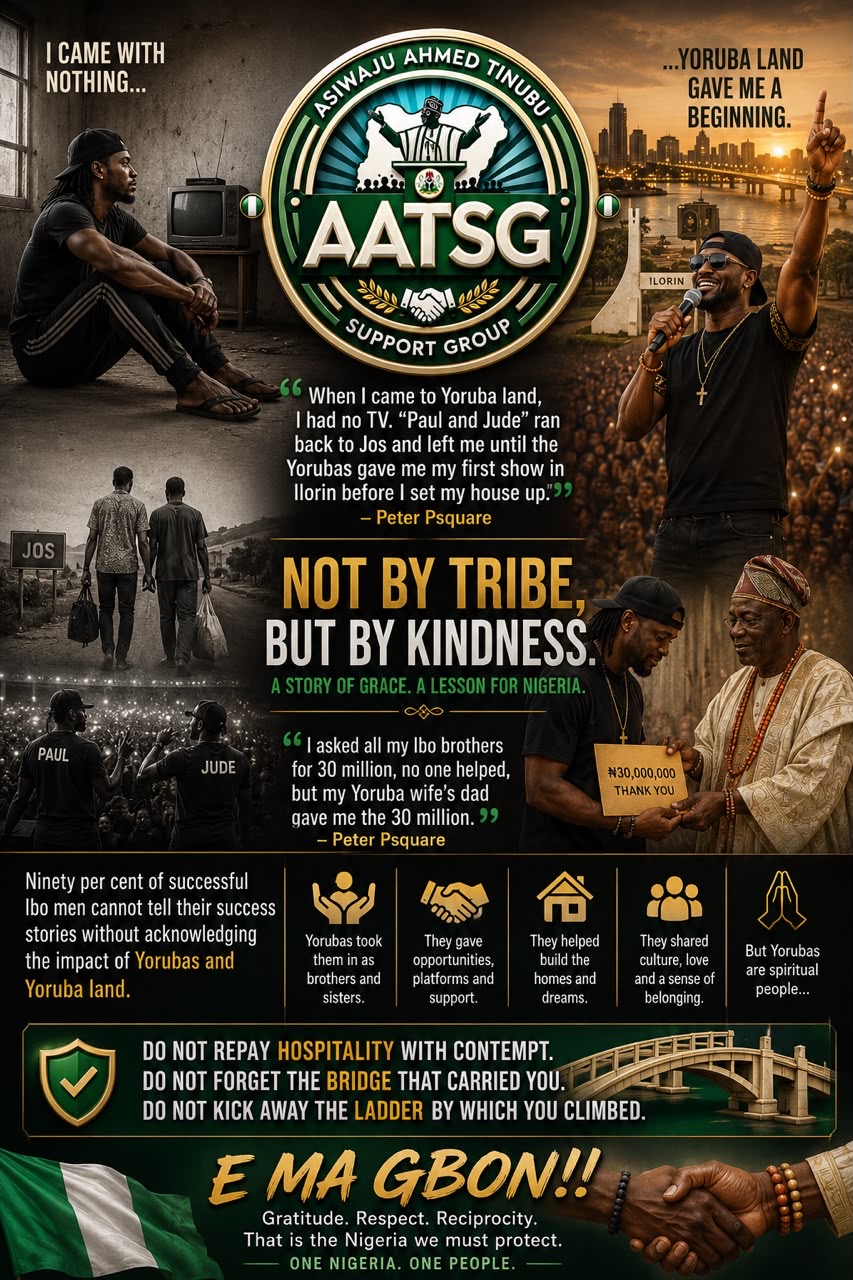
Peter P-Square’s story carries a powerful lesson about hospitality, gratitude, opportunity, and the danger of letting ethnic hostility wipe away the kindness that once helped us rise.
There are moments in a person’s life when tribe stops mattering and humanity takes over.
There are times when the hand that lifts you is not your brother’s by blood, but the hand of someone who simply sees another human being struggling and decides: “You will not fall while I can help you stand.”
That, really, is the deeper lesson in the story linked to Peter Okoye of P-Square.

According to the account, there was a hard season when Peter found himself in Yorubaland without even the basic comfort of a television. Paul and Jude had returned to Jos, and he was left to find his feet.
Then an opportunity came.
Not from his village.
Not from his kinsmen.
Not from people who first wanted to know where his ancestors came from.
His first show came in Ilorin.
One opening led to another. A door swung open. He began rebuilding. Slowly, what looked like uncertainty started turning into a future. And there is an even more moving part of the story.
Peter reportedly needed ₦30 million at a critical point and reached out to people he believed might help. The help did not come.
But according to his account, his Yoruba father-in-law stepped in and provided the ₦30 million.
Think about the symbolism in that for a moment.
At the hour when money, trust, and opportunity mattered most, somebody looked past ancestry and said, in effect:
“You are family. Your dream matters. I will stand with you.”
That is the Yorubaland many Nigerians have encountered, and the Nigeria many of us still, quietly, believe in.
For generations, Lagos, Ibadan, Abeokuta, Ilorin, and other cities across the Southwest have provided platforms on which Nigerians from every corner of the federation have studied, traded, built businesses, raised families, acquired property, and pursued their dreams.
And this is not a story that belongs to one ethnic group alone.
There are Igbo industrialists, Hausa traders, Ijaw professionals, Edo entrepreneurs, and Nigerians from virtually every part of the country whose success stories contain chapters written far from their ancestral homes.
In the same way, countless Yoruba men and women have prospered in Kano, Kaduna, Abuja, Port Harcourt, Onitsha, Aba, and communities across Nigeria because somebody from another ethnic group gave them an opportunity, a stall, a contract, a recommendation, or simply a place to begin again. That is the Nigeria we must protect. Especially now.
As the 2027 elections draw nearer, the temperature of our public conversation is already rising. Old wounds are reopening. Old suspicions are being dusted off and weaponised. Social media amplifies the loudest, angriest voices until it starts to feel as though entire peoples are enemies of one another.
But they are not.
An individual who insults another culture does not speak for millions of decent people who share the same ethnic identity. A political disagreement does not erase decades of shared markets, mixed marriages, joint businesses, and quiet acts of kindness that never make the news.
The tragedy begins when we let political competition or online warfare make us forget the bridges that have carried us across difficult rivers.
We should never repay hospitality with contempt.
We should never answer the misconduct of a few by condemning the many. And we should never allow the noise of election season to drown out the quieter truth of our shared history.
We have traded together.
Married one another.
Built businesses together.
Celebrated together.
Mourned together.
And, in countless cases, lifted one another when there was nobody else to help.
That is why stories such as Peter’s should not become ammunition for another ethnic battle. They should become reminders of something far greater and more urgent as we approach 2027:
Never forget the bridge that carried you across the river.
If a community welcomed you, respect it.
If someone outside your tribe helped you, acknowledge it.
If another culture provided the soil in which your dream grew, never imagine that appreciating that culture diminishes your own.
Gratitude has no tribe.
Success has no tribe.
Kindness has no tribe.
And destiny does not ask for your state of origin before deciding through whom your blessing will come.
Yorubaland should remain what it has historically aspired to be: confident enough in its identity to welcome others, strong enough to defend its heritage, and wise enough not to confuse individual hostility with the character of an entire people.
And to every Nigerian, regardless of ethnicity, there is a simple, urgent lesson as the nation prepares once again to choose its leaders:
Respect the land that gives you shelter.
Respect the people who give you opportunity.
Remember those who stood beside you when you were struggling.
And when prosperity eventually comes, never kick away the ladder by which you climbed.
Because sometimes the person God uses to change your story will not speak your language, bear your surname, or come from your village.
He may simply see you as a fellow human being.
And that recognition of shared humanity over the noise of tribe and the heat of politics is the Nigeria we desperately need to rediscover before 2027.
Ẹ má gbàgbé ẹni tó ṣe yín lóore.
Never forget those who showed you kindness.
Ẹ má gbọ́n ju ìtàn lọ.
Never become too clever to remember history.
Nigeria will be stronger when gratitude becomes louder than tribalism, especially in an election year.
Signed
Otunba (Dr.) Abdulfalil Abayomi Odunowo
National Chairman AATSG
Asiwaju Ahmed Tinubu Support Group.