


By Okoi Obono-Obla
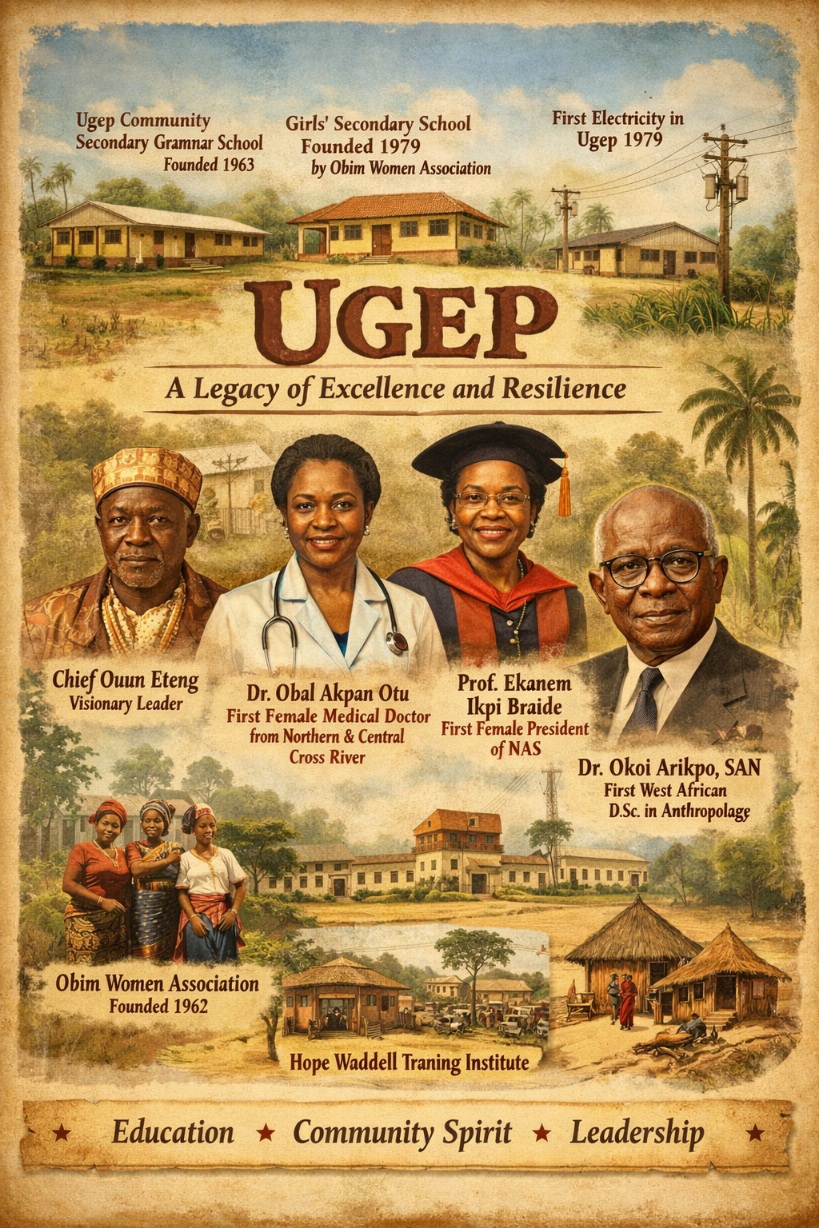
Most of the development in Ugep was achieved purely through community effort. The first time Ugep benefited from government intervention was in 1979, when electricity was introduced. The Ugep Community Secondary Grammar School was founded in 1963 through the contributions of peasant farmers. Credit must also go to the late Chief Onun Eteng of blessed memory, who contributed substantially to ensure the completion of the Ugep Community Secondary School. Chief Onun Eteng was the father of Dr. Obal Akpan Otu, the first female medical doctor from the Northern and Central Senatorial Districts of present-day Cross River State, who graduated from the University of Ibadan in 1970 as the best graduating student in the College of Medicine, and Professor Ekanem Ikpi Braide, a distinguished parasitologist, former Vice Chancellor of the Federal University of Lafia, and the first female president of the Nigerian Academy of Science. Chief Eteng himself became a Permanent Secretary in the defunct Eastern Region in 1954. He attended the prestigious Cambridge University in the United Kingdom in the early 1940s and returned home with an MA in Natural Sciences.
The first male medical doctor from the famous Eteng family of Aneja, Ijom (Bob T also hails from this family), graduated from the old University of London (University of Ibadan) in 1952. The Yakurr people of Ugep embraced western education with remarkable zeal and enthusiasm.
The Girls’ Secondary School Ugep was founded in 1979 to promote the education of the girl child by the Obim Women Association, which itself was founded in 1962. I am proud to note that my mother was one of its founders. Our people toiled to establish these institutions, which have contributed immensely to the educational development of Yakurr, Boki, Ikom, and Obubra, among others.

Ugep attained urban status in 1951. It had its County Council (Local Government Council) in the 1960s. However, Ugep was later downgraded to a touring area after the creation of the defunct South Eastern State in 1967. It remained under this inferior status until 1989, when the Federal Military Government created the defunct Ugep Local Government Area Council and made Ugep its headquarters. In 1991, the Federal Military Government divided Ugep into Ugep North Local Government Area with headquarters in Ugep, and Ugep South Local Government Area with headquarters in Idomi. Less than 48 hours later, Ugep North and Ugep South were reorganized into Abi Local Government Area with headquarters at Itigidi, while Ugep North was renamed Yakurr Local Government Area with headquarters in Ugep, including Idomi.
Comparing Ugep with towns in the defunct Eastern Region such as Aba, Umuahia, and Ikot Ekpene, which also attained urban status in 1951, one sees the resilience of the Yakurr people. Yakurr women, in particular, are hardworking, shrewd, and industrious. They contributed substantially to the spread of education in Ugep. My grandfather, an influential chief in Ijiman Ward and a ledu title holder, was lukewarm towards my father’s education despite his wealth in the 1920s. However, my grandmother took up the challenge and toiled to send my father to school. My father, in turn, sent his younger sister to the Women Teachers College, Umuahia, in 1952. At that time, sending a woman to a post-primary school was a remarkable achievement in Yakurr. Today, my aunt’s children are excelling in law, civil service, and the health sector. The kudos must go to our mothers, who toiled to establish the first Girls’ Secondary School in Yakurr.
Debunking False Narratives
Recently, some false narratives have been peddled on social media by certain Yakurr youths, claiming that Ugep has cornered all the resources meant for Yakurr Local Government Area of Cross River State. This is false in all material particulars. Historical records clearly show that Ugep’s development was not driven by government largesse but by the industriousness, competitiveness, and communal spirit of its people.
Ugep people are hardworking and resourceful, and their women embody this ethos. My grandfather was a traditional ruler and somewhat wealthy, but due to the social structure of his era, he chose to invest in his maternal relations rather than train my father. The responsibility fell on my grandmother, who toiled by trading palm oil between Ugep and Ediba to raise money to educate her son. This reflects the spirit of a typical Ugep woman. Indeed, most of the people who attained education in the community were supported by their mothers.
Another defining feature of Ugep society is the cultural emphasis on building beautiful houses. In Ugep, if a man does not have a befitting house, he is not respected, regardless of his attainments. This ethos of industriousness, competitiveness, and pride in achievement has driven much of the development seen in Ugep today, far more than government interventions.
–
The Famous Eno Ebri Family:
The Eno Ebri family is one of Ugep’s most prominent lineages, known for its influence in traditional leadership, education, and civic development. Their contributions, alongside those of the Eteng family, symbolize the blend of tradition and modernity that propelled Ugep into prominence.
Among the distinguished members of this lineage are:
– Professor Inyang Abam Eteng, the first professor from Yakurr and a first-class graduate in Sociology from the University of Nigeria, Nsukka, in 1965. He is a scion of the Eno Ebri family and a respected academic whose scholarship has inspired generations.
– Dr. Francis Eno Ebri, the first medical doctor from Yakurr, who graduated from the University of Ibadan in 1952. His achievement marked a turning point in the region’s educational history.
Dr. Okoi Arikpo SAN:
Another towering figure from Cross River State is Dr. Okoi Arikpo SAN, whose achievements further highlight the intellectual heritage of the region.
– He made a First Class at the University of London in the early 1920s.
– He attended Hope Waddell Training Institute, Calabar, and Government College, Umuahia.
– In 1943, he became the first West African to earn a Ph.D. in Anthropology from the University of London.
– He studied at Gray’s Inn and was called to the English Bar in 1956.
– He was the first Executive Secretary of the National Universities Commission (NUC), established in 1962.
– He made history as Nigeria’s longest-serving Foreign Minister (1968–1975).
– Earlier, he served as Minister of Lands and Survey in 1951.
Honourable Justice Emmanuel Etowa Arikpo:
Honourable Justice Emmanuel Etowa Arikpo was called to the English Bar in 1962 and to the Nigerian Bar in 1964. He served as Attorney General and Commissioner for Justice in the defunct South Eastern State in 1975 and was appointed to the High Court of Cross River State in 1976, where he later became Chief Judge of Cross River State.
It is on record that Ugep has produced two Chief Judges of Cross River State. The Honourable Justice Okoi Ikpi Itam served as Chief Judge from 2009 to 2017. His father, Chief Okoi Ikpi Itam, a veteran civil servant, attended Hope Waddell Training Institute, Calabar, in the 1920s, continuing the family’s legacy of education and public service.
Obol Otu Uket Oka:
My wife also told me that her father, Obol Otu Uket Oka, went to school because of the determination of his mother, who traded in palm kernel between Ugep and Ediba—an old trading port on the Cross River—in the 1940s. He graduated from the University of Ibadan in 1971, joined the Nigerian Army, attained the rank of Major, later studied law, and was called to the Nigerian Bar in 1986. His story, like many others from Ugep, reflects the enduring spirit of Yakurr women who sacrificed to educate their children.
Early Educational Heritage:
Late Chief Obeten Bassey Iwara once told me that as early as the 1900s, Ugep people had already begun attending Hope Waddell Training Institute, Calabar, which was founded in 1895. He himself was an alumnus of that prestigious institution. This early embrace of education by Ugep people underscores their foresight and commitment to learning long before formal government support reached the community.
Conclusion:
The story of Ugep is one of resilience, sacrifice, and communal determination. From the contributions of peasant farmers and visionary leaders like Chief Onun Eteng, to the trailblazing achievement of Dr. Obal Akpan Otu, the groundbreaking career of Professor Ekanem Ikpi Braide, the intellectual legacy of Dr. Okoi Arikpo SAN, the judicial excellence of Justice Emmanuel Etowa Arikpo, the academic distinction of Professor Inyang Abam Eteng, the pioneering medical achievement.
@ Okoi Obono-Obla











God Bless You Sir Of A Truth You Have Said It All More Iconic Information From You Too Us Ugep @ They Top To The World
Dr Christie Onuorah Nee Akpagu is the First Female Medical Doctor from Cross River State. You will need to check again the assertion with regards to Dr. Obal Akpan Otu. Thanks