By Okoi Obono-Obla
I. A Personal Observation and a Historical Hypothesis
A friend of mine from Ogbia in Bayelsa State recently sent me this message:
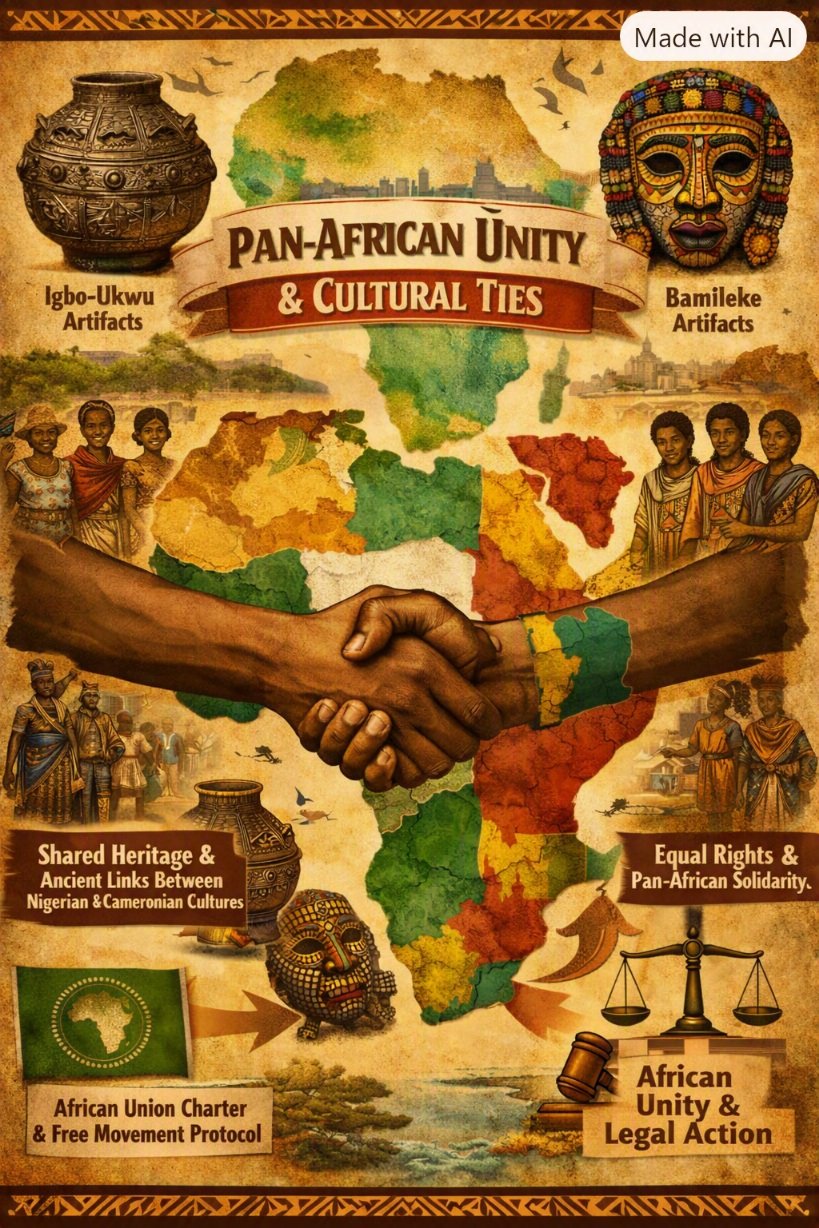
“I saw some artifacts that were taken from Cameroon yesterday on the British Museum website and they have the same designs and motifs as the Igbo-Ukwu artifacts. The ones I saw were said to have been mostly taken from the ‘Bamileke’ area. Bamileke people live in the western and north-western regions of Cameroon. Bamileke is a Central Delta word. I don’t know if they are also of Akpa origin, but from the artifacts I have seen, I am sure there are Akpa amongst them.”
His observation is significant, particularly as the Akpa are known to have originally lived in what is now the Republic of Cameroon in the 15th century. This prompted me to attempt to construct a historiography to examine whether the Akpa are related to the Bamileke people of Cameroon.
The Bamileke language shows similarities to some of the Upper Cross and Delta-Cross languages spoken in Cross River, Bayelsa, Rivers, and Ebonyi States of Nigeria.

II. Linguistic and Cultural Linkages
Historically and linguistically, the Bamileke people are related to various Grassfields languages and Southern Bantoid groups. These groups share historical migration roots and linguistic ties with minority ethnic communities in eastern and south-eastern Nigeria, particularly in Taraba State, such as the Mambilla region, and the broader Cross River borderlands.
The Bamileke languages are Grassfields languages that belong to the Southern Bantoid branch of the Niger-Congo language family.
Most Bamileke historical narratives trace their origin to the Nile River in what is now Sudan. Oral tradition collected by Alexis Maxime Feyou de Happy and his son, Joseph, suggested that the arrival of the Bamileke in Western Cameroon occurred in multiple waves with two primary routes. The first route originated in the North between the Lake Chad area and the Nile Valley. The second route originated in Nigeria around the Cross River area.
Southern Bantoid is a major branch of the Bantoid language family. It consists of the Bantu languages along with several small branches and isolates of eastern Nigeria and west-central Cameroon. Some of these Southern Bantoid languages include the Mbe language, spoken by the Mbube people of the Ogoja area in Cross River State. Bantoid is divided into Northern Bantoid and Southern Bantoid, while Cross River itself is classified to include Delta-Cross groups like Kugbo, Ogbia, etc.
The Upper Cross River languages are a branch of the Cross River language family spoken primarily in Cross River State, Nigeria. The North-South cluster includes Koring, Kukele, Kohumono, Agwagwune and others. The languages are spoken in Obubra, Abi, Biase, Yala, Yakurr, Odukpani, Ikom, and Akamkpa Local Government Areas.
Related languages include the Korring, Kukele, and Mbembe languages of Ebonyi State, and the Korop language of Southwest Cameroon.
Some of the groups within the Southern Bantoid, Upper Cross River and Delta-Cross clusters, such as the Yakurr, Ogbia and others, trace their genealogy to the Akpa people. This Akpa identity is now largely lost within the complex ethnic mosaic of modern Nigeria and may have fused into one of the ethnic groups we have today in Cross River State – is it the Ejagham? Further research and findings will be required to confirm this.
Ultimately, the history of a people can be traced from a variety of sources, including motifs, language, artworks, archaeological excavations, written records, and oral traditions. The striking similarity in motifs between the Bamileke artifacts documented in the British Museum collection and the renowned 9th-century Igbo-Ukwu bronzes also housed in the British Museum provides a compelling starting point for further research.
III. Contemporary Relevance: An Unfolding Identity Crisis
This reflection is particularly important as recent reports have highlighted the failure of the Cameroonian authorities to issue passports and identity documents to about 4 million Nigerians resident in Cameroon. These are people born and bred in the Republic of Cameroon, who were raised there and have raised families there. This situation has triggered one of the greatest identity crises ever seen in Africa.
It is an irony of history, because Cameroon and Nigeria – both countries created by colonial masters, the United Kingdom and France, only in the twilight of the 19th century – share so much in terms of ethnicity and culture. The ethnic nationalities shared by Cameroon and Nigeria include the Fulani, Hausa, Tiv, Chamba, Bachama, and Jukun.
It is therefore incongruous that the Cameroonian government would deny recognition and rights to Nigerians who were born, bred, and continue to live in Cameroon.
Historically, the South Western Province of Cameroon was, between 1940 and 1955, part of the Eastern Region of Nigeria. In 1961, following a United Nations-organized plebiscite, the territory voted to remain in Cameroon rather than Nigeria. A plebiscite was held to give inhabitants a choice between joining Nigeria or unifying with the newly independent state formed from Francophone Cameroon. On 11 February 1961, voters chose to go the latter route. Conversely, the northern territories, corresponding to present-day Taraba and Adamawa States, were part of Cameroon until they voted in the same plebiscite to join Nigeria. a055c0c7
IV. A Legal and Pan-African Perspective
The decision of the Cameroonian authorities to deny approximately four million Nigerians their rights of belonging is not only injurious to the spirit of Pan-Africanism, but also constitutes a violation of binding continental instruments.
The African Union Constitutive Act (2000) emphasizes the objective to promote and protect human and peoples’ rights in accordance with the African Charter and to promote unity, solidarity, and peaceful co-existence among African peoples and States. def5
Furthermore, the African Charter on Human and Peoples’ Rights (1981) guarantees the right to freedom of movement and residence. Article 12(1) of the African Charter enshrines the right to freely move and choose one’s residence within a State. Article 2 of the Charter prohibits discrimination, providing that every individual shall be entitled to the enjoyment of the rights and freedoms recognized and guaranteed in the present Charter without distinction of any kind such as race, ethnic group, colour, sex, language, religion, while Article 19 affirms that all peoples shall be equal. 2a5edef5c64e
By denying Nigerians born and raised in Cameroon their rightful recognition, the Cameroonian government risks breaching:
The Protocol on Free Movement of Persons, Right of Residence and Right of Establishment (2018), which seeks to eliminate barriers to mobility within Africa.
The principles of non-discrimination and equality enshrined in the African Charter.
The Pan-African ideal of integration, which is foundational to the African Union.
This decision undermines the collective aspiration of African peoples to transcend colonial boundaries and live in dignity across the continent. It is imperative that the African Union, through its organs, calls Cameroon to order and ensures compliance with the Charter’s provisions and the AU protocols, thereby safeguarding the rights of millions whose identity straddles both Nigeria and Cameroon.