

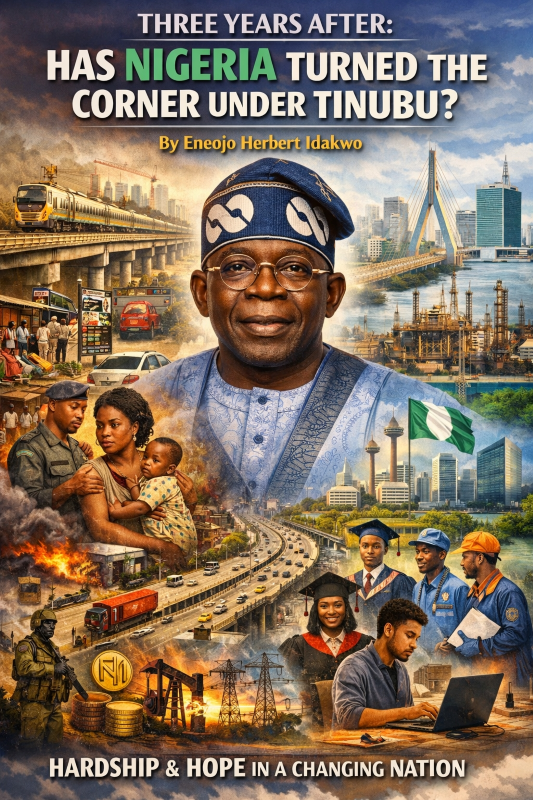
By Eneojo Herbert Idakwo
Three years after President Bola Ahmed Tinubu assumed office, Nigeria stands at one of the most consequential crossroads in its democratic history.
The atmosphere in the country remains mixed and deeply complex. Across markets, transport parks, offices, farms, universities, and homes, Nigerians continue to wrestle with the difficult realities of inflation, rising living costs, and economic uncertainty. Yet at the same time, major infrastructure projects are expanding, investor confidence appears to be recovering gradually, fiscal reforms are reshaping public finance, and government officials insist that the foundations of long-term recovery are finally being laid.
This contradiction defines the Tinubu presidency at its third anniversary.

The administration argues that Nigeria is emerging from years of structural weakness and fiscal distortion. Critics counter that the burden of reform has fallen too heavily on ordinary citizens. Supporters believe the country is passing through a painful but necessary transition. Skeptics remain unconvinced that promised gains will sufficiently reach the grassroots.
The central question therefore remains unavoidable:
Has Nigeria truly turned the corner under Tinubu, or is the country still searching for stability amid prolonged hardship?
The Inheritance Debate
To understand the current administration, one must first understand the conditions it inherited in 2023.
When Tinubu took office, Nigeria was grappling with multiple overlapping pressures:
- Escalating subsidy costs
- Foreign exchange instability
- Weak public revenue
- Rising debt-servicing obligations
- Insecurity across several regions
- Declining investor confidence
- Severe infrastructure deficits
- Fragile electricity supply
- High unemployment and underemployment
Government officials frequently argue that these structural weaknesses left the country vulnerable to deeper economic breakdown if urgent reforms were not introduced immediately.
The administration’s supporters often describe the situation as a delayed crisis that previous governments avoided confronting decisively.
Critics, however, insist that inherited challenges cannot permanently serve as justification for current hardship. In their view, governments must ultimately be judged by outcomes, not explanations.
Both perspectives continue shaping Nigeria’s political conversation.
The Defining Reforms
No policy decisions have shaped the Tinubu administration more than the removal of fuel subsidy and the unification of the foreign exchange market.
These reforms fundamentally altered the structure of the Nigerian economy within months of the administration taking office.
The government maintains that subsidy payments had become fiscally unsustainable and economically destructive. Officials also argued that multiple exchange-rate systems encouraged corruption, arbitrage, and speculative distortions that weakened productive economic activity.
The reforms, according to the administration, were intended to restore fiscal discipline, improve transparency, and reposition Nigeria for long-term growth.
Yet the immediate consequences were severe.
Fuel prices surged.
Transportation costs increased sharply.
Food inflation worsened.
Manufacturers struggled with rising operational expenses.
Household purchasing power weakened.
For many Nigerians, the reforms became associated less with macroeconomic restructuring and more with daily hardship.
Still, the administration insists the difficult phase was unavoidable.
Signs of Economic Stabilization
Three years later, government officials increasingly point to indicators suggesting that Nigeria may be gradually stabilizing.
Among the most frequently cited developments are:
- Increased allocations to states and local governments
- Improved public revenue performance
- Renewed investor interest
- Expansion of infrastructure projects
- Increased oil and gas sector investments
- Growth in the Nigerian stock market
- Improvements in local refining capacity
- Expansion in telecommunications and digital investment
Large-scale infrastructure projects have become central symbols of the administration’s development strategy.
Projects such as the Lagos-Calabar Coastal Highway, the Sokoto-Badagry Super Highway, ongoing rail modernization efforts, and rehabilitation of major federal roads are repeatedly presented as evidence that reform savings are being redirected into long-term national assets.
In the energy sector, local refining initiatives and renewed investment commitments are gradually reshaping conversations around energy security and foreign exchange conservation.
The administration also argues that expanded student loan programs, agricultural interventions, housing projects, and consumer credit initiatives represent efforts to support social recovery alongside economic restructuring.
The Gap Between Statistics and Daily Reality
Despite these indicators, the lived experience of many Nigerians remains difficult.
This remains perhaps the greatest political challenge facing the administration.
Macroeconomic improvements often take time before producing visible relief at household level. Inflation may slow while prices remain high. Investment may increase without immediate job expansion. Fiscal stability may improve even while citizens continue struggling with daily expenses.
This gap between national indicators and personal experience creates public skepticism.
A government may celebrate improved economic fundamentals, but citizens judge governance through practical realities:
- Can they feed their families?
- Can they afford transportation?
- Are businesses surviving?
- Is electricity improving?
- Are jobs becoming available?
- Is insecurity reducing?
These are the questions shaping public perception across the country.
Infrastructure as a Political and Economic Statement
One of the administration’s strongest areas of visibility has been infrastructure development.
Unlike abstract economic indicators, roads, rail projects, bridges, housing estates, and industrial facilities provide physical evidence of state activity.
The government appears to understand this political reality.
Across the federation, construction activity has increased on major transport corridors and development projects. Supporters of the administration argue that these investments are essential for long-term productivity, regional trade integration, logistics efficiency, and industrial growth.
Infrastructure, in this context, serves both economic and psychological purposes.
It signals movement.
It signals continuity.
And perhaps most importantly for the administration, it signals that the sacrifices of reform are producing visible national assets.
The Youth Question
No demographic group reflects Nigeria’s future more than its youth population.
Young Nigerians remain central to both the optimism and anxiety surrounding the current administration.
On one hand, reforms in digital infrastructure, student financing, innovation support, and entrepreneurship are creating new conversations around opportunity and productivity.
On the other hand, unemployment, migration pressure, rising living costs, and frustration continue affecting large sections of the youth population.
The administration’s long-term success may ultimately depend on whether economic reforms can generate sufficient employment and mobility for Nigeria’s expanding youth demographic.
Without broad-based opportunity creation, public patience may weaken over time.
Security and National Stability
Security remains another major factor in assessing the administration’s performance.
The government maintains that security operations against terrorism, banditry, kidnapping, and oil theft have intensified significantly over the past three years.
Officials point to improved intelligence coordination, expanded surveillance capabilities, and increased operational activities across affected regions.
Some highways and communities previously considered dangerous have reportedly experienced relative improvement.
However, insecurity remains one of Nigeria’s most persistent national challenges.
The ability of the administration to sustain economic recovery may depend heavily on its capacity to maintain territorial stability and protect economic activity across farming, transportation, commerce, and energy-producing regions.
Has Nigeria Truly Turned the Corner?
The answer depends largely on how one defines recovery.
If recovery means immediate household comfort, many Nigerians would argue the country is still struggling.
If recovery means structural correction and institutional repositioning, supporters of the administration believe progress is underway.
Nigeria today is neither fully stabilized nor entirely stagnant.
The country is in transition.
The economic architecture of the past decade is being dismantled and replaced with a new framework whose long-term outcomes remain uncertain but increasingly visible.
Public finances are adjusting.
Infrastructure activity is expanding.
Investment discussions are returning.
Energy reforms are progressing.
Digital growth is accelerating.
Yet inflationary pressure, poverty, and public frustration remain significant realities.
A Nation Still in Motion
Three years into the Tinubu presidency, one conclusion appears increasingly difficult to dismiss: Nigeria has entered a period of profound structural change.
Whether these changes eventually produce widespread prosperity remains the defining test of the administration.
History may ultimately judge this era not by the pain of reform alone, but by whether those reforms succeeded in building a more productive, stable, and self-sustaining Nigerian economy.
For now, the country continues navigating the uneasy space between hardship and hope.
The corner may not yet have been fully turned.
But the direction of movement is becoming clearer.