
Book Review by Khaleed Yazeed
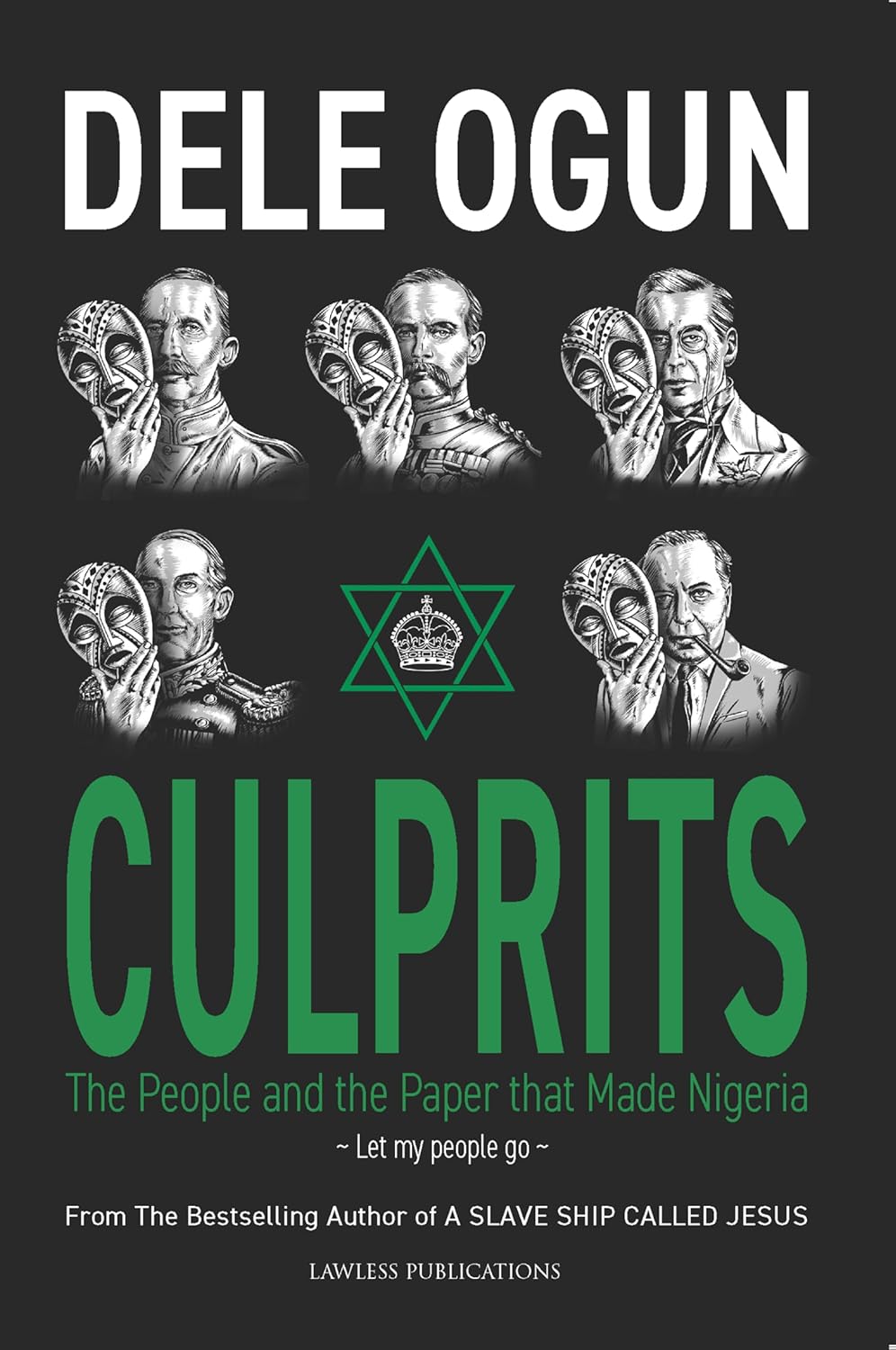
Dele Ogun’s “Culprits: The People and the Paper That Made Nigeria” is not a history book. It is a murder investigation. And the body is still warm.
For two hundred years, we have been told that the Fulani jihad was a religious reformation. For a hundred years, we have been told that the 1914 Amalgamation was an act of administrative convenience. For sixty years, we have been told that Nigeria’s problems are our own fault, tribalism, corruption, laziness.
Everything you have been told is a lie. Dele Ogun, a London-based constitutional lawyer of thirty years’ experience, has done what Nigerian historians have been too afraid to do. He has followed the paper trail. And the paper trail leads straight to Whitehall.
This is not a work of emotion. It is a work of forensic accounting. Ogun, called to the Bar in 1985 and a solicitor in London since 1995, approaches the creation of Nigeria the way a prosecutor approaches a crime scene: with documents, ledgers, treaties, and sworn statements. He owns his own publishing company, Lawless Publications, because no mainstream publisher would touch what he has uncovered.
The book’s central argument is simple but devastating. Nigeria’s dysfunction is not an accident. It is a mathematical output of a deliberately flawed blueprint designed by the British Empire to maximize extraction.
Ogun writes with the precision of a lawyer and the fire of a prophet. Each chapter is a count in an indictment. Each footnote is a nail in a coffin. And by the time you finish the book, you will understand that the Nigerian state is not a nation, it is a corporation. And you are not a citizen. You are a shareholder with no dividends.
The Hidden Hand: How America Broke the British Empire
Ogun proves that the real driver of African decolonization was not Harold Macmillan’s “Winds of Change” speech of 1960. It was Franklin Delano Roosevelt, the American president, who extracted a secret commitment from Winston Churchill in 1941: the liquidation of the British Empire was the price for American entry into World War II.
The Atlantic Charter of August 14, 1941, which pledged self-determination for all colonized peoples, was not a moral awakening. It was a deal. Churchill, desperate to bring America into the war against Hitler, agreed to dismantle the empire his ancestors had spent centuries building. Implementation was delayed only by Roosevelt’s death and the onset of the Cold War.
Ogun pulls back the curtain on this geopolitical chess match, revealing that African nations did not win their independence through peaceful negotiation or violent struggle alone. They were handed a pre-packaged form of sovereignty, a flag independence that left all the economic and administrative levers firmly in British hands. Nigeria’s constitution was written in London, not Lagos. Its civil service was trained to serve the Crown, not the people. Its military was structured to protect British interests, not Nigerian borders.
This is the first indictment: Nigerian independence was a theatrical performance. The script was written in Whitehall. The audience was the world. And the actors were our own leaders.
The Paper That Condemned Us
Ogun then turns his scalpel to the infamous Paper, the treaties, colonial edicts, and administrative acts that forced over 371 ethnic groups into a single geographic prison. He proves that the 1914 Amalgamation was not a marriage of northern and southern protectorates. It was a corporate bailout.
The landlocked Northern Protectorate was running a massive deficit. The Southern Protectorate held a massive surplus from coastal customs duties. The British solution was to Shackle them together and call it a nation. The North got a lifeline. The South got a burden. And both got a colonial administrator named Lord Lugard, who was less a governor and more a CEO of a failing conglomerate.
Ogun provides the financial ledgers. He reproduces the internal memoranda. He names the civil servants who designed this “extractive blueprint.” The goal was never to build a nation. The goal was to build a machine for resource extraction, groundnuts from the North, palm oil from the East, cocoa from the West, and tin from the Plateau. All of it shipped to British factories. All of it processed into British goods. All of it sold back to Nigerians at British prices.
This is the second indictment: Nigeria was not born. It was manufactured. And its manufacturers were not interested in its survival beyond their profit margins.
The Betrayal of the Fulani Elite: A Two-Century Crime
But Ogun does not stop with the British. He names the local collaborators. And here, the book becomes a mirror in which every Hausa person must look.
The British did not invent the emirate system. They inherited it from the Fulani jihad of 1804. And they preserved it because it was the most efficient machine for controlling the Hausa masses. One Fulani emir could collect taxes, enforce order, and deliver groundnuts to the railway station. The British provided weapons and legitimacy. The Fulani provided obedience and information.
The scale of the crime is staggering. By 1900, the Sokoto Caliphate had at least 1 million slaves, and perhaps as many as 2.5 million. This made it the second-largest slave society in the modern world, second only to the American South. Slave-raiding devastated vast regions and almost depopulated the countryside, hampering the commercial activity of major cities like Zaria and Kano. The annual tribute to the Sultan of Sokoto was paid by the Emir of Kano and all other chiefs in the form of slaves, and these slaves were “nearly all raided from the neighbouring outlying villages”. Charles H. Robinson, a British observer, reported that 500 slaves could often be seen for sale in the Kano market in a single day. He estimated that if the whole population of the world were brought together, one out of every three hundred would be a Hausa-speaking slave. He also stated that if London were emptied, the city could be filled by the slaves held in captivity in Hausaland.
Ogun documents how the Sultan of Sokoto, the Emir of Kano, and other Fulani traditional rulers were given guarantees of their continued authority under British rule. In exchange, they agreed to suppress any resistance, to deliver taxes, and to ensure that the Hausa masses remained docile. The British called this “Indirect Rule.” Ogun calls it what it is: a deal with the devil.
This is the third indictment: The Fulani elite are not innocent victims of colonialism. They are its willing agents. And they have been cashing the checks ever since.
The Betrayal of Abdussalami Bagimbame: The Hyena’s Share
Ogun’s book resonates powerfully with the story of Malam Abdussalami Bagimbame, a Hausa scholar and one of Usman dan Fodio’s most trusted followers. Abdussalami fought in the jihad, helped establish the Caliphate, and then watched as the spoils were divided exclusively among the Fulani elite.
After the death of Shehu Usmanu Danfodiyo, Abdussalami wrote a bitter letter to Sultan Muhammadu Bello, recorded in Bello’s own book, Saddur Kalam. Abdussalami drew a map showing how the conquered lands were divided:
·The West went to Abdullahi Danfodiyo, the Shehu’s brother
· The South went to Atiku and Buhari, the Shehu’s sons
·The East went to Muhammadu Bello, the Shehu’s son
·The North went to Aliyu Jaido, the Shehu’s son-in-law, and his two sons
Then Abdussalami asked the question that echoes across two centuries: “I, Abdussalami, where is my share?” He stated that he had received nothing but his pre-jihad farm and the plot of land for his grave. He called this “rabon kura” the hyena’s share.
The Caliphate’s response was swift and brutal. Sultan Muhammadu Bello charged Abdussalami with treason, led a military campaign against him, and had him killed. An arrow pierced Abdussalami as he fled toward Zamfara. The Fulani elite had used the Hausa to fight their war, and then discarded them.
This is not ancient history. This is the DNA of the Nigerian state. The pattern of using Hausa scholars, soldiers, and commoners to secure power, only to push them aside, has never stopped. Ogun’s book exposes this pattern at the national level, but it began in the palaces of Sokoto.
This is the fourth indictment: The Nigerian state did not invent exploitation. It inherited it from the Fulani Caliphate. The same elites who betrayed Abdussalami in 1817 are the same elites who betray the Hausa masses today.
The Betrayal by Southern Elites: The Fifth Wall
Ogun does not spare the South either. He exposes how the Yoruba and Igbo elites also collaborated with the British, competing for colonial favors, dividing their own people, and laying the foundation for the ethnic tensions that would explode into civil war in 1967. He names the politicians who signed the pre-independence constitutions without demanding real sovereignty. He names the lawyers who advised the colonial office on how to keep Nigeria together for British benefit.
The Fourth Republic itself, Ogun argues, is not a democracy. It is a managed democracy, a system where elections are held, but outcomes are predetermined; where politicians rotate, but policies remain the same; where the people vote, but the real power resides in the same extractive machinery that Lugard installed in 1914.
This is the fifth indictment: Nigerian elites, across all ethnic groups, have been complicit in the continuation of the colonial project. They have traded the liberation of their people for personal power.
The Orange Union: A Path Forward
The book concludes with a radical proposal: the Orange Union, a true, voluntary federation of ethnic nations, each maintaining its “fullness of identity, self-determination and integrity” under a shared protective union. Ogun explains the metaphor: “As with the fruit, it is a concept whereby humanity enjoys the peaceful harmony of a union within which the separate segments are distinctly and uniquely covered by a soft internal border, while the shared cover is the much firmer peeling acting as the external border to the rest of the world.”
This is not secession. This is honesty. Ogun argues that “real nationalists are those who believe in their identities as Yoruba, Hausa, Ijaw, Ogoni, Kanuri, etc. organic and God-given identities” that sustained us for thousands of years before the colonialists came and caused their confusion. The “tag of nationalism” has been used as a dirty word by “servants of the colonial confusionists” to keep Nigeria trapped in its original prison.
He points out the hypocrisy: in Britain, it is acceptable to wave the Welsh flag or the Scottish flag without being called a separatist. In Nigeria, to speak of ethnic nations is seen as “the politics of hatred.” The Orange Union would allow each ethnic nation to govern its internal affairs, while cooperating on defense, currency, and external trade. It would end the forced marriage that has produced nothing but violence, poverty, and despair.
This is the sixth indictment: The Nigerian state has criminalized the very idea of self-determination, while pretending to be a democracy. The Orange Union is not a threat to peace. It is the only path to peace.
Why Every Hausa Man Must Read This Book
The Hausa are 80 million strong across West Africa. We have the numbers. We have the land. We have the history. We have the economic muscle. What we lack is the will to organize, the courage to confront, and the patience to build.
This book is the weapon we have been waiting for. It proves that our suffering was not ordained by Allah. It was drafted in Whitehall and implemented in the palaces of Sokoto. The Fulani elite were not victims of colonialism. They were junior partners. And they have been junior partners ever since.
Ogun warns that “those behind the Nigerian state see the IPOB leader as a threat to the continuation of Nigeria as it is.” The same applies to any Hausa man who asks why he cannot be emir in Kano. The same applies to any Hausa woman who asks why her children must beg on the streets while Fulani children fly to London for university. The Nigerian state was designed to suppress such questions.
Reading Culprits is an act of rebellion. Owning a copy is a declaration of war against the colonial confusion that has kept us enslaved. Sharing it is the first step toward building the Orange Union.
The Verdict
Culprits is a chef-d’œuvr. It is a gripping cinematic detail of the greed of Empire and the lots of its victims even after hundred years. It is essential reading for every Hausa intellectual, every Hausa student, every Hausa farmer who has ever wondered why his people are the permanent servants of a foreign elite.
The problem is not Nigerians. The problem is Nigeria. And the solution is not to wait for a messiah. The solution is to understand the blueprint, dismantle the prison, and build something new.
Ogun has given us the indictment. Now we must sit as the jury. The evidence is overwhelming. The witnesses have testified. The documents have been submitted. The only question remaining is: what is your verdict?
Will you continue to accept the colonial prison? Or will you join the movement to build the Orange Union, a voluntary federation of free Hausa, free Yoruba, free Igbo, free Ijaw, free Ogoni, free Kanuri, and free every other ethnic nation that wishes to govern itself in dignity and peace?
The choice is yours. But make no mistake: silence is a verdict too. And history will judge you for it.
This book is not just a history. It is a manual for liberation. It is the most important book written about Nigeria in the last fifty years. Every Hausa household that can read must own a copy. Every Hausa leader who claims to speak for the people must read it. Every Hausa youth who dreams of a better future must study it.
Khaleed Yazeed
Founder, Wakilin Yamma Youth Development Network
Katsina State, Nigeria









This is a masterpiece that unveils the establishment narrative and the politically ‘correct’ version of Nigeria’s and indeed African odds. It is my book of the year.