By Okoi Obono-Obla
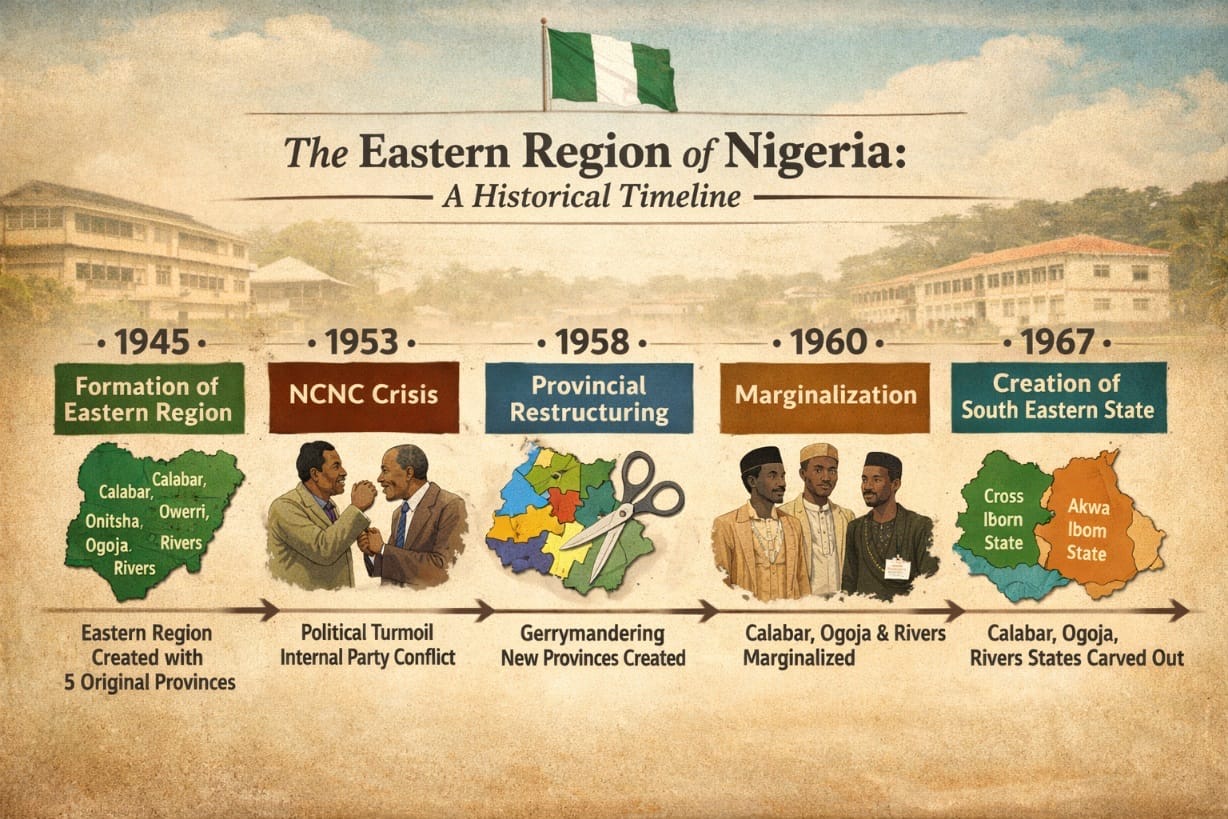
It is now 59 years since the defunct South Eastern State (today’s Akwa Ibom and Cross River States) and Rivers States (today Bayelsa and Rivers States) were carved out of the old Eastern Region of Nigeria. The Eastern Region itself came into being in 1945, during colonial rule, and was originally made up of five provinces: Calabar, Onitsha, Ogoja, Owerri, and Rivers.
By 1953, the stability of the Eastern Region was fractured when a debilitating political crisis erupted within the National Convention of Nigerian Citizens and Cameroons (NCNC). At that time, Southern Cameroon—placed under British mandate by the League of Nations in 1919 after Germany lost its colonies following World War I—was administered as part of the Eastern Region of Nigeria. The crisis arose when NCNC leaders from Owerri and Onitsha provinces pressured Professor Eyo Ita of Calabar Province, then Leader of Government Business (Premier) in the Eastern Regional House of Assembly, to resign in order to pave the way for Dr. Nnamdi Azikiwe. Azikiwe, who had built his political career in the Western Region and aspired to become its Premier, returned to the East after NCNC lost its majority in the Western House of Assembly to Chief Obafemi Awolowo’s Action Group.
Azikiwe’s return triggered discontent. NCNC parliamentarians from Calabar, Ogoja, and Rivers provinces revolted, resigned from the party, and formed the United Nigerian Independence Party (UNIP) under Dr. Okoi Arikpo. UNIP quickly aligned with the Action Group to form a strong opposition in the East. This movement also birthed the agitation for the creation of the Calabar‑Ogoja‑Rivers (COR) State.

Further political restructuring deepened the divide. In 1958, new provinces were created: Port Harcourt, Yenagoa, Degema, Annang, and Uyo emerged from Calabar, Ogoja, and Rivers; while Abakaliki, Enugu, Onitsha, Owerri, and Umuahia were carved from Owerri and Onitsha. Ogoja Province, though original, was weakened when Afikpo, Abakaliki, and Obubra divisions were excised to form Abakaliki Province—a subtle act of political gerrymandering.
By 1960, marginalisation of the Calabar, Ogoja, and Rivers people was complete. The cabinet of Dr. Michael Okpara, Premier of Eastern Nigeria, tells the story starkly:
– Ibanga Udo Akpabio – Internal Affairs
– Samuel Efem Imoke – Finance
– Patrick Nwokoye Okeke – Agriculture
– Basil Charles Okwu – Information
– John Ugwu Nwodo – Commerce
– Gilbert Ekwenugo Okeke – Education
– Michael Oguejiofo Ajegbo – Attorney General
– Echeme Emole – Town Planning
– Ezekiel Pappah Okoya – Health
– Paul Omerenyia Ururuka – Works
– Pius Nwoga – Local Government
– Dr. Michael Iheonukara Okpara – Premier
Only two members—Dr. Samuel Efem Imoke (from Afikpo Division, originally Ogoja Province) and Ibanga Udo Akpabio (Calabar Province)—hailed from the minority areas. Rivers Province had no representation at all. In effect, Calabar, Ogoja, and Rivers accounted for a mere 0.24% of cabinet appointments, while Onitsha and Owerri dominated with ten appointments, including the Premier himself.
Comparative Representation in the Eastern Region (1960)
| Province | Cabinet Representation | House of Chiefs Representation |
|—————–|————————-|——————————–|
| Calabar | 1 (Ibanga Udo Akpabio) | Ika Ika Oqua II (Provincial Rep) |
| Ogoja | 1 (Samuel Efem Imoke, originally Ogoja) | J.U. Okudare (Provincial Rep) |
| Rivers | 0 | Sampson I. Adoki (Degema), J. Mpi (Port Harcourt), Zumoh Efeke V (Yenagoa) |
| Onitsha | Multiple (Premier Dr. Nnamdi Azikiwe, others) | N.N. Anyika (Provincial Rep) |
| Owerri | Multiple | Johnson Osuji Njemanze (Provincial Rep) |
| Abakaliki | None directly (created from Ogoja) | Neil Ubi Ofem (Provincial Rep) |
| Enugu | Multiple | Ako Okwoli II (Provincial Rep) |
| Umuahia | Multiple | J.N. Wachukwu (Provincial Rep) |
| Uyo | None in cabinet | Eket Inyang‑Udo (Provincial Rep) |
| Annang | None in cabinet | S.A. Essien (Provincial Rep) |
| Others (Igbo divisions) | Dominant majority | Minimum of 2 representatives each |
Key Takeaways:
– Calabar, Ogoja, Rivers: Only 2 cabinet members out of 12, and limited representation in the House of Chiefs.
– Onitsha and Owerri: Dominated both cabinet and House of Chiefs, including the Premier.
– Rivers Province: Completely excluded from cabinet appointments despite being one of the original provinces.
– Igbo-speaking areas: Consistently had multiple representatives, reinforcing political imbalance.
Conclusion:
History is not meant to reopen old wounds or fuel division, but to illuminate the forces that shaped past generations. The marginalisation of Calabar, Ogoja, and Rivers within the Eastern Region highlights how political exclusion breeds agitation and mistrust. For future generations, the lesson is clear: inclusivity and fairness in governance are essential to building unity and trust in diverse societies.